- 152 pages
- English
- ePUB (mobile friendly)
- Available on iOS & Android
eBook - ePub
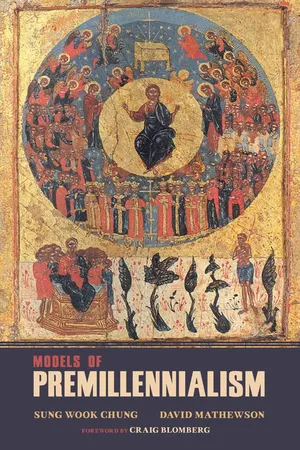
Models of Premillennialism
About this book
The meaning of "the millennium"--the thousand-year reign of Christ spoken of in Revelation 20--has been controversial for much of the church's history, and even the main perspectives on the matter turn out to be more variegated than is often realized. This book takes the oldest of those options, premillennialism, and offers an excellent introduction to a variety of models of premillennialism currently available, including classical dispensationalism, progressive dispensationalism, historic premillennialism, thematic premillennialism, and historic premillennialism in Asian context. The product of collaboration between a systematic theologian and a New Testament scholar, this book provides a fascinating reference tool for anyone interested in what Scripture teaches about the last things of redemptive history, the Parousia, and the millennial kingdom.
Information
Topic
Theology & ReligionSubtopic
Biblical Studies1
Historic Premillennialism
Introduction
In this chapter we will examine historic premillennialism, focusing on its hermeneutical principles, major tenets, and origins, as well as its development throughout the history of Western Christianity. Historic premillennialism is a rich view with a profound legacy and tradition within the church. It is certainly not an overstatement to conclude that most evangelical theologians today hold to the historic premillennial view. It is widely accepted that the majority of professionally trained evangelical theologians espouse the historic premillennial view and judge it to be the most faithful among the millennial views to the teaching of the Bible. It is hard to determine whether that scholarly majority consists of 50 percent, 60 percent, or 70 percent of the trained professionals, but it is no small thing that a perceivable majority of trained biblical and systematic theologians align themselves with the historic premillennial view. For instance, Roger Olson, a professor of historical theology at Baylor University, commented on this matter in his endorsement of A Case for Historic Premillennialism: An Alternative to “Left Behind” Eschatology, which the current author co-edited with Craig L. Blomberg: “It’s about time we had a scholarly presentation and defense of historic premillennialism, which is probably the majority view of the ‘end times’ among theologically trained evangelicals. . . . If read carefully by many, it will turn the growing tide of ‘pretrib rapturism’ and restore the eschatology of the Bible and the church fathers.”1
While dispensationalism finds overwhelming support from the public, historic premillennialism continues to be the dominant view among evangelical scholars. These scholars agree that this view remains closest to the text of Scripture and, moreover, serves as the most biblically sound view of eschatology. Here, I intend to corroborate this argument with various sources of evidence. In the first section of this chapter, I will examine the hermeneutical principles and fundamental tenets of historic premillennialism. In the second section, I will engage critically with historic premillennialism, delving into some of its difficulties and demerits. In the third section, I will explore the two-thousand-year history of the Christian church and trace the origins and the developments of the historic premillennial view. In the fourth section, I will investigate the standing of historic premillennialism in the twentieth- and twenty-first-century Western evangelical camp. In the final section, I will summarize the key points of my argument and suggest a number of ways in which current studies of the book of Revelation and biblical eschatology can advance in the future.
Hermeneutical Principles and Fundamental Tenets
Literal and Futurist Interpretation of Revelation 20:1–6
One of the most important hermeneutical principles of historic premillennialism is its literal, futurist interpretation of Revelation 20, which describes the millennial kingdom. This is closely connected with a rejection of symbolic and spiritual readings of the chapter, which have been dominant in both amillennial and postmillennial circles. Verses 1–3 tell us that an angel from heaven will seize the dragon, that ancient serpent who is the devil, or Satan, and bind him for a thousand years. The angel will throw him into the abyss, and lock and seal it over him. Satan will be kept from deceiving the nations anymore until the thousand years will be ended. After the thousand years, Satan must be set free for a short time.
In addition, vv. 4–6 tell us that those have been given authority to judge will be seated on thrones. Those who have been beheaded and have not worshiped the beast or its image will come back to life and reign with Christ for a thousand years. There are still scholarly debates and disputes over who these people are. Many scholars argue that these will be all true Christians, including martyrs. Other scholars contend that these will be martyrs alone who have been killed not only throughout church history but also during the great tribulation right before the parousia.2
Nevertheless, from the perspective of a literal, futurist interpretation of this passage, it is crystal clear that those who will experience the first resurrection will reign with Christ for a thousand years. The second death will have no power over them and they will be priests of God and of Christ. For historic premillennialists, this passage must be interpreted in a plain sense, not symbolically or spiritually, as most amillennialists and postmillennialists have interpreted it. Moreover, this passage must be interpreted from the futurist, not preterist, perspective. For example, most amillennialists argue that the binding of Satan in v. 2 is symbolic of the defeat of Satan that occurred when Jesus Christ was crucified for our sin and resurrected from the dead for our righteousness. Historic premillennialists view the symbolic and preterist interpretation of the passage to be groundless because the devil is still prowling “around like a roaring lion looking for someone to devour” (1 Pet 5:8). According to 1 Peter 5:8, Satan seems not completely bound but rather still very active in devouring and deceiving people.
Chronological Interpretation of Revelation 19–20
For historic premillennialists, the literal and futurist interpretation of Revelation 20:1–6 is closely connected with the chronological interpretation of Revelation 19–20. Most interpreters of the book of Revelation, including those committed to historic premillennialism, concur that Revelation 19 talks about the second coming of the Lord Jesus Christ. In particular, vv. 19–21 of this chapter tell us that both the beast and the false prophet will be captured and thrown alive into the fiery lake of burning sulfur. So two members of the evil trinity, not including Satan, have already been thrown into the lake of fire by chapter 20.
After the depiction of the Lord’s second coming in Revelation 19, 20:1–6 describes the millennial reign of Christ and his saints. According to vv. 7–10, after the millennial kingdom, Satan will be released to deceive the nations in the four corners of the earth. Many will be deceived and will participate in Satan’s attempt to attack the city of God’s people. But they will be devoured by the fire from heaven. And then the devil will be “thrown into the lake of burning sulfur, where the beast and the false prophet had been thrown” (v. 10). This is the description of the final destiny of Satan. It is very important to note here that when the devil was thrown into the lake o...
Table of contents
- Title Page
- Foreword
- Introduction
- Chapter 1: Historic Premillennialism
- Chapter 2: Classical Dispensational Premillennialism
- Chapter 3: Progressive Dispensationalism
- Chapter 4: Thematic Millennialism
- Chapter 5: Historic Premillennialism in South Korea
- Concluding Reflections on Premillennialism
- Bibliography
Trusted by 375,005 students
Access to over 1.5 million titles for a fair monthly price.
Study more efficiently using our study tools.
Frequently asked questions
Yes, you can cancel anytime from the Subscription tab in your account settings on the Perlego website. Your subscription will stay active until the end of your current billing period. Learn how to cancel your subscription
No, books cannot be downloaded as external files, such as PDFs, for use outside of Perlego. However, you can download books within the Perlego app for offline reading on mobile or tablet. Learn how to download books offline
We are an online textbook subscription service, where you can get access to an entire online library for less than the price of a single book per month. With over 1.5 million books across 990+ topics, we’ve got you covered! Learn about our mission
Look out for the read-aloud symbol on your next book to see if you can listen to it. The read-aloud tool reads text aloud for you, highlighting the text as it is being read. You can pause it, speed it up and slow it down. Learn more about Read Aloud
Yes! You can use the Perlego app on both iOS and Android devices to read anytime, anywhere — even offline. Perfect for commutes or when you’re on the go.
Please note we cannot support devices running on iOS 13 and Android 7 or earlier. Learn more about using the app
Please note we cannot support devices running on iOS 13 and Android 7 or earlier. Learn more about using the app
Yes, you can access Models of Premillennialism by Sung Wook Chung,David L. Mathewson in PDF and/or ePUB format, as well as other popular books in Theology & Religion & Biblical Studies. We have over 1.5 million books available in our catalogue for you to explore.