eBook - ePub
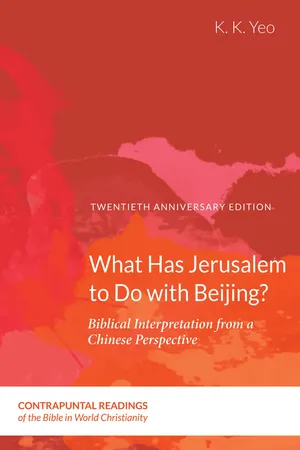
What Has Jerusalem to Do with Beijing?
Biblical Interpretation from a Chinese Perspective, Second Edition
- 398 pages
- English
- ePUB (mobile friendly)
- Available on iOS & Android
eBook - ePub
What Has Jerusalem to Do with Beijing?
Biblical Interpretation from a Chinese Perspective, Second Edition
About this book
The rise of China as a superpower and of Chinese Christians as vital members of the global church mean that world Christianity would be a dynamic transformation and bountiful blessing to the world by engaging with Chinese biblical interpretations among global theologies. This book, a twentieth-anniversary revised and expanded edition, includes studies that range from exploration of the philosophical structure of Eastern culture to present-day sociopolitical realities in Malaysia and China--all in support of cross-cultural methods of reading the Bible culturally and reading the cultures biblically.
Information
Topic
Theology & ReligionSubtopic
Biblical StudiesPart I
The Methods of Cross-Cultural Hermeneutics
1
Theological Methods and Chinese Contexts
The twenty-first century can be characterized as the age of specialized technology, an explosion of information, and instantaneous communication. These hallmarks of our time do not necessarily indicate or guarantee that human culture is moving toward the eradication of conflict, an understanding of the wholeness of life, or mutual collaboration of diverse groups. On the contrary, humanity continues to face the crisis of alienation and the threat of annihilation as it uncritically accepts and glorifies the current state of technology. Satellite communication brings different parts of the world into our living rooms, but it does not necessarily help us connect with one another. We may try to reach out to someone through social media, but virtual reality can never replace the human touch.1 We use many words, but we do not always use them meaningfully or in ways that allow us to be heard.
The danger of specialization lies in the tunnel vision of the world and the fragmented lifestyle it creates. Knowledge does not necessarily breed understanding and love. Particularity, while unavoidable, eventually boasts of itself and alienates others. Universality seems too ideal and far removed; it also runs the risk of absorbing all particularities into a melting pot, obliterating one another’s uniqueness. It has the added danger of providing a superficial sense of oneness. In short, in the struggle to coexist and flourish, people of the earth face crises of alienation, fragmentation, and annihilation more than ever before.
The familiar theme of coexistence in Chinese stories (Confucian, Daoist, and the yin-yang schools) haunts me as I see similar patterns repeated in modern history. The issue of coexistence seems to be the primary challenge underlying the human story. Are our stories fragmented by the necessity of difference, by the tugs of beginning and end, by conflict and mistrust of our neighbors’ stories, by ambiguity and meaninglessness? While I do not aim or claim to solve the world’s problems, I do hope to address the issue of coexistence by way of a methodology that is cross-cultural and theological.
Content and Methodology of Theology
The essence and means of doing theology are distinct but related. Doing theology involves rational inquiry and theoretical formulation that point us to a more coherent and clear disclosure of reality and ultimately of God. Theology is primarily a cognitive enterprise, an intellectual dimension of faith that concerns the whole structure and order of intelligibility in the universe. Theology can be a rational inquiry into the knowledge and creation of God, because God’s revelation is either rational or supra-rational but never—although it may appear—irrational. There is an intelligible structure and order in the creation of God. Theology is, therefore, our attempt to love God with our minds, for faith seeking understanding. Faith has its subject matter, which is the subject of our theological enquiry. The experiment of cross-cultural reading of the biblical texts in this volume will show that the quest for meaning is the primary task of theology and that God is the primary subject matter of theology.
Theology has its objective knowledge, like any other discipline, where knowledge speaks in its own right, impinging upon us what it stands for. Theology is not merely a value-subjective, judgmental, alternative lifestyle, but a high calling of God to realize the objective, indicative, imperative, and subjunctive of God. This touches on the issues of the essence (content) and methodology of theology, that is, on—in the conceptualization of the Greek—ontology and epistemology.
Theological methodology is a rational inquiry into the knowledge of God. The difference between ontology (what we know about reality) and epistemology (how we know about reality) must be kept distinct, although the two are mutually interactive. In methodology, ontology is faith prior to reason, while epistemology is reason prior to faith. In ontology, faith in God is based not on evidence but on the authority of God himself through his revelation. But in epistemology, faith finds its logical support and evidence in reason, experience, and history.
In addition, theology is an interpretation of the essence of one’s faith. For the “essence” of theology is God, while the “form”2 of theology is the expression or interpretation of our faith. Essence and content are different but related. Colin Gunton points out that “human rational activity consists largely, if not wholly, in the discovery and creation of form.”3 No one can say that his own formulation or conceptualization of God is absolute. However, despite one’s finite interpretation, the essence of theology, which is God, is infinite. We experience God as the sure object of our trust despite the relative character of our interpretation or biblical reading. Of course, the task of hermeneutics is to get the form as close to the essence as possible. Therefore, theologizing is done not to build walls or to exclude others; rather, it is done to build bridges and networks—to create dialogue, tolerance, and appreciation of one another’s theology. This personal and communal understanding of theological inquiry is that only a community can do theology in mutual interaction, with tradition and with postulations. While theologizing is mainly a cognitive enterprise, it becomes a great dynamic in one’s spiritual formation, in practical mission to the world. Theology needs to live and work in the dynamic tensions that exist between the word of God and the community of believers, between biblical and systematic theologies, and between exegesis and homiletics.
In doing theology, the basic level is the theological and scientific, while the ultimate level is the spiritual (Holy Spirit), evangelical (the gospel of Christ), and doxological (the worship of God). The climax of theology is not simply the construction of a coherent system (it is that, no doubt), but a new and fresh appreciation of the grace and love of God. The end of theology is always the beginning of doxology. Aristotle was probably the first to have a systematic view of theology as the first philosophy, wisdom, and an a priori science; thus, he calls it “meta-physics.” The scientific...
Table of contents
- Title Page
- Acknowledgments
- Abbreviations
- A Chinese Introduction
- Part I: The Methods of Cross-Cultural Hermeneutics
- Part II: Dialogue with Perennial Themes in Chinese Culture
- Part III: Biblical Messages for the Current Chinese Situation
- A Christian Chinese Conclusion
- Bibliography
Trusted by 375,005 students
Access to over 1.5 million titles for a fair monthly price.
Study more efficiently using our study tools.
Frequently asked questions
Yes, you can cancel anytime from the Subscription tab in your account settings on the Perlego website. Your subscription will stay active until the end of your current billing period. Learn how to cancel your subscription
No, books cannot be downloaded as external files, such as PDFs, for use outside of Perlego. However, you can download books within the Perlego app for offline reading on mobile or tablet. Learn how to download books offline
Perlego offers two plans: Essential and Complete
- Essential is ideal for learners and professionals who enjoy exploring a wide range of subjects. Access the Essential Library with 800,000+ trusted titles and best-sellers across business, personal growth, and the humanities. Includes unlimited reading time and Standard Read Aloud voice.
- Complete: Perfect for advanced learners and researchers needing full, unrestricted access. Unlock 1.5M+ books across hundreds of subjects, including academic and specialized titles. The Complete Plan also includes advanced features like Premium Read Aloud and Research Assistant.
We are an online textbook subscription service, where you can get access to an entire online library for less than the price of a single book per month. With over 1.5 million books across 990+ topics, we’ve got you covered! Learn about our mission
Look out for the read-aloud symbol on your next book to see if you can listen to it. The read-aloud tool reads text aloud for you, highlighting the text as it is being read. You can pause it, speed it up and slow it down. Learn more about Read Aloud
Yes! You can use the Perlego app on both iOS and Android devices to read anytime, anywhere — even offline. Perfect for commutes or when you’re on the go.
Please note we cannot support devices running on iOS 13 and Android 7 or earlier. Learn more about using the app
Please note we cannot support devices running on iOS 13 and Android 7 or earlier. Learn more about using the app
Yes, you can access What Has Jerusalem to Do with Beijing? by K. K. Yeo in PDF and/or ePUB format, as well as other popular books in Theology & Religion & Biblical Studies. We have over 1.5 million books available in our catalogue for you to explore.