eBook - ePub
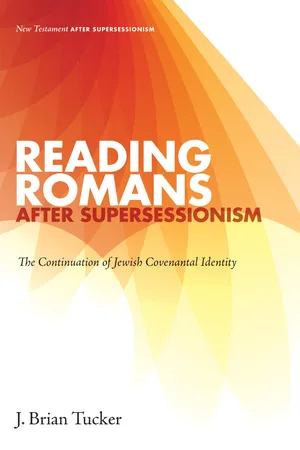
Reading Romans after Supersessionism
The Continuation of Jewish Covenantal Identity
- 310 pages
- English
- ePUB (mobile friendly)
- Available on iOS & Android
eBook - ePub
About this book
The Letter to the Romans explains the way Paul thought Jewish covenantal identity continued now that the messianic era had begun. More particularly, Paul addresses the relevance of Abraham for Jews and gentiles, the role of Torah, and the way it is contextualized in Christ. All too often, however, these topics are read in supersessionist ways. This book argues that such readings are unpersuasive. It offers instead a post-supersessionist perspective in which Jewish covenantal identity continues in Paul's gospel. Paul is no destroyer of worlds. The aim of this book is to offer a different view of the key interpretive points that lead to supersessionist understandings of Paul's most important letter. It draws on the findings of those aligned with the Paul within Judaism paradigm and accents those findings with a light touch from social identity theory. When combined, these resources help the reader to hear Romans afresh, in a way that allows both Jewish and non-Jewish existing identities continued relevance.
Information
1
Introduction
Paul was no supersessionist. He was part of a Jewish mission to the nations, designed to declare God’s gospel and bring about the obedience of faith among the gentiles (Rom 1:1, 5). This mission developed from within the traditions of the Jewish people, but as an ever-increasing number of non-Jews responded to the gospel, cultural tensions arose between groups that had been and continued to be different.1 The intersection of these social identities and the way they are transformed in Christ became the focal point of much of the content of Paul’s letters. Romans is no different, even though it was written to a Christ-group he did not found. Clearly, I am not the first interpreter of Paul to recognize this; identity and the relationship between the Christ-movement and Judaism have been a regular focus of scholars. However, the dominant paradigm that emerges from their work has a problem: it is supersessionist. This calls for a new reading strategy, a post-supersessionist one. Such an approach would maintain two key ideas: the irrevocability of God’s covenant with the Jewish people and a continuing role for Torah as a demarcator of the Jewish people and their identity.
Paul’s Identity-Forming Work among the Romans
This study sets out to investigate several verses from Romans that impinge on these two claims: Israel has a continuing covenantal identity and Torah has continuing validity within the Christ-movement. While one could argue that the entire letter would need to be exposited in order to establish a post-supersessionist reading, I do not intend this book to answer all the questions that might be raised, but rather to interact with key discussions, laying out alternative understandings in order to add to the conversations about the letter as a whole.
This book is written from within the current of scholarship loosely referred to as the Paul-within-Judaism paradigm.2 I have become convinced that Paul specifically, and the Christ-movement generally, is best understood within prevailing Jewish patterns of life, informed by their ancestral traditions, since the parting of the ways between Judaism and Christianity was yet to occur. This study is also informed by contemporary identity research, especially Tajfel and Turner’s social identity approaches.3 Social identity—that part of an individual’s self-concept that derives from his or her membership in a group, along with the emotional attachment experienced from that membership—guides this research in terms of the identity-based groupings evident in Romans.4 While these approaches inform the exegesis in this book at key points, they do so in the role of background technology and not as a dominant framework. They function primarily to make my theoretical approach and assumptions accessible to the reader.5 The first-century Roman Empire was replete with differing ethnic groups, languages, and religious traditions all unified, according to the political elites, under the peace of Rome.6 This environment presents an ideal setting for the role of social identity to be brought to bear. Thus, this study will be guided by three ideas: (a) the interpretive advances of the Paul-within-Judaism approach, (b) the understanding of group-based problems from Tajfel and Turner, and (c) the way the Roman Empire functioned as an outgroup for Christ-followers in Rome.
This study builds on my earlier work on Paul, even though most of that has focused on 1 Corinthians.7 Those books explored the way existing aspects of the Corinthians’ Roman social identity was adversely affecting their communal life in Christ. Their civic identity was functioning too highly in their identity hierarchy, and thus Paul needed to remind them of two key ideas: (a) they belonged to Christ and (b) they were to remain in their calling with God. This suggests that the problem was not one between Judaism and the Christ-movement, a Torah-informed versus Torah-free pattern of life; rather, existing civic identities were hindering the salience of the Corinthians’ in-Christ identity. Thus, Paul was not seeking to dissociate them from Judaism but to get them to reprioritize all aspects of life under Christ’s lordship. Further, he actually sought to maintain a connection with Jerusalem via the collection (1 Cor 16:1–4). Paul does something similar with the Jerusalem collection in Romans 15:23–26; in-Christ gentiles are to remain connected with Israel and the Jewish people.8 Another important finding from my earlier work that continues to be relevant is that Paul’s “rule in all the congregations” is that ethnic identities are to continue as a matter of calling (1 Cor 7:17–24) and that Torah-informed praxis applies to both Jews and gentiles, though with different implications (1 Cor 9:19–23).9 For Paul what matters is “keeping the commands of God” (1 Cor 7:19), which suggests that he has halakhic guidance for his audience. Paul does something similar in Romans, especially at the beginning when he lets his audience know that part of his apostleship is “to bring about the obedience of faith among all the Gentiles” (Rom 1:5).10 Paul is, for one thing, instructing them on the social implications of the gospel, implications that differ for Jews and gentiles, and other socially relevant groups within the congregation in Rome (Rom 14:3, 5; 15:7). Much, then, of what Paul addresses in Romans has little to do with a desire to separate from Judaism, or with conflicts between his mission praxis and that of those from Jerusalem; rather, his concerns are with the normal group-based challenges that occur when individuals with differing social identifications gather for a common purpose and mission. These questions, along with the challenges of translating the gospel discourse, a set of ideas sourced in the Jewish symbolic universe, account for much if not all of the issues Paul addresses. Thus, the imposition of the idea that Paul had a problem with Judaism that needed fixing is not required. This study aims to show that Paul did not have such a problem but rather remained faithfully within the Jewish tradition even as he sought the formation of an in-Christ identity among the nations (Rom 16:26).
Supersessionist Interpretations of Romans
As mentioned above, the dominant pattern of interpretation of Romans is supersessionist; a new approach, a post-supersessionist one is needed.11 Several key interpretive choices combine to produce a supersessionist understanding of Romans. What follows highlights some of these crucial choices and provides a quick orientation to ongoing debates within Romans scholarship. It highlights tension points between much of the dominant scholarship and the view put forth in this book in relation to the continuation of Jewish covenantal identity in the messianic age, especially as it relates to the social implications of Paul’s gospel.12 It also challenges interpreters to overcome both supersessionist and implicit supersessionist tendencies in their work.13 One goal of this book is to highlight several interpretive moves that produce supersessionist readings of Romans. In one example of a supersessionist conclusion, Herman Ridderbos writes: “The church, then, as the people of the New Covenant has taken the place of Israel, and national Israel is nothing other than the empty shell from which the pearl has been removed and which has lost its function in the history of redemption.”14 While most interpreters craft more nuanced statements in the post-Shoah context, their interpretive moves still result in supersessionist readings.15 This book highlights several such results, even though some of the scholars in question deny such implications to their work. Consequently, a post-supersessionist reader will be able to consider more fully the implicit supersessionism evident in certain scholars’ arguments.
Supersessionism is not only a problem among contemporary interpreters; it finds adherents in the second century. Justin and Irenaeus are two early examples. Justin writes: “As, therefore, Christ is the Israel and Jacob, even so we, who have been quarried out from the bowels of Christ, are the true Israelite race,” while Irenaeus contends: “For inasmuch as the former [the Jews] have rejected the Son of God, and cast Him out of the vineyard when they slew Him, God has justly rejected them, and given to the Gentiles outside the vineyard the fruits of its cultivation.”16 While they are writing in a different conte...
Table of contents
- Title Page
- Acknowledgements
- Abbreviations
- Chapter 1: Introduction
- Chapter 2: To the Jew First
- Chapter 3: The Fatherhood of Abraham
- Chapter 4: The Validity of the Law
- Chapter 5: Israel’s Present Covenantal Identity
- Chapter 6: Christ Fulfills Torah
- Chapter 7: Israel’s Future Covenantal Identity
- Chapter 8: The Weak and the Strong
- Chapter 9: A Doxological Social Identity
- Chapter 10: Conclusion
- Bibliography
Trusted by 375,005 students
Access to over 1.5 million titles for a fair monthly price.
Study more efficiently using our study tools.
Frequently asked questions
Yes, you can cancel anytime from the Subscription tab in your account settings on the Perlego website. Your subscription will stay active until the end of your current billing period. Learn how to cancel your subscription
No, books cannot be downloaded as external files, such as PDFs, for use outside of Perlego. However, you can download books within the Perlego app for offline reading on mobile or tablet. Learn how to download books offline
Perlego offers two plans: Essential and Complete
- Essential is ideal for learners and professionals who enjoy exploring a wide range of subjects. Access the Essential Library with 800,000+ trusted titles and best-sellers across business, personal growth, and the humanities. Includes unlimited reading time and Standard Read Aloud voice.
- Complete: Perfect for advanced learners and researchers needing full, unrestricted access. Unlock 1.5M+ books across hundreds of subjects, including academic and specialized titles. The Complete Plan also includes advanced features like Premium Read Aloud and Research Assistant.
We are an online textbook subscription service, where you can get access to an entire online library for less than the price of a single book per month. With over 1.5 million books across 990+ topics, we’ve got you covered! Learn about our mission
Look out for the read-aloud symbol on your next book to see if you can listen to it. The read-aloud tool reads text aloud for you, highlighting the text as it is being read. You can pause it, speed it up and slow it down. Learn more about Read Aloud
Yes! You can use the Perlego app on both iOS and Android devices to read anytime, anywhere — even offline. Perfect for commutes or when you’re on the go.
Please note we cannot support devices running on iOS 13 and Android 7 or earlier. Learn more about using the app
Please note we cannot support devices running on iOS 13 and Android 7 or earlier. Learn more about using the app
Yes, you can access Reading Romans after Supersessionism by J. Brian Tucker in PDF and/or ePUB format, as well as other popular books in Theology & Religion & Biblical Criticism & Interpretation. We have over 1.5 million books available in our catalogue for you to explore.