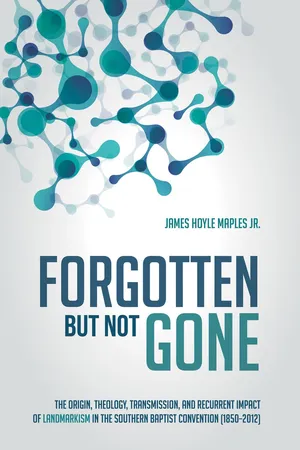
eBook - ePub
Forgotten but Not Gone
The Origin, Theology, Transmission, and Recurrent Impact of Landmarkism in the Southern Baptist Convention (1850–2012)
- 294 pages
- English
- ePUB (mobile friendly)
- Available on iOS & Android
eBook - ePub
Forgotten but Not Gone
The Origin, Theology, Transmission, and Recurrent Impact of Landmarkism in the Southern Baptist Convention (1850–2012)
About this book
All of us are shaped in many ways by unseen markers in our DNA. Unknown ancestral traits contribute to determination of such things as eye and hair color, height, and even a certain propensity or susceptibility to certain diseases. To some extent religious bodies are similarly the product of their beliefs and doctrines, at times and in certain ways, to beliefs and doctrines buried in the inherited make-up of that body or denomination. Landmarkism is such a genetic-like marker in the Southern Baptist Convention yet is largely unknown, and its influence is barely recognized today as a contributing factor in much of Baptist practice and belief. This book seeks to trace the origin and transmission of landmark beliefs from the time of its greatest influence to the present day when it is largely unknown but certainly present in beliefs and practices that have developed and become part of the Southern Baptist body in many instances.
Information
Subtopic
Dénominations chrétiennes1
Introduction
Background
The Landmark movement was perhaps the greatest controversy ever within the Southern Baptist Convention, the largest Baptist denomination, and the second largest denomination in America. The Landmark movement was highly sectarian and the attacks of the Landmarkers focused on other denominations, but also included mission boards, seminary presidents and professors, denominational boards and leaders, and even other churches and pastors within the Southern Baptist Convention. Many see Landmarkism as a movement which appeared for a few decades preceding and following the American Civil War but one which was largely forgotten in the twentieth century. It is true that a majority of Southern Baptists today cannot define Landmarkism or articulate anything relative to the controversies that were spawned by the Landmarkers. This is odd because many Landmark principles and doctrines are very visible within the Southern Baptist Convention today. The explanation lies in the fact that to many Southern Baptists these doctrines and principles are not strange or aberrant at all even though church historians or theologians would view them as such. Many Southern Baptists view some tenets of Landmarkism as basic Baptist doctrine and recognize nothing aberrant or Landmark about them.
The Southern Baptist Convention has been gripped by several major controversies during its 173-year history. The denomination was birthed as a direct result of the slavery controversy which ultimately led to war in America. Landmarkism began its ascendency during the first decade of the Southern Baptist Convention’s life and firmly planted itself within the fabric of the denomination. Although many would not agree in toto, the position set forth herein is that all the major controversies which have gripped the Southern Baptist Convention have at least some roots in or connection to Landmarkism in doctrine, principles, or practice.
This relationship and influence is striking because many Landmark beliefs are contrary to historic Baptist beliefs and various positions proceeding from the convention. These Landmark beliefs, however, have insinuated themselves into Baptist life, belief, and practice to such an extent that Landmark principles are seen by many as Southern Baptist principles. The difficulty herein has several facets.
The Landmark view of church history (both a history of the church and as a discipline of study) is unsupported by critical, historical research. If there are any Baptist historians who hold to a strict succession of Baptist churches from the first century to the present, they are an incredibly small minority. However, decades of teaching Baptist church succession in the seminaries and in the churches have produced numbers of pastors, leaders, and teachers who have inculcated such beliefs into the mainstream of Baptist life. Acceptance of such by large numbers of Southern Baptists is often seen as a curiosity rather than a cause for alarm.
Landmark ecclesiology presents a different set of challenges which center around the autonomy of the local church and its actions. The “high-church”1 attitude of Landmarkism has seeped into the Southern Baptist Convention and there is an attitude of congregational authority which rivals in some cases anything Rome has put forth regarding papal authority. This view has manifested itself repeatedly in various controversies, in relations or lack thereof with other denominations, in mission work and support, and in the workings of the Southern Baptist Convention itself. One’s ecclesiology, however, cannot be considered in isolation. By definition, it has influence upon other areas of doctrine.
The father of Landmarkism was James Robinson Graves (1820–1893). The author of the tract from which Landmarkism derived its name (An Old Landmark Re-Set) was James Madison Pendleton (1813–1891). Much has been written about these two men, but I believe there is more to be found in the sermons, letters, and other unpublished material which may shed more light upon their theology particularly in the area of ecclesiology.
The extent to which Landmark theology, doctrine, and practice have made their way into current-day Southern Baptist thought is somewhat remarkable. This was expected and reported in the decades when Landmarkism was a major force within the Southern Baptist Convention but the extent of that assimilation into current beliefs, attitudes, and practice is of great interest to and presents a great challenge to this historiographical research. The theology and historical view of the church fostered by Landmarkism was molded by a group of strong personalities within the Southern Baptist Convention. Rather than being condemned by Southern Baptists these views were embraced by the vast majority of Southern Baptists particularly in the Southern regions of the United States. These doctrines of Landmarkism, far from being a forgotten curiosity in Baptist history, have become part of Baptist faith and practice in the minds of many Southern Baptists and have exerted a significant influence in many controversies within that denomination even to the present day.
Rather than being a curious and to some an embarrassing part of Baptist history from which the Southern Baptist Convention has long since moved on, Landmarkism has proven to have amazing staying power, so much so, that it continues to influence Southern Baptist life today. Many do not recognize the distinctive Landmark doctrines and, if questioned, do not attribute these beliefs and practices to Landmark influence, if indeed they even recognize such influence, but categorize these doctrines as Southern Baptist doctrines. Many Baptist historians have demonstrated conclusively the faulty scholarship behind the Landmark view of Baptist church succession but there is still much in print even in recent publications which support, defend, and promote the Landmark position.
One area that is noticeably lacking in the history of Landmarkism and its influence is the time immediately preceding the Civil War. In addition, the loss of the war in the South, the period of Reconstruction, and the Landmark assessment of that time is curiously missing from or is treated very lightly in most studies. This was a time of high emotions. The American Civil War has been described as a religious war. Both sides in the conflict believed they had divine warrant for their position and in many cases the loudest denunciation, condemnation, and excoriation of the other side came from the pulpits and the pages of the religious press. The issues of slavery, states’ rights, and republicanism were front and center, and the loss of the war did nothing to change the minds of those in the South on these topics. After the slaves were freed the attitudes of most within the South did not change regarding the Negro. Most have ignored or skipped this part of history as if the Landmarkers had nothing to say on the subject. Research has proven that not to be the case. In fact, the twin doctrines of anthropology and the imago Dei and the Landmark interpretation of the same figure prominently in the Landmark-controlled press in what was then called the Southwest where Landmark influence was greatest. These doctrines would prove to have profound influence in the Southern Baptist Convention in later controversies which grew out of the aftermath of the Civil War and the Lost Cause mentality of many in the South. These connections and their Landmark roots are explored here.
Most of the studies of Landmarkism have terminated in the early twentieth century. After many Southern Baptist churches with strict Landmark beliefs split from the Southern Baptist Convention and formed their own convention it appeared that Landmarkism as an issue within the Southern Baptist Convention was a thing of the past. In addition, the tracing of Landmark positions during the last century has proven difficult and imprecise. Such a study is one of the primary goals of this work.
These are the reasons behind this work. It is intended as a detailed and in-depth history of the areas noted above. Every effort has been made to let the Landmarkers speak for themselves rather than respond to individual apologetic challenges. At times it is necessary to call some of the Landmark apologists to account but every effort to do so has sought foundation in the words and works of the Landmarkers themselves. It is the author’s stated purpose to go beyond what has been presented in other works and add to the historiography of the Landmark movement and its influence. This treatment, particularly in the areas noted above, seeks to better understand this movement and particularly its current influence and the foundations on which that influence is grounded. There will be, no doubt, much that can be advanced upon following this work, and it is hoped that this writer’s contribution will be useful in future research into this subject.
Naturally not everything written, preached, or said about Landmarkism can be included. This work is limited to pastors, editors, persons in positions of influence within the Southern Baptist Convention, and those of other denominations who were often the target of their attacks. The significant participants in the controversies which took place or persons who exercised considerable influence in propagating and extending the influence of Landmark beliefs among the members of the churches of the Southern Baptist Convention are the focus of this research.
From a historical point of view, a review of the theology of various groups claimed as Baptists in the successionist view of the history of the Baptist church will be examined. It should become clearer to what extent both the Landmarkers and the adherents of Landmarkism were willing to overlook theological inconsistencies and even heresies2 if the key marks of what they considered the true church and true church doctrine were present. Further, it is the aim here to document the presence of the Landmark views of ecclesiology and the church ordinances of baptism and the Lord’s Supper within the Southern Baptist Convention and give relevant examples of the extent of that influence.
Achievement of those aims will address certain questions/objectives:
a. Can it be demonstrated that certain theological aberrations are overlooked if one’s ecclesiology and view and practice of the church ordinances are correct according to Landmark doctrine and practice?
b. Is this the sine qua non of what it means to be a Southern Baptist?
c. What part did Landmarkism play in shaping responses by Southern Baptists to critical events in Baptist life like the Civil War, the civil rights movement, the conservative-moderate controversy, the missions controversy, and the debate over Baptist cooperation with other evangelicals?
d. How pervasive is Landmark doctrine and belief in the Southern Baptist Convention today?
Historiographical Method, Chronology,Authenticit...
Table of contents
- Title Page
- Preface
- Acknowledgments
- Chapter 1: Introduction
- Chapter 2: Early Landmarkism
- Chapter 3: An Evaluation of Baptist Church Succession
- Chapter 4: Controversies Generated by Landmarkers
- Chapter 5: Gone in Name but Present in Doctrine
- Chapter 6: Conclusion
- Appendix A: Tennessee Publication Society
- Appendix B: Mass Meeting at Cotton Grove
- Appendix C: The Trail of Blood
- Appendix D: Constitution of the Southern Baptist Sunday School Union
- Appendix E: Whitsitt’s Statement before the Board of Directors at the Southern Baptist Convention 1897
- Appendix F: Resolution Presented By B. H. Carroll at the Southern Baptist Convention, 1898
- Bibliography
Trusted by 375,005 students
Access to over 1.5 million titles for a fair monthly price.
Study more efficiently using our study tools.
Frequently asked questions
Yes, you can cancel anytime from the Subscription tab in your account settings on the Perlego website. Your subscription will stay active until the end of your current billing period. Learn how to cancel your subscription
No, books cannot be downloaded as external files, such as PDFs, for use outside of Perlego. However, you can download books within the Perlego app for offline reading on mobile or tablet. Learn how to download books offline
We are an online textbook subscription service, where you can get access to an entire online library for less than the price of a single book per month. With over 1.5 million books across 990+ topics, we’ve got you covered! Learn about our mission
Look out for the read-aloud symbol on your next book to see if you can listen to it. The read-aloud tool reads text aloud for you, highlighting the text as it is being read. You can pause it, speed it up and slow it down. Learn more about Read Aloud
Yes! You can use the Perlego app on both iOS and Android devices to read anytime, anywhere — even offline. Perfect for commutes or when you’re on the go.
Please note we cannot support devices running on iOS 13 and Android 7 or earlier. Learn more about using the app
Please note we cannot support devices running on iOS 13 and Android 7 or earlier. Learn more about using the app
Yes, you can access Forgotten but Not Gone by James Hoyle Maples Jr. in PDF and/or ePUB format, as well as other popular books in Théologie et religion & Dénominations chrétiennes. We have over 1.5 million books available in our catalogue for you to explore.