eBook - ePub
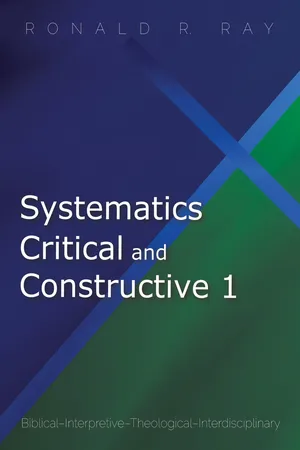
Systematics Critical and Constructive 1
Biblical–Interpretive–Theological–Interdisciplinary
- 372 pages
- English
- ePUB (mobile friendly)
- Available on iOS & Android
eBook - ePub
Systematics Critical and Constructive 1
Biblical–Interpretive–Theological–Interdisciplinary
About this book
This labor of love distills Dr. Ron Ray's lifetime reflections on the truth and meaning of the gospel of Jesus Christ. Gathered in one volume is an abundant harvest from the best of twentieth-century systematic theology. Beginning students will find here an informative and clear introductory text. Working pastors will receive a refresher course to steady and strengthen a ministry of integrity and joy. Preachers will benefit from the author's recommendation of the "topical-biblical sermon," an approach that leads to contemporary topics for textually-based scriptural preaching, while reinvigorating topical preaching with scriptural sturdiness. With both conviction and transparency, Ray welcomes his readers into a thoughtful conversation about why and how the Christian message still matters today. In the process, we also see firsthand how and why systematic theology can still matter today for those entrusted with proclaiming the good news of Jesus Christ.
--James F. Kay, Dean and Vice President of Academic Affairs, Professor, Princeton
Theological Seminary
This critical and constructive perspective interacts with such fields as biblical studies, Old and New Testament theology, hermeneutics and other philosophy. Ray's synthesis arises out of a unique theological and pastoral pilgrimage as a minister in the United States and as a missionary theologian and Christian ethicist in Nigeria and Kenya. As one might expect from a scholar who did the first PhD dissertation on Jacques Ellul, Ray writes with a forthright, probing, honest style. He criticizes authors at highly specific points, but often demonstrates indebtedness to the same scholars. He is deeply informed by the New Testament, and secondarily by the Old Testament, yet insists that interpretive dishonesty is no Christian virtue.
--Leicester R. Longden, Assoc. Professor of Evangelism and Discipleship Emeritus, University of Dubuque Theological Seminary
Information
Topic
Theology & ReligionSubtopic
Christian TheologyDevelopments toward the Testaments, Authority of Each
Chapter 4
Developments toward Old Testament Canon
Though we must distinguish between God’s revelation and the book that attests that, more is required than such a distinction, else the Bible’s humanity becomes a mere assertion that faith easily forgets. The complexities of the developments that led to the acceptance of particular books into the Bible need to be faced—and by systematic theology—which will help us to understand why Scripture evidences much diversity. If bibliolatry is to be avoided, theological students and Christians in general need to learn a good deal from the specialists who have spent lifetimes studying the complexities surrounding the creation of the writings that comprise the Bible and the human decisions concerning the writings to be included. Yet even canonicity specialists admit that much is unknown. Historical science is limited to studying available evidence, and “recent scholarship has been made painfully aware of the lack of solid historical evidence by which to determine large areas of [OT canonical] development.”147
1. Development of Jewish Understandings of Written Sources of Authority
For Judaism the final authority is the God known through revelation concerning His will and ways, especially regarding His commandments. Largely for this reason written attestations of God’s communicating came to be regarded as important (Exod 24:12; 32:15, 34:1; Deut 4:13). Moses is said to have recorded the commandments of the Lord (Exod 24:4a; 34:27), and the same is said of Joshua (Josh 24:26a) and Samuel (1 Sam 10:25ab).148
A variety of written scriptures had long been used in ancient Israel and Judah without being given canonical (delimited) status. Shortly after the 621 BC discovery of the Book of the Covenant, King Josiah read it to the assembled people, and King and people vowed to keep the commandments and statutes enunciated there (2 Kgs 23:1–3).149 Second Kings reflects no statement of canonizing principle, no circumscribing of some writings as of greater authority than others for determining the nature of Jewish faith. Yet the divine inspiring of the content of the Book of the Covenant is more than implied by describing these words as directly spoken by God.
Within its Deuteronomic placement, where the Book of the Covenant provides only a small part, comes a warning (supposedly directly from God) not to change the text of the whole of Deuteronomy. These Dueteronomistic words, perhaps put into God’s mouth, are not likely intended to delimit these writings as only authoritative, but to emphasize their importance and forbid their alteration when being hand copied: “You shall not add to the word which I command you, nor take from it . . . ” (4:2).150 However this may be, from the recognized authority of the Book of the Covenant and then Deuteronomy’s claim also for its own religious and moral importance, a dynamic expansion of the formal sources of authority would continue.
The book of Nehemiah tells of the priest-scribe Ezra’s reading of the book of the law of Moses to the people (8:1–5, 13). The group of writings Nehemiah claimed was authoritative (but probably not demarcated) was likely an earlier version of the Pentateuch (the first five OT books), with the possible addition of Joshua.151 What should not be overlooked is that the extra-pentateuchal claim that the Pentateuch should be regarded as Mosaic law implicitly reflects widely recognized religious and moral written authority in Israel beyond the Pentateuch!
2. Judaism’s Evolving Pre-Old Testament Scriptures
By 200 BC many Jewish people also looked to a group of prophetic writings. Most such books had existed before 400 BC, but had not been considered especially authoritative. That such earlier books came to be highly regarded by 200 BC was apparently linked to the emerging belief that the age of revelation and prophecy had ceased (1 Macc 9:27), that therefore no new prophetic literature could be written, and that the scope of accepted prophetic literature needed to be demarcated.152 In rabbinic Judaism (Phariseeism) the movement toward authoritative writings seemed to link to a legalizing and formalizing of religion, the idea that God had no fresh Word for the present. Most Pharisees thought that God’s present will was to be determined entirely by scribal analysis of the written testimonies concerning His revealed laws.
Childs and Blenkinsopp put an unjustifiably positive interpretation on the Jewish belief in the cessation of revelation and prophecy and the substitution of scribal interpretations of recognized texts. Certainly the formation of a collection of Jewish scriptures as a vehicle whereby past divine communication is actualized serves revelational purposes, as does the scholarly (scribal) interpretation of the same.153 But the interpreting of sacred texts is not sufficient to make up for a sense of divine presence and guidance. The NT claims that with Christ and His resurrection the Spirit poured forth and that teaching/interpreting should be undertaken only by charismatic leading.
The Jews of the Dead Sea Scrolls (likely Essenes) were among the Jewish minority who did not confine revelation to the distant past, but saw it as continuing in their time and place, at least with their leader, the Teacher of Righteousness.154 Furthermore, the pharisaic opinion that the time of revelation was past did not succeed in preventing new prophetic writings from being added to the authoritative (but not canonically demarcated) collection of OT scriptures.
Israel’s scriptures were still developing during the NT period, and the third part (“the Writings”) was still in flux. Thus when the NT refers to the OT scripture it usually mentions only the Law and the Prophets.155 However, since the NT often alludes to particular psalms, many early Christians must have been familiar with some of those and attributed considerable authority to them...
Table of contents
- Title Page
- Understanding the Discipline: Preface and Introduction
- Developments toward the Testaments, Authority of Each
- Canon and Interpretation
- More Interaction With Related Disciplines
- Service to Other Related Disciplines
- General Interpretation And Additional Biblical Interpretation
- Conclusion
- Glossary with References
- Bibliography
Trusted by 375,005 students
Access to over 1.5 million titles for a fair monthly price.
Study more efficiently using our study tools.
Frequently asked questions
Yes, you can cancel anytime from the Subscription tab in your account settings on the Perlego website. Your subscription will stay active until the end of your current billing period. Learn how to cancel your subscription
No, books cannot be downloaded as external files, such as PDFs, for use outside of Perlego. However, you can download books within the Perlego app for offline reading on mobile or tablet. Learn how to download books offline
Perlego offers two plans: Essential and Complete
- Essential is ideal for learners and professionals who enjoy exploring a wide range of subjects. Access the Essential Library with 800,000+ trusted titles and best-sellers across business, personal growth, and the humanities. Includes unlimited reading time and Standard Read Aloud voice.
- Complete: Perfect for advanced learners and researchers needing full, unrestricted access. Unlock 1.5M+ books across hundreds of subjects, including academic and specialized titles. The Complete Plan also includes advanced features like Premium Read Aloud and Research Assistant.
We are an online textbook subscription service, where you can get access to an entire online library for less than the price of a single book per month. With over 1.5 million books across 990+ topics, we’ve got you covered! Learn about our mission
Look out for the read-aloud symbol on your next book to see if you can listen to it. The read-aloud tool reads text aloud for you, highlighting the text as it is being read. You can pause it, speed it up and slow it down. Learn more about Read Aloud
Yes! You can use the Perlego app on both iOS and Android devices to read anytime, anywhere — even offline. Perfect for commutes or when you’re on the go.
Please note we cannot support devices running on iOS 13 and Android 7 or earlier. Learn more about using the app
Please note we cannot support devices running on iOS 13 and Android 7 or earlier. Learn more about using the app
Yes, you can access Systematics Critical and Constructive 1 by Ronald R. Ray in PDF and/or ePUB format, as well as other popular books in Theology & Religion & Christian Theology. We have over 1.5 million books available in our catalogue for you to explore.