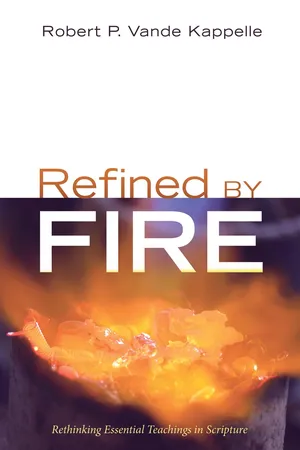
- 180 pages
- English
- ePUB (mobile friendly)
- Available on iOS & Android
eBook - ePub
About this book
From time immemorial, in every age, a set of questions has persisted, perplexing human beings. Does God exist? Where did the universe come from? Is there any purpose to our lives? Why is there so much suffering? Do we live on after death? How can we find release from suffering and sadness? For what can we hope? These have been called life's "big questions"; they are the ones that never go away. It is the main business of religion to answer ultimate questions. To accomplish this task, every generation of believers benefits by reexamining its theology, thereby providing society with vision. A stagnant theology reflects a religion that is limited in usefulness and effectiveness.
Refined by Fire is written for those who affirm the value of lifelong spiritual growth, realize the limits of logic, and embrace the paradoxes in life. This guide provides a mechanism for individuals and small groups to interact with timely theological topics such as the nature of God, Christ, Scripture, truth, faith, evil, sin, salvation, heaven, hell, creation and evolution, the role of the church, and the future of the human race.
Each session (chapter) follows a threefold pattern: (a) "Getting Started" provides an initial assignment; (b) "Gaining Momentum," the central part of the text, provides perspective; and (c) "Going Deeper" provides questions for discussion or further reflection.
Information
Topic
Theology & ReligionSubtopic
Biblical StudiesSession 1
Introduction
Getting Started
Homework Assignment: Answer the following question, writing your answers in your journal. Be prepared to share your views with others in the class. 1. Examine Fowler’s stages of faith, found in the appendix. Assess his model. Where do you find yourself on his scale? Where would you like to be? (Note: At the conclusion of this study you will be asked to revisit this topic and to rate your progress from start to finish).
Gaining Momentum
From time immemorial, in every age, a set of questions has persisted, perplexing human beings. What is going on in the universe? Is there any point to it all? Why are we here? Is there any purpose to our lives? How should we live? Does God exist? Where did the universe come from? Why does anything exist at all? Why is there so much suffering? Why do we die? Do we live on after death? How can we find release from suffering and sadness? For what can we hope? These have been called life’s “big questions”; philosophers speak of them as “ultimate questions.” They are the ones that never go away.
It is the main business of religion to answer the big questions. This is why, even when we try to distance ourselves from it, we remain intrigued by religion. Religion responds to the preoccupations that arise when one’s life comes up against barriers beyond which ordinary—including scientific—ways of coping cannot take us. For our purposes, therefore, religions may be understood very simply as pathways or “route-findings” through the ultimate limits on our lives. These limits include not only death and meaninglessness but also anything that threatens our wellbeing, anything that stands between us and lasting peace or happiness.
To accomplish this task, every generation of believers benefits by reexamining its theology, thereby providing society with vision. A theology that is stagnant reflects a religion that is limited in both usefulness and effectiveness. The sociological, ecclesiastical, and theological concerns of the Reformation and the Enlightenment are largely behind us, as are the battles between modernists and fundamentalists, and there are more critical issues now at stake. Fundamentalist claims (inerrancy, young earth, literalism, dispensationalism, premillenial rapture eschatology) have set themselves up for attack by critical scholars, producing individuals bent on discarding the baby with the bath water when they encounter evidence that their strict upbringing may not be up to the task of explaining in the post-reformation, postmodern world. We can do better than that.
In this book, I wish to celebrate the many voices of scripture, written over a span of a thousand years from a variety of sociological and theological perspectives, and also the potential wisdom that can result when a group of twenty-first-century readers, also with varying sociological and theological perspectives, commit to join one another in honest, loving, and respectful discussion regarding theological topics such as the nature of God, Christ, scripture, truth, faith, evil, sin and salvation, heaven and hell, creation and evolution, the role of the church, and the future of the human race.
Life on planet earth is fragile, and our lives are immensely complex. Many issues divide us and many problems exhaust our resources. Can we as individuals make a difference? Can a small group, centered on biblical study and committed to honest and intelligent dialogue, move our society one step closer to a better and more hopeful future? As Van Jones, the television pundit, stated in an interview with TIME magazine: “Can we have a better set of debates, a more meaningful set of debates, and actually get somewhere?”1
A Defining Moment
Several years ago nine students, all seniors, joined me around a large old table in a seminar room for a course titled “The Development of Western Christianity.” The topic was “The Sources of Authority for Modern Christians.” The assigned reading featured the well-known epistemological approach called the Wesleyan Quadrilateral, which enumerates four sources of theology within the Christian tradition—scripture, tradition, reason, and religious experience—and the students were asked to prioritize them and to support their choice.
One fellow, preparing for the Christian ministry, began the discussion by arguing that scripture should be given top priority. The books of the Bible, he stated, are the basis of all Christian belief and practice, since all were inspired directly by God and therefore provide the highest degree of authority. All sources of authority should defer to biblical revelation.
The next student questioned that conclusion. Admitting that scripture is central to Christianity, she noted that the biblical canon was produced by the church and therefore should be included under the category of tradition. In her estimation, tradition, understood as comprising scripture, should have priority for Christian belief and practice.
Another person brought up an equally valid point: tradition, including scripture, comes bound in cultural and historical context and requires interpretation in order to be applied meaningfully to contemporary life. Since interpretation must be filtered through a variety of lenses, including human reason, one could argue that reason stands as the final and foremost source of authority for modern Christians. Several students found this to be persuasive, while recognizing that not all aspects of faith derive from human reason or can be subjected to the authority of reason.
The last person to speak, while agreeing that reason should be held in high esteem, particularly where theological beliefs might be shown to contradict logic or scientific conclusions, noted that logic and reason are not exclusively objective phenomena. Rational people, after all, disagree, and in a global and pluralistic world they increasingly concede that there are—and always have been—many different “rationalities.” Thus, while affirming the centrality of reason, she concluded that reason could not claim the final word. In all cases, experience has the first and final word.
We left class pondering that final insight. Does reason, together with scripture and tradition, derive ultimately from experience? Our exercise seemed to support that conclusion, for none of the students had prioritized or substantiated their organization of the four categories in the same way. Subjective experience, it seems, lies at the heart of human consciousness and fashions reality as we know it. What we experience, we are. What we are, we think. What we think, we create. What we create, we become. What we become, we express. And what we express, we experience.
This exercise reminds us that to live and think fully, human beings need to find harmony within, firing on all cylinders of their selfhood. In his 1976 book, Forgotten Truth, the renowned scholar of comparative religions, Huston Smith, delved into the “primordial tradition,” the common, fundamental experience of humankind, as found in the core teachings of the world’s religions, identifying therein four levels of selfhood: body, mind, soul, and spirit. We will explore these levels in Session 7, understanding how they correlate with the four levels of reality. At his point, I simply emphasize the importance of connecting body and spirit for living fully, and of connecting head and heart (soul) for thinking wisely.
Whatever Does Not Grow Dies
There is in every human an impetus which, when nourished, seeks health and wholeness. Healthy human beings are said to go through discernible stages of growth throughout their lifetime. According to psychologist Erik Erikson, psychosocial development proceeds by critical steps. Each stage is marked by crisis, connoting not a catastrophe but a turning point, a crucial period of increased vulnerability and heightened potential. At such points, achievements are won or failures occur, leaving the future to some degree better or worse but in any case, restructured. As humans grow by progressing physically, psychologically, emotionally, and even intellectually, so they undergo various stages of growth in their faith.
Out of one’s individuality flows a spirituality that also yearns for growth and expression. What Erikson contributed to our understanding of the stages of psychosocial development, Jean Piaget to the stages of cognitive development, and Lawrence Kohlberg to the stages of moral development, so James Fowler did for spirituality. He identified seven stages of faith, from stage zero, called “primal faith,” when infants and toddlers develop (or fail to develop) a sense of safety about the universe and the divine, to a sixth stage called “universalizing faith.” This level, rarely reached, characterizes those who live their lives to the full in service of others without any real fears or worries. Most people plateau at what Fowler calls the “synthetic-conventional” stage, one arising in adolescence. At this stage, authority is usually placed in individuals or groups that represent one’s beliefs.2
The Translation Principle
Andrew Walls, perhaps the leading Christian missiologist today, has compared the nature of Christian expansion to that of Islam, the world’s other great missionary religion. While both have spread across the globe claiming the allegiance of diverse peoples, Islam has demonstrated more continuity in its expansion and on the whole more success in retaining allegiance. With relatively few exceptions, the areas and peoples that accepted Islam have remained Islamic ever since, whereas the ancient Christian heartland, including Egypt and Syria, is now Islamic, and the European cities once stirred by the preaching of John Knox or John Wesley are now secular, filled with empty pews and abandoned churches. While it is possible to provide social and political explanations for this loss of allegiance, Walls points to an inherent fragility in Christianity itself, a built-in vulnerability that he labels “the translation principle in Christian history.”
Unlike Islam, in which the effectual hearing of the Word of Allah (recorded as the Qur’an) occurs essentially through the medium of the Arabic language and through a scripture that cannot be translated, Christianity rests on the opposite premise, on a divine act of translation known as the incarnation: “the Word became flesh and dwelt among us” (John 1:14). In Islamic faith, God speaks to humanity in direct speech, delivered at a chosen time through God’s chosen Apostle; such speech is immutable and unalterably fixed in heaven for all time. In prophetic faiths such as Judaism and Islam, God speaks; in the Christian faith, God becomes human. According to Walls, much misunderstanding has occurred due to the assumption that the Bib...
Table of contents
- Title Page
- Preface
- Session 1: Introduction
- Session 2: Rethinking Truth
- Session 3: Rethinking Faith
- Session 4: Rethinking God (the Sacred)
- Session 5: Rethinking Jesus
- Session 6: Rethinking Scripture
- Session 7: Rethinking Creation
- Session 8: Rethinking Evil, Sin, Death, and Hell
- Session 9: Rethinking Salvation, Heaven, and Eternal Life
- Session 10: Rethinking the Church, Its Nature, Mission, and Composition
- Appendix: James Fowler’s Stages of Faith
- Bibliography
Trusted by 375,005 students
Access to over 1.5 million titles for a fair monthly price.
Study more efficiently using our study tools.
Frequently asked questions
Yes, you can cancel anytime from the Subscription tab in your account settings on the Perlego website. Your subscription will stay active until the end of your current billing period. Learn how to cancel your subscription
No, books cannot be downloaded as external files, such as PDFs, for use outside of Perlego. However, you can download books within the Perlego app for offline reading on mobile or tablet. Learn how to download books offline
Perlego offers two plans: Essential and Complete
- Essential is ideal for learners and professionals who enjoy exploring a wide range of subjects. Access the Essential Library with 800,000+ trusted titles and best-sellers across business, personal growth, and the humanities. Includes unlimited reading time and Standard Read Aloud voice.
- Complete: Perfect for advanced learners and researchers needing full, unrestricted access. Unlock 1.5M+ books across hundreds of subjects, including academic and specialized titles. The Complete Plan also includes advanced features like Premium Read Aloud and Research Assistant.
We are an online textbook subscription service, where you can get access to an entire online library for less than the price of a single book per month. With over 1.5 million books across 990+ topics, we’ve got you covered! Learn about our mission
Look out for the read-aloud symbol on your next book to see if you can listen to it. The read-aloud tool reads text aloud for you, highlighting the text as it is being read. You can pause it, speed it up and slow it down. Learn more about Read Aloud
Yes! You can use the Perlego app on both iOS and Android devices to read anytime, anywhere — even offline. Perfect for commutes or when you’re on the go.
Please note we cannot support devices running on iOS 13 and Android 7 or earlier. Learn more about using the app
Please note we cannot support devices running on iOS 13 and Android 7 or earlier. Learn more about using the app
Yes, you can access Refined by Fire by Robert P. Vande Kappelle in PDF and/or ePUB format, as well as other popular books in Theology & Religion & Biblical Studies. We have over 1.5 million books available in our catalogue for you to explore.