eBook - ePub
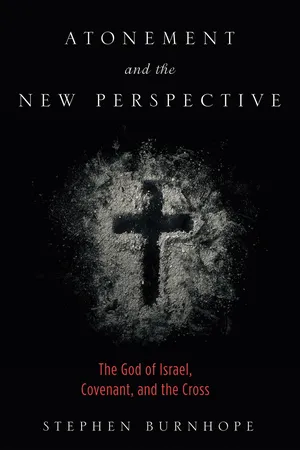
Atonement and the New Perspective
The God of Israel, Covenant, and the Cross
- 290 pages
- English
- ePUB (mobile friendly)
- Available on iOS & Android
eBook - ePub
About this book
Atonement has been described as the central doctrine of Christianity and yet, surprisingly, the church has never insisted on a particular understanding of how redemption in Christ was achieved. Instead, a miscellany of metaphors has been employed, each picturing "something" of Christ's work. Recent debate within Reformed Evangelicalism has been characterized by claims for hegemony to be granted to penal substitution versus counter-arguments for a kaleidoscopic, multi-model understanding. Notably absent in these discussions, however, are two considerations. One is any common nexus to draw atonement thought together. The other is any positive theological contribution deriving from God's preexisting relationship with Israel (the presumed role of which has rather been to provide a negative contrast of law-versus-grace and works-versus-faith, as the dark background against which the light of Christ may shine more brightly). Recent scholarship, however--particularly the "new perspective on Paul"--has comprehensively dismantled the old stereotypes concerning first-century Judaism. This book asks how differently we might think about the atonement once it is brought into conversation with the new scholarship. It concludes by proposing a "new perspective" on atonement in which Christ is central, Israel and Torah are affirmed, and the traditional metaphors continue to find their place.
Information
Topic
Theology & ReligionSubtopic
Biblical Studieschapter one
The Doctrine of Atonement
How can a judicial murder be represented as a salvific event? This is the kind of question that has driven the church to seek a theology of atonement. Many such theories have been produced and there is no single one that is universally accepted. At the best, we can only hope to have a number of analogies and metaphors, correcting and supplementing each other but together conveying something of the mystery of the cross as it has been experienced in Christian faith.1
1.1 Introduction
The Christian doctrine of atonement is attempting to answer the question of how, exactly, humanity is made “at one” with God through the person and work of Christ—or, in the language of Middle English, restored to a state of “at-one-ment.”2 Given its critical importance, it is unsurprising that Leon Morris should describe the atonement as “the central doctrine of Christianity.”3 One might therefore be forgiven for finding it curious that no particular or exclusive understanding of atonement has ever been insisted upon by the church as determining Christian orthodoxy. As J. N. D. Kelly sums it up, “While the conviction of redemption through Christ has always been the motive force of Christian faith, no final and universally accepted definition of the manner of its achievement has been formulated to this day.”4 Accordingly, one can inhabit the land of Christian orthodoxy, classically defined, without embracing one particular theory of the atonement.5 Through the centuries, atonement has been explained by reference to sundry analogies and metaphors deriving from biblical imagery, mediated through contemporary thought, each “conveying something”—in John Macquarrie’s phrase, quoted above—of how the cross of Christ is salvific.
Theological consideration of atonement has tended to focus either on arguing for a preferred theory or, alternatively, on how the various theories ought to be understood to fit together. A recent example of this is the debate within Evangelicalism concerning the claimed hegemony of the penal substitutionary doctrine (on which, more anon). However, the burden of this particular work lies elsewhere. Perhaps the most curious thing about all of the traditional Christian accounts of atonement is the virtual absence of any meaningful reference to the historic relationship between Israel and its God within which the atoning work of Christ took place. To all intents and purposes, atonement has been abstracted from the religious context in which it was achieved—it has come adrift from its Jewish moorings. It is as if the entire narrative of Israel and its God up until that point has no material bearing on the Christian doctrinal perspective, notwithstanding that Jesus was speaking to Jews from within Judaism and that his immediate followers were all Jews.6 It seems that a conflation has occurred, in which the fact that Christ’s work has universal and timeless significance has been confused with the idea that atonement is to be explained in universalized and dehistoricized terms. The doctrine of atonement exemplifies what Soulen calls an “Israel-forgetfulness”; namely, that
Christians [. . .] have commonly accounted for [the gospel’s] truth by means of a construal of the Bible’s narrative unity that [. . .] renders God’s identity as the God of Israel and the center of the Hebrew Scriptures almost wholly indecisive for grasping God’s antecedent purpose for human creation.7
Soulen’s insight offers the intriguing idea of looking at the subject of atonement through the opposite end of the telescope—that is to say, with a presumption that God’s identity as the God of Israel and the center of the Hebrew Scriptures is actually decisive for grasping his antecedent purpose and that accounting for the gospel’s truth might somehow depend on such a construal. This would be a radical change of direction from the assumption that an old and inferior religion called Judaism is the province of the Old Testament, while a new and better religion called Christianity is the province of the New.8 It would render null and void any on-going construal of Christian faith that sought to define its own qualities over against Judaism’s corresponding failings. It would necessitate reversing the tendencies in Christian history to separate Jesus from his Judaism and to espouse an essentially ahistorical gospel beginning with a decontextualized and universalized Savior.
However, the development of such an account must await chapter three. The purpose of this present chapter is a discussion of the current state-of-play concerning how atonement is and has historically been understood and an analysis of its key themes. We will reflect on the manner in which its theories, models, and metaphors construe the interaction of the “problem” with its corresponding “solution” and the role that is played in that construal by culture and worldview. Given our chosen scholarly context, we will be mostly concerned to consider Evangelicalism’s perspective. This will necessitate addressing, in particular, the claims to hegemony of the penal substitutionary doctrine, since Evangelicalism widely perceives this to be “obviously” the principal and necessary biblical understanding.9 Self-evidently, were this to be the case, there would be no “gap” to fill, whether with reference to the story of Israel or anything else.
The chapter will therefore develop as follows. To begin, we will look at atonement in history. Here, we will firstly note the absence of creedal confessional affirmations concerning the atonement. Secondly, we will briefly review how atonement has been conceived historically, through various “objective” or “subjective” models, metaphors, or theories. Thirdly, we will consider in depth the principal Evangelical idea of the atonement—penal substitution. Finally, we will contrast that approach with the alternative multi-faceted or “kaleidoscopic” understanding that many prefer.
In the second part of the chapter we shall briefly review the work of a few scholars who may be perceived already to have taken some steps along the same path, in offering a contribution to atonement theory drawn from aspects of the biblical story of Israel.
As the chapter develops, we shall see time and again that—whether we are talking about the traditional models or recent thinking—“Israel-forgetfulness” is to the fore. We find this to be so in both parts of the chapter. Even where atonement accounts touch upon Old Testament “themes” it will be evident that they draw no necessary or substantive ...
Table of contents
- Title Page
- Author’s Preface
- General Introduction
- Chapter One: The Doctrine of Atonement
- Chapter Two: New Perspectives on First-Century Judaism
- Chapter Three: Atonement in New Perspective
- Chapter Four: The Continuing Place of the Traditional Ideas of Atonement
- Bibliography
Trusted by 375,005 students
Access to over 1.5 million titles for a fair monthly price.
Study more efficiently using our study tools.
Frequently asked questions
Yes, you can cancel anytime from the Subscription tab in your account settings on the Perlego website. Your subscription will stay active until the end of your current billing period. Learn how to cancel your subscription
No, books cannot be downloaded as external files, such as PDFs, for use outside of Perlego. However, you can download books within the Perlego app for offline reading on mobile or tablet. Learn how to download books offline
We are an online textbook subscription service, where you can get access to an entire online library for less than the price of a single book per month. With over 1.5 million books across 990+ topics, we’ve got you covered! Learn about our mission
Look out for the read-aloud symbol on your next book to see if you can listen to it. The read-aloud tool reads text aloud for you, highlighting the text as it is being read. You can pause it, speed it up and slow it down. Learn more about Read Aloud
Yes! You can use the Perlego app on both iOS and Android devices to read anytime, anywhere — even offline. Perfect for commutes or when you’re on the go.
Please note we cannot support devices running on iOS 13 and Android 7 or earlier. Learn more about using the app
Please note we cannot support devices running on iOS 13 and Android 7 or earlier. Learn more about using the app
Yes, you can access Atonement and the New Perspective by Stephen Burnhope in PDF and/or ePUB format, as well as other popular books in Theology & Religion & Biblical Studies. We have over 1.5 million books available in our catalogue for you to explore.