- 334 pages
- English
- ePUB (mobile friendly)
- Available on iOS & Android
eBook - ePub
About this book
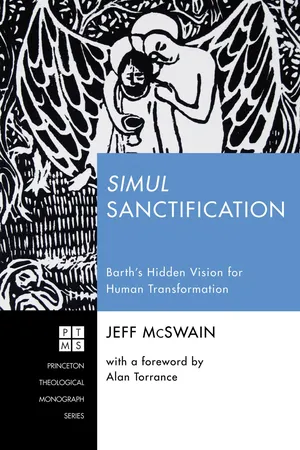
Why do we see so much fruitful good in unbelievers and so much evil in believers? What could it mean for a believer that the old is "gone," especially when it doesn't feel that way? What does it mean for humans who are simul iustus et peccator (simultaneously righteous and sinner) to be transformed in Christ and by his Spirit? We typically think of sanctification as pertaining to humans being conformed to Jesus, but what could it mean when Jesus speaks of himself as being sanctified for our sakes (John 17:19)? Jeff McSwain mines the theology of Karl Barth to engage such questions. In looking "through the simul," he concludes with Barth that universal human transformation is a reality before it is a possibility, and that, despite our contradictory state, we may live Spirit-filled lives as we participate in Christ's true humanity that determines ours--a humanity which never gets old.
Information
Topic
Theology & ReligionSubtopic
Christian Ministry1
Simul Sanctification: “no easier way”
“Luther’s ‘simul (totus) iustus, simul (totus) peccator,’ has thus to be applied strictly to sanctification and therefore conversion if we are to see deeply what is denoted by these terms . . . the same man, in the ‘simul’ of to-day, is both the old man of yesterday and the new man of to-morrow”63
Martin Luther’s phrase simul iustus et peccator, describing the Christian to be simultaneously righteous and sinful, has undoubtedly been controversial since Luther introduced it at Wittenberg in his Romans lectures of 1515–16.64 For many “the simul” is considered a useless paradox. Those already uneasy with what they consider to be Luther’s antinomian tendencies spy in his enigmatic phrase worrisome sponsorship for both false comfort and sinning “boldly.” Surely it is not surprising when the Christian sins, but shall we go so far as to classify the saint as a sinner?
Historically, even those impacted by Luther’s teachings on justification have struggled to embrace the Reformer’s insistence on the simul and its static categories in light of Scripture’s admonitions to “be transformed.” John Wesley, for example, famously converted at Aldersgate while listening to a reading of Luther’s commentary on Galatians, later voiced great distrust in Luther’s view of sanctification.65 Wesley, always wary of antinomianism, preferred a gradualist model of Christian progress meant to eventually translate into perfection or “full sanctification.” Opposite of full sanctification is the potential for Christians to lose salvation altogether (for those not progressing), making for a rather tenuous concept of justification, or at least an uneasy and fragile assurance of justification for believers. The more objective emphasis of Luther and the more subjective emphasis of Wesley are indicative of the two poles between which Protestants have continually sought to understand how their justification relates to their sanctification and vice-versa. Is the supposed healthy tension between the objective and subjective poles really possible to attain? Is it possible to speak of sanctification and true genuine human subjectivity without devolving into a subjectivism where any real objective meaning is at risk?
Barth’s Reappropriation
Karl Barth’s emergence from nineteenth-century German Liberalism includes an expansive christocentric view of sanctification that holds together justification and sanctification and their objective and subjective aspects in unprecedented ways. Not without irony, it is actually Barth’s radical adaptation of Luther’s simul in matters of sanctification and conversion that causes him to eschew both Luther’s monergist conception of justification and the Reformer’s juxtaposition of Law and Gospel.66 Throughout our study I will contend that Barth’s version of Luther’s simul includes helpful antidotes where gradualist (Wesleyan) thinking may be prone to overreact to Luther’s static categories.
The first question this raises is, “To what extent and in what form did Karl Barth reappropriate Luther’s simul?” For Luther, it must be remembered, the discussion about the simul and sanctification only begins when Christian believers are assured of their justification and thereby declared iustus. On Barth’s view, however, sanctification (like justification) is related less to the beginning of a believer’s faith experience and more directly to the person of Jesus Christ and all to whom he is related! Because of who Jesus Christ is, Barth’s scope for sanctification (and justification) is universal and actual. Sanctification is not contingent on a person’s expression of faith. As the Second Adam, Jesus Christ is the primary human being who includes and sanctifies all humans in his own humanity; all persons are positively incorporated into his saving work. The actual sanctification of every human being in Christ is so comprehensive that Barth views even our participation “as objective before it ever becomes active.”67 George Hunsinger elaborates,
Barth’s doctrine of universal objective participation breaks with almost the entire Latin theological tradition, including perhaps especially the ever dominant Augustinian tradition. One has to go all the way back to early Greek fathers like Athanasius to find relatively comparable associations of the phrase in Christ with the word all. Barth boldly allots certain New Testament passages like I Corinthians 15, II Corinthians 5, Romans 5 and Romans 11, where similar universalistic associations occur, a weight of significance they have not enjoyed for centuries.68
Hunsinger goes on to say, “It should not be surprising if for many conscientious believers Barth’s position, at least initially, should seem implausible or counter-intuitive or fraught with unfortunate consequences.”69 Indeed, full sanctification by grace, extended to all, is a departure from Luther and one of the most difficult aspects of the doctrine for a Lutheran or Wesleyan to assimilate!70 The fact that Barth adamantly holds to this view of justification and sanctification is evidence of his certainty that any iustitia gifted to humanity originates ontologically in the depths of the Giver himself, in his history, and not in the individual conversion experience.71
On Barth’s view, the full sanctification of Jesus Christ accomplished in his birth, life, death, resurrection, and ascension interpenetrates the full justification accomplished in the judgment of the cross, together making them simultaneous aspects “of the one redemptive act of God in Jesus Christ.”72 While not to be confused with our simul iustus et peccator, this “other simul” of justification and sanctification is obviously correlated to the former and provides the christological foundation for extending the simul iustus et peccator to all of humanity. Iustitia and peccatum are plainly central features to this one act of redemption, this sanctifying and justifying story, whereby: “For Christ also suffered for sins [pro peccatus] once for all, the righteous for the unrighteous [est iustus pro iniustus], in order to bring you to God” (1 Pet 3:18).73 In chapter 3 we will consider more deeply how the simul applies to Jesus Christ himself, the first-century Jew from Nazareth. For now it suffices to recognize that it is Barth’s doctrine of simultaneous justification and sanctification—premised on his interconnection of ...
Table of contents
- Title Page
- Foreword
- Preface
- Acknowledgments
- Introduction
- Chapter 1: Simul Sanctification: “no easier way”
- Chapter 2: Can We Speak of a Chalcedonian Anthropology?
- Chapter 3: Chalcedonian Change and the Spirit of Righteousness
- Chapter 4: No Partim-Partim in Participation!
- Chapter 5: Hercules at the Crossroads
- Chapter 6: Freedom to Be Transformed
- Chapter 7: The Simul as a Matter of Life and Death
- Chapter 8: A New Perspective on the Cross
- Chapter 9: When Is the Simul?
- Chapter 10: The Darkness Shall not Overcome It
- Chapter 11: The Humanity from Heaven and the Humanity of Earth
- Chapter 12: A Kinship of Being: How Far Can We Go?
- Chapter 13: Taking Scripture with Totus Seriousness
- Chapter 14: Seeing through the Simul
- Conclusion
- Final Reflections
- Bibliography
Trusted by 375,005 students
Access to over 1.5 million titles for a fair monthly price.
Study more efficiently using our study tools.
Frequently asked questions
Yes, you can cancel anytime from the Subscription tab in your account settings on the Perlego website. Your subscription will stay active until the end of your current billing period. Learn how to cancel your subscription
No, books cannot be downloaded as external files, such as PDFs, for use outside of Perlego. However, you can download books within the Perlego app for offline reading on mobile or tablet. Learn how to download books offline
Perlego offers two plans: Essential and Complete
- Essential is ideal for learners and professionals who enjoy exploring a wide range of subjects. Access the Essential Library with 800,000+ trusted titles and best-sellers across business, personal growth, and the humanities. Includes unlimited reading time and Standard Read Aloud voice.
- Complete: Perfect for advanced learners and researchers needing full, unrestricted access. Unlock 1.5M+ books across hundreds of subjects, including academic and specialized titles. The Complete Plan also includes advanced features like Premium Read Aloud and Research Assistant.
We are an online textbook subscription service, where you can get access to an entire online library for less than the price of a single book per month. With over 1.5 million books across 990+ topics, we’ve got you covered! Learn about our mission
Look out for the read-aloud symbol on your next book to see if you can listen to it. The read-aloud tool reads text aloud for you, highlighting the text as it is being read. You can pause it, speed it up and slow it down. Learn more about Read Aloud
Yes! You can use the Perlego app on both iOS and Android devices to read anytime, anywhere — even offline. Perfect for commutes or when you’re on the go.
Please note we cannot support devices running on iOS 13 and Android 7 or earlier. Learn more about using the app
Please note we cannot support devices running on iOS 13 and Android 7 or earlier. Learn more about using the app
Yes, you can access Simul Sanctification by Jeff McSwain in PDF and/or ePUB format, as well as other popular books in Theology & Religion & Christian Ministry. We have over 1.5 million books available in our catalogue for you to explore.