eBook - ePub
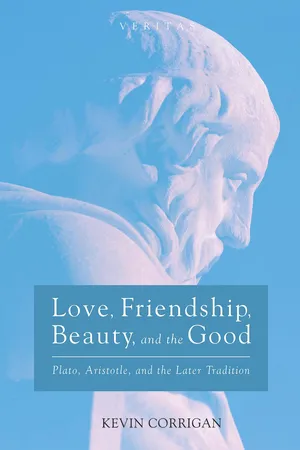
Love, Friendship, Beauty, and the Good
Plato, Aristotle, and the Later Tradition
- 170 pages
- English
- ePUB (mobile friendly)
- Available on iOS & Android
eBook - ePub
About this book
This book tells a compelling story about love, friendship, and the Divine that took over a thousand years to unfold. It argues that mind and feeling are intrinsically connected in the thought of Plato, Aristotle, and Plotinus; that Aristotle developed his theology and physics primarily from Plato's Symposium (from the "Greater" and "Lesser Mysteries" of Diotima-Socrates' speech); and that the Beautiful and the Good are not coincident classes, but irreducible Forms, and the loving ascent of the Symposium must be interpreted in the light of the Republic, as the later tradition up to Ficino saw. Against the view that Platonism is an escape from the ambiguities of ordinary experience or opposed to loving individuals for their own sakes, this book argues that Plato dramatizes the ambiguities of ordinary experience, confronts the possibility of failure, and bequeaths erotic models for the loving of individuals to later thought. Finally, it examines the Platonic-Aristotelian heritage on the Divine to discover whether God can love us back, and situates the dramatic development of this legacy in Plotinus, Iamblichus, Proclus, and Dionysius the Areopagite.
Information
Topic
PhilosophySubtopic
Ancient & Classical Philosophy1
Desire, Love, and Ascent through the Beautiful to the Good
Since desire, friendship, and love, together with the search for truth, beauty, and goodness, are necessary for any human life, and yet nothing is more likely to get us into trouble, more enigmatic in the final analysis, and more potentially fatal, I want to examine some of these issues in Plato, Aristotle, Plotinus, and some other major figures in the later history of thought. This is important because we in the modern world are divided about these ancient figures, so many convinced that Plato, Aristotle, and especially Plotinus rigidly divorced mind and feeling and thereby left a fatal legacy from which we are still trying to recover. It is important, too, because even in the various fields of contemporary scholarship it is still unusual to link the study of early and late antiquity directly. From Schleiermacher on, we have inherited a conviction that Plato, Aristotle, the Stoics, etc., should be separated from the preoccupations of the Neoplatonists, who, on some interpretations, invented the one as their highest Principle and introduced religious and ethical perspectives of an otherworldly character into what should be a world unencumbered by extraneous considerations. For most modern scholarship, the “good” is not a transcendental principle, but something we have to negotiate in the ambiguities of ordinary experience. In fact, if we can do without truth, according to truth-redundancy theory, perhaps we need the “good” even less, since even the Romantics could apparently get by without it. Keats appealed only to beauty and truth in the final lines of his famous poem Ode on a Grecian Urn: “Beauty is truth, truth beauty,—that is all/ Ye know on earth, and all ye need to know.” But is it really true that “beauty is truth and truth beauty,” as the Symposium (apparently) and Keats’ Ode on a Grecian Urn might have us believe?1 Or is this simply “all” we really need to know? But even if it is all we need, it seems unlikely that beauty is truth in any simple sense or that what is true is beautiful and that what is beautiful true, no matter how powerful the conjunction or identity of truth and beauty might be. What is true can be petty and crippling; what is beautiful can be deceptive—a path to destruction, like the figure of Alcibiades in Plato’s Symposium; and what is good can be brilliant but empty inventiveness, like Agathon’s speech in the Symposium. So how should the true, the beautiful, and the good be configured if what I shall, for convenience, call the “Romantic” interpretation of the erotic ascent is to be avoided? Can we, in other words, avoid petty truth, deceptive beauty, and empty good?
In this chapter, I will first examine the commonly supposed divide between reason and feeling, love and intellect in ancient thought. For Plato, Aristotle, and Plotinus, is desire lower than reason and always subordinated to reason, or does desire have its own reasons? Does reason generate its own desire? And can desire really characterize intellect? These are important life questions in themselves, since desire and its consequences ruin lives so easily and the question of how we are to live and from what perspective is so easily submerged by practical economic, social, and technological concerns. They are also important questions because even when they do arise, Platonism2 and the ancient and medieval worlds are frequently dismissed as of no value, relics of elitist ages that have little relevance to modern thought. Platonism itself ...
Table of contents
- Title Page
- Acknowledgements
- Abbreviations
- Introduction
- Chapter 1: Desire, Love, and Ascent through the Beautiful to the Good
- Chapter 2: Friendship and Love of the Individual
- Chapter 3: The Problem of Divine Love
- Conclusion
- Select Bibliography
Trusted by 375,005 students
Access to over 1.5 million titles for a fair monthly price.
Study more efficiently using our study tools.
Frequently asked questions
Yes, you can cancel anytime from the Subscription tab in your account settings on the Perlego website. Your subscription will stay active until the end of your current billing period. Learn how to cancel your subscription
No, books cannot be downloaded as external files, such as PDFs, for use outside of Perlego. However, you can download books within the Perlego app for offline reading on mobile or tablet. Learn how to download books offline
We are an online textbook subscription service, where you can get access to an entire online library for less than the price of a single book per month. With over 1.5 million books across 990+ topics, we’ve got you covered! Learn about our mission
Look out for the read-aloud symbol on your next book to see if you can listen to it. The read-aloud tool reads text aloud for you, highlighting the text as it is being read. You can pause it, speed it up and slow it down. Learn more about Read Aloud
Yes! You can use the Perlego app on both iOS and Android devices to read anytime, anywhere — even offline. Perfect for commutes or when you’re on the go.
Please note we cannot support devices running on iOS 13 and Android 7 or earlier. Learn more about using the app
Please note we cannot support devices running on iOS 13 and Android 7 or earlier. Learn more about using the app
Yes, you can access Love, Friendship, Beauty, and the Good by Kevin Corrigan in PDF and/or ePUB format, as well as other popular books in Philosophy & Ancient & Classical Philosophy. We have over 1.5 million books available in our catalogue for you to explore.