- 200 pages
- English
- ePUB (mobile friendly)
- Available on iOS & Android
eBook - ePub
Faith, Hope, and Love in the Technological Society
About this book
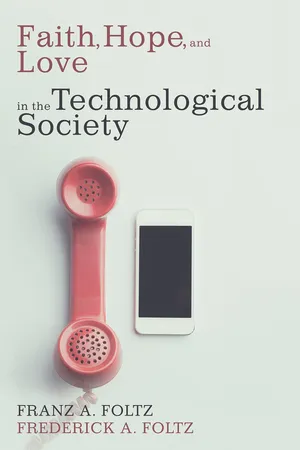
Franz and Frederick Foltz examine how modern technology creates an environment that significantly affects Christianity by reducing the mysteries of faith to manageable techniques. The body of their work analyzes the effects of technology on the theological virtues of faith, hope, and love, the triad that believers have used for a common narrative to understand and express their thoughts and experiences. They begin by looking at how recent developments have brought us into a post-truth era by removing words from their context in nature, time, place, and community. Popular theologies such as the power of positive thinking, the laws of creation, the plan for salvation, and the prosperity gospel reflect this change by gearing all for efficiently getting what we want and ignoring tradition. The authors then examine each of the virtues separately, finding that faith has become a risk management tool that depends on confidence in systems rather than personal relationships, hope is defined as the expectation that our present desires shall be granted rather than a vision of the future, and love has become an intimacy that provides escape from the real world and community rather than a self-denying care for them. Finally, the authors take a look at some appropriate responses.
Information
Topic
Theology & ReligionSubtopic
Christian Theology1
The Technological Society
Until recently, technology was defined as the tools humans used to enhance their labor. It was assumed that each new tool overcame another natural limitation. Society marked its progress by advancements in technology, characterizing each stage of civilization by its tools. At a young age, students were taught about the Stone, Bronze, and Iron Ages. Older students divided modernity into the Age of the Printing Press, the Machine, the Automobile, and the Computer. It was expected that the next technical innovation would solve many, if not all, of humanity’s present problems.
People understood that each new tool brought some changes to the world in which we live, forcing society to conform to its nature and causing modifications in lifestyles. As the saying goes, if all I have is a hammer, everything looks like a nail. It was assumed that the change would be an improvement. A simple tool would increase bodily strength. A complicated machine would surmount obstacles of time and space.
Today we have entered a new technological age, characterized by electronic machines and systems. It is no longer a matter of picking up a primitive tool to perform a specific task. This new technology shapes our world and pervades our lives far more decisively. As soon as we wake, we begin pushing buttons to turn on lights, heat food, and fire up computers. Throughout the day, we are constantly connected to systems, such as the electric grid and the Internet. Before we go to bed we turn off some of our connections, but many systems continue to serve us. Even as we sleep, thermostats regulate heating, lights provide security, and computers receive messages.
This has led some to question if every new technology really enriches human life. They are increasingly aware that while modern devices might increase the quality of some aspects, they also diminish others. The telegraph, for instance, enabled people to communicate with tremendous speed over great distances, but in doing so it removed body language and facial expressions from the conversation.
Others wonder whether we control modern technologies or they control us. We adjust to their requirements when we electrify our houses, drive our cars, and use the Internet. No matter how prudent we desire to be, we find ourselves constantly buying the latest devices. Ten years is ancient in the electronic age, and the system will not service “outdated” devices. Perhaps we are no longer masters of our technologies.
Three Speeches
A brief look at three commencement speeches indicates how much our society’s perception of technology has shifted over the past century. By examining these excerpts, we shall see how this perception has morphed basic concepts and words that traditionally defined our society. Each speaker presented a view of technology consistent with his time period.
JFK and the Technocratic 1960s
When the older of the authors received a graduate degree from Yale in 1962, the President of the United States, John Fitzgerald Kennedy, delivered the commencement address. He used the occasion to champion technology as the means to a better, happier, more rational society. All of our problems had become “technical and administrative.”1 He observed that this meant, “In our own time we must move on from the reassuring repetition of stale phrases to a new, difficult, but essential confrontation with reality.”
Kennedy identified these stale phrases as the truisms, stereotypes, and clichés of philosophies and ideologies. Although he never mentioned religion, it certainly fits his understanding of old-fashioned ideas that lead to clashes rather than unity. In place of these, he maintained that the “ways and means of reaching common goals” had become the “practical management of a modern economy.”
The president ended by acknowledging that depending on technical rather than ideological reasoning necessitated the confidence that all major elements of our society would live up to their responsibilities. His last paragraph spoke of what would enable this to happen:
But the unfortunate fact of the matter is that our rhetoric has not kept pace with the speed of social and economic change. Discussion is essential. Nearly 150 years ago Thomas Jefferson wrote, “The new circumstances under which we are placed call for new words, new phrases, and for the transfer of old words to new objects.” New words, new phrases, the transfer of old words to new objects—that is truer today than it was in the time of Jefferson, because the role of this country is now vastly more significant. There is a show in England called “Stop the World, I Want to Get Off.” You have not chosen to exercise that option. You are part of the world, and you must participate in these days of our years in the solution of the problems that pour upon us, requiring the most sophisticated and technical judgment; and as we work in consonance to meet the authentic problems of our times, we will generate a vision and an energy which will demonstrate anew to the world the superior vitality and strength of the free society.2
The 1962 audience and press regarded JFK’s address as cutting edge. Many historians still regard it as a major speech. It certainly reflected the times. The United States was focused on putting a man on the moon. Only a few years later, the nation turned to technology as a means of accomplishing President Johnson’s Great Society. Not long after that, Bill Clinton expressed the same confidence in technology when he welcomed the new age of nanotechnology as bringing the solution to all of humanity’s problems.3
Kennedy’s address assumed that the solution of modern problems was beyond the ability of ordinary people. He promised to gather specialists who were up to the task. One of those experts, former Secretary of Defense Robert McNamara, has come to epitomize the position that every problem can be solved by technocratic means. He defined the Pentagon as a group of technicians solving military problems rather than a group of politicians. As that approach has taken over all areas of government, it has effectively taken public decision-making in all matters out of the hands of ordinary citizens. Supposedly, only experts who specialize in a discipline have the knowledge and skills necessary to make decisions and regulate practices in that area.
JFK’s commencement address also assumed that the rise of technology has to be accompanied by the denigration of tradition. Belief systems, described as philosophy and ideology, should not play a role in modern decision-making because they cause conflict and stand in the way of progress. To the contrary, the bulk of our work will argue that belief systems are essential for the vision and energy necessary for direction and purpose in making life’s important decisions. To destroy belief systems is to lose the very resources needed for a meaningful democratic society. A society must be very careful when creating new words or phrases, and especially when transferring old words to new objects. Too often we end up “worshipping” an automobile.
A LEGO World in the 1990s
When the younger author received his doctorate from Rensselaer Polytechnic Institute in 1996, the commencement speaker was Peter Eio, President of LEGO/Dacta Systems, the largest toy manufacturer in the world. The significance of this speech was not the particular words spoken, but the speaker himself. There is nothing wrong with manufacturing toys. However, until recently, it would be very strange for a university to illustrate its fundamental values with the CEO of a company that makes toys. The value, of course, was not toy making but rather the efficient use of blocks as an educational tool. The award recognized that technique had become a value ...
Table of contents
- Title Page
- Preface
- Acknowledgements
- Introduction
- Chapter 1: The Technological Society
- Chapter 2: Christianity in the Technological Society
- Chapter 3: Words and Meaning
- Chapter 4: Interaction
- Chapter 5: Faith
- Chapter 6: Hope
- Chapter 7: Love
- Chapter 8: Connections
- Chapter 9: So What?
- Bibliography
Trusted by 375,005 students
Access to over 1.5 million titles for a fair monthly price.
Study more efficiently using our study tools.
Frequently asked questions
Yes, you can cancel anytime from the Subscription tab in your account settings on the Perlego website. Your subscription will stay active until the end of your current billing period. Learn how to cancel your subscription
No, books cannot be downloaded as external files, such as PDFs, for use outside of Perlego. However, you can download books within the Perlego app for offline reading on mobile or tablet. Learn how to download books offline
Perlego offers two plans: Essential and Complete
- Essential is ideal for learners and professionals who enjoy exploring a wide range of subjects. Access the Essential Library with 800,000+ trusted titles and best-sellers across business, personal growth, and the humanities. Includes unlimited reading time and Standard Read Aloud voice.
- Complete: Perfect for advanced learners and researchers needing full, unrestricted access. Unlock 1.5M+ books across hundreds of subjects, including academic and specialized titles. The Complete Plan also includes advanced features like Premium Read Aloud and Research Assistant.
We are an online textbook subscription service, where you can get access to an entire online library for less than the price of a single book per month. With over 1.5 million books across 990+ topics, we’ve got you covered! Learn about our mission
Look out for the read-aloud symbol on your next book to see if you can listen to it. The read-aloud tool reads text aloud for you, highlighting the text as it is being read. You can pause it, speed it up and slow it down. Learn more about Read Aloud
Yes! You can use the Perlego app on both iOS and Android devices to read anytime, anywhere — even offline. Perfect for commutes or when you’re on the go.
Please note we cannot support devices running on iOS 13 and Android 7 or earlier. Learn more about using the app
Please note we cannot support devices running on iOS 13 and Android 7 or earlier. Learn more about using the app
Yes, you can access Faith, Hope, and Love in the Technological Society by Franz A. Foltz,Frederick A. Foltz in PDF and/or ePUB format, as well as other popular books in Theology & Religion & Christian Theology. We have over 1.5 million books available in our catalogue for you to explore.