- 154 pages
- English
- ePUB (mobile friendly)
- Available on iOS & Android
eBook - ePub
About this book
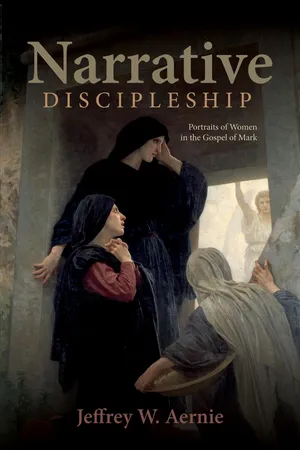
Narrative Discipleship examines the thematic and theological impact of women in the Gospel of Mark. Using narrative analysis, Aernie explores how Mark intentionally crafts the narratives of women in the Gospel to extend his portrait of discipleship. Mark portrays these women as exemplars of four key aspects of discipleship--restored life, kingdom speech, sacrificial action, and cruciformity. These portraits of discipleship provide a transformative paradigm for Mark's audience. Mark creates a portrait of narrative discipleship as a means to encourage his audience toward embodied discipleship and faithful participation in God's in-breaking kingdom.
Information
Part One—Narratives and Discipleship
1
Narrative Exegesis
Introduction
Mark’s Gospel is a story. Although we sometimes read the Gospel in fragmented ways—examining the significance of individual miracle stories or considering the intention of specific parables—the Gospel itself is a holistic and unified narrative which portrays the way in which Jesus brings about the in-breaking of God’s kingdom through his life, death, and resurrection.1 Because Mark’s Gospel is a narrative it is important that we read and interpret it as a narrative. Constructive interpretation of the Gospel requires what I want to refer to as narrative exegesis. The phrase “narrative exegesis” is intended to denote the basic idea that our interpretation of any narrative text needs to reckon with the literary nature of the text itself. Since Mark’s Gospel is a narrative, our exegesis (or interpretation) of the Gospel needs to consider its various narrative components and characteristics (e.g., characters, plot, and setting). In the same way that effectively reading a newspaper editorial or a cookbook recipe requires an awareness of its genre, reading and interpreting Mark’s Gospel requires a particular orientation to the shape and nature of its narrative. The way in which we orient ourselves toward the Gospel impacts our evaluation of its meaning and our response to its theological agenda.
My intention within this chapter is to explain how the rest of the volume will orient itself toward Mark’s Gospel. There are two components to this orientation: (1) a brief rationale for focusing on Mark’s Gospel as a narrative, and (2) an explanation of the significance of Mark’s portrayal of a specific set of characters within the Gospel—the women. These dual aims provide the basic framework for the material that follows. The first section of the chapter provides an introduction to narrative analysis of Mark’s Gospel with a particular focus on defining the interpretive framework that will be used in the exegetical chapters in part two. The second section of the chapter then provides an introduction to the specific concept of characterization—the way in which Mark intentionally develops portraits of characters to support the development of the Gospel’s theological agenda.
Narrative Criticism and the Gospel of Mark
Recognition of the need to interpret Mark’s Gospel as a unified story normally takes place in biblical scholarship within the framework of narrative criticism. Narrative criticism is a method unique to the field of biblical studies which uses insights from the discipline of literary criticism (the critical study of literary texts) to explore scriptural narratives.2 To define it in basic terms, narrative criticism is a method of interpretation that examines the literary characteristics of a narrative to determine how that narrative is intended to impact its audience. For example, we might inquire as to how the structured narrative of Mark’s Gospel encourages its audience to consider and to respond to the identity of Jesus. To this end, narrative critics are predominantly interested in two key components of a narrative—its story and discourse. In this context, the term “story” refers to the content of the narrative and the term “discourse” refers to the shape of the narrative.3 More specifically, the term “story” refers to the actual components of a narrative, such as the characters portrayed or the events described, and the term “discourse” refers to the way in which those elements are organized into a unified whole. The primary aim of narrative criticism is to understand how the intentional organization (discourse) of specific narrative elements (story) impacts the audience.4
Applied specifically to Mark’s Gospel, the intent of narrative criticism is to examine the way in which the Gospel narrative interacts with and impacts upon its audience. In determining how the narrative elements of the story are structured within the discourse of the Gospel, we hope to gain insight into Mark’s expectation for the way his audience will respond to his presentation of the narrative of Jesus’s life, death, and resurrection. In other words, we are interested in examining how Mark’s intentional organization of the plot, events, settings, and characters within the Gospel narrative impacts the audience’s response to Jesus. In the present volume our focus is on the way in which Mark portrays a specific group of characters within the narrative—the women—as a means to develop a portrait of discipleship that the audience may either accept or reject depending upon how they respond—both cognitively and affectively—to the shape of Mark’s narrative. We want to know how Mark’s narrative portrayal of the women functions as part of the aretegenic purpose of the Gospel to explain the good news about Jesus (Mark 1:1). This form of examination is built on three components: (1) engagement with the Gospel as a cohesive narrative, (2) narrative exegesis of individual narratives, and (3) analysis of the aretegenic (virtue-forming) nature of the narrative.5
The Gospel of Mark as a Cohesive Narrative
James Resseguie helpfully notes that “Narrative critics are interested in narratives as complete tapestries in which the parts fit together to form an organic whole.”6 For the most part narrative criticism is not concerned with explaining the historical process behind the creation of a text (e.g., who was Mark and what sources did he have available to him?) but rather with determining how a text behaves and communicates as a complete narrative. The focus of narrative criticism is not on the historical construction of a narrative, but on how the narrative as constructed functions as a meaningful piece of communication.7 If we approach the Gospel merely as a compilation of distinct fragments, then it is difficult to argue for any form of intentional point of view within the material. In contrast, if we approach the Gospel as an intentionally and creatively crafted piece of communication, then we are able to examine its story, discourse, and impact.8
Within biblical studies the genesis of narrative criticism came about in large measure because of an emerging dissatisfaction with several other critical methods of interpretation—such as source, form, and redaction criticism—because of their relative inability to interact with the Gospels as cohesive narratives.9 Although these methods provide insight into the historical construction and development of the Gospels, they tend not to examine the holistic nature of the Gospel narratives themselves. Source criticism, for example, provides valuable insight into the literary interdependence of the Gospels, but it does not provide an analysis of the Gospels as integrated narratives in their own right. Similarly, redaction criticism constructively identifies the writers of the Gospels as intentional authors as opposed to mere compilers, but it often creates an unhelpful distinction between original source material (“the tradition”) and edited content (“the redaction”). The use of narrative criticism within biblical studies seeks to redress these deficiencies by paying special attention to the cohesive nature of the Gospel narratives. As narrative criticism has been applied specifically to Mark’s Gospel a general consensus has emerged which views the Gospel as an integrated narrative with a clear rhetorical impact in relation to its audience.10 App...
Table of contents
- Title Page
- Acknowledgments
- Abbreviations
- Introduction
- Part One—Narratives and Discipleship
- Part Two—Narratives of Discipleship
- Conclusion
- Bibliography
Trusted by 375,005 students
Access to over 1.5 million titles for a fair monthly price.
Study more efficiently using our study tools.
Frequently asked questions
Yes, you can cancel anytime from the Subscription tab in your account settings on the Perlego website. Your subscription will stay active until the end of your current billing period. Learn how to cancel your subscription
No, books cannot be downloaded as external files, such as PDFs, for use outside of Perlego. However, you can download books within the Perlego app for offline reading on mobile or tablet. Learn how to download books offline
We are an online textbook subscription service, where you can get access to an entire online library for less than the price of a single book per month. With over 1.5 million books across 990+ topics, we’ve got you covered! Learn about our mission
Look out for the read-aloud symbol on your next book to see if you can listen to it. The read-aloud tool reads text aloud for you, highlighting the text as it is being read. You can pause it, speed it up and slow it down. Learn more about Read Aloud
Yes! You can use the Perlego app on both iOS and Android devices to read anytime, anywhere — even offline. Perfect for commutes or when you’re on the go.
Please note we cannot support devices running on iOS 13 and Android 7 or earlier. Learn more about using the app
Please note we cannot support devices running on iOS 13 and Android 7 or earlier. Learn more about using the app
Yes, you can access Narrative Discipleship by Jeffrey W. Aernie in PDF and/or ePUB format, as well as other popular books in Theology & Religion & Biblical Criticism & Interpretation. We have over 1.5 million books available in our catalogue for you to explore.