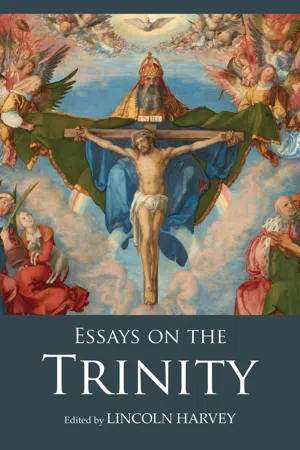
- 250 pages
- English
- ePUB (mobile friendly)
- Available on iOS & Android
eBook - ePub
Essays on the Trinity
About this book
This volume gathers together twelve essays on the doctrine of the Trinity. It includes the work of systematic theologians, analytic theologians, and biblical scholars who address a range of issues concerning the Christian doctrine of God. Contributors include Jeremy Begbie, Julie Canlis, Douglas Campbell, William Hasker, and Christoph Schwobel. The volume also includes a new essay written by the late Robert W. Jenson shortly before his death.
Information
Topic
Theology & ReligionSubtopic
Biblical StudiesChapter 1
Choose Ye This Day Whom Ye Will Serve . . .
I
At various times in the history of Christian theology, one might have stepped to the side, viewed the theological scene, and pronounced, “We are now urgently faced with an historically decisive choice, between theological proposals that do [A] and those that do [not-A].” And on very few occasions the claim would even have been true. I am about to make just such a risky move.
I urge: it is time to deliberately choose between (A) attributing decisive ontological weight to the overall narrative character of the Bible and to the plot of the story that it does seem to tell, and (not-A) holding that one or both of these cannot or should not bear such a burden. (My own conviction will not long remain secret.)
Perhaps there is general assent to the observation that the Bible on its face tells a history running from its first verses to its last, from Creation to creation’s End—to be sure, with detours, subplots, and incorporated stories; memoirs of the prophetic word by which in Israel’s understanding God drives history; and pauses for prayer and for lament or celebration of major turnings. Perhaps there is even widespread agreement that this observation is in some way theologically important. But in what way important? That is the question, I now propose, starkly before us. Let me begin with some possible not-As to my A.
II
Of course, if one is antecedently determined enough, one can use historical-critical regents to resolve the Bible’s prima facie over-all narrative into a heap of detached bits and pieces, some of which are narratives and very many of which are not. Then you have departed from that “general assent,” and can have the fun of putting the bits together in whatever fashion pleases you—or indeed leaving them in postmodern chaos. I mention this only because there are still a few such vandals out there, despite Irenaeus and the church’s general rejection of gnostic-style exegesis.
Moving on to more respectable possibilities: one can plausibly treat many of the stories incorporated in the Bible, such as Jesus’s parables, as intended to evoke a reality that is not itself narratable, that is not itself shaped by any before-and-after—as Jesus’s parables are indeed often interpreted. Then we may, once launched on such reading, come to suppose that also the over-all story that the Bible tells must point to a reality that is itself not finally narratable. After all, the Bible reveals God; and God in and for himself, it will be said—often with outrage at the very thought—surely knows no before-and-after. Our knowledge of this atemporal sort of divinity must then derive from some available and prior metaphysics; and several have been on offer, one or two claiming biblical origin or sanction.
Or we may have encountered the power of narrative in another context, perhaps as a general theory of language, and applied it to theological discourse. At least some of what used to be called “narrative theology” seems to me to have proceeded in this fashion. It may be that the general theory was itself inspired by observations about Scripture and its exegetical tradition, but that is beside the present point.
It may even be that the doctrine of the Trinity—to which I am coming on A’s behalf—is invoked and so shaped as to provide or suggest a metaphysics of divine timelessness. Father, Son, and Spirit must be somehow distinguished from one another. One not-A way in which this might be done is by distributing pieces of usual Trinitarian discourse. “The Son became incarnate” is indeed a narrative sentence, and thus can provide a parking place for any theologically weighty narratives found incorporated in the Bible. The Spirit is “breathed” by the Father with this Son. Thus, Son and Spirit, and their relation, are “of” the Father, who just so is himself prior to their doings. He is neither incarnate nor breathed; and he is the fons trinitatis, who defines what it means to be God.
There are many ways of using the mass of inherited language about the Trinity to construct a not-A doctrine. I have invented the above only as a sample.
Doubtless, the simplest way to assert not-A is just to denounce the proposal of A as by some criterion—however obtained—outside the bounds of legitimate theological development. This simplicity does, however, demand a further current choice, between two ways to read the theological tradition, to which we now turn.
III
The choice within which our A vs. not-A resides is between two ways of reading the long, intense, and richly profitable history between the gospel and pagan Greek religious reflection—effectively Aristotle and the Platonists. Von Harnack set the usual terms of discussion by describing that history as a progressive hellenization of the gospel. He regarded this as a bad thing, an alienation of the church from an original simple faith. But one can affirm the “hellenization thesis” itself and instead judge this history good. The gospel message—it is said—needs a presupposed “theism,” which Platonism and/or Aristotle can provide. This claim, I suggest, is at least implicitly made in current versions of not-A known to me.
On the other hand, those like me who affirm A read the tradition just the other way around, either explicitly or in effect: what the Fathers were, in fact, up to was the gospelizing of Hellenism. The hellenization thesis, whether used negatively or affirmatively, got it exactly backwards.
On this latter view of the history, revisionary interpretation of Greece’s religious metaphysics by the biblical gospel-narrative may be seen as a continuing task of Western theology. Thus Aquinas, to instance one—often very daring—reviser, regularly made “the philosopher” say the exact contrary of anything the historical Aristotle could have dreamed. The observation which occasions this essay is that work on this long project is under renewed dispute within Western theology. There are influential authors who vehemently deplore taking this aspect of theological history so seriously, and in fact hold to the hellenization theory in its above noted positive use.
IV
A chief locus of the history between Greece and the gospel is the teaching of God’s Trinity, comprising dogmatic decisions, unchallenged tradition, and continuing work on questions which the at any time established orthodoxy leaves open for further thought and decision. And present necessities of Trinitarian reflection are a stated theme of this volume, so Trinity is the final—in both senses—matter of this essay.
Close to the heart of classical Greece’s religious thinking was the apprehension of divinity as a predicate capable of degrees: deities could posses more or less of what makes them be deities. The second-century Christian “philosophers”—their word—whom we usually call “the Apologists,” exploited this feature to interpret the Son’s ability to mediate between God’s presumed timeless and impervious eternity and creatures’ needy temporality, conceiving this ability as constituted by the Son’s being not quite as divine as the Father. Surely a clear case of von Harnack’s hellenization! But consider what followed.
We often label this device of locating the Son’s—and then the Spirit’s—divinity down a tiny step from that of the Father “subordinationism.” Under the spell of its use by the great Origen it was for a century a standard reliance in the theologically dominant East. But Origen also called for conceptually self-disciplined biblical exegesis, and if you heed this call you will sooner or later notice that in Scripture the line between Creator and creature admits of no such blurring, of no almost-gods or almost-creatures: everything is either the one or the other. At this point one strand of Origen’s multifarious work undercut another strand. (Which often happens with the legacy of powerful thinkers.)
So—on which side of the line is the Son? The question could no longer be finessed after Arius stated the subordinationist principle altogether too bluntly: according to Arius the Son is indeed a very, very special creature, but if you insist on a straight answer, he is a creature. Compelled by Constantine’s political needs to rule on the disputes that Arius had stirred up, the bishops at Nicaea finally blurted, “Ok already! So Arius and his closer followers must be wrong about that.” Therewith they—many of them unwittingly—rejected that central feature of Greek religious wisdom on which they had been relying at a key juncture of their own thinking. It took some time and much further controversy before the church could settle down to this ruling.
Of course, Nicene thinkers could not just stop discoursing about deity with Plato and Aristotle, and in the process picking up much of their language. But now we were using—and if need be distorting—this language for our own purposes, step by step working toward speech about deity shaped to biblical commitments.
So that is one side of the matter. The other is a need for some ventures in Trinitarian thought itself. I will take up just one, that has recently been a center of controversy.
V
As we have noted, one dominant form of current not-A polemics posits the necessity of a “theism” not shaped by Christology and presupposed by Christology. This teaching has an inner-Trinitarian correlate, the posit of a Logos asarkos, an existence of the Logos “before” it is incarnate as Jesus of Nazareth.
To assert A we must challenge this language—among more obvious reasons, reliably to negate the heresy that “there was when the Son was not.” I have been working on that project, and hope to have contributed a few bits. The following may perhaps add another.
For who exactly is this Son? Surely not an entity fully characterized only by not being incarnate, for such a negative entity could have no soteriological role and the concept “asarkos” could then have no place in theology. The notion thus undoes itself in use; or if it does not must evoke a vacancy “before” the birth of the Son, and so indeed dream a sort of “time” when the Son was not.
And indeed Christian discourse about the Logos has never gotten well along without somehow identifying the preexisting Logos soteriologically. To instance a surely orthodox author, Athanasius in the first volume of his work on the incarnation exhibits a language-habit that is often remarked—and regularly quietly dismissed. But there the passages sit on the page: precisely the preexistent Logos is identified as “our Lord and Savior Jesus Christ.” Nothing compels us to take this as thoughtless or enthusiastic. We are free to note its possible kinship to certain other—to be sure, startling—phenomena, in which in various ways the Trinity’s constitutive inner discourse seems to intersect with ours. Despite our initial recoil, the phenomena are many and unavoidable.
Prominent among such is prayer of petition, which must either be absurd, or be nothing less than our permitted mixing into the triune deliberation we call providence. As the Father and the Son deliberate in the Spirit, we as members of the “whole Christ” are invited to contribute our opinions. Then there are the places in John’s gospel where the mutual verbal glorification of the Father and the Son opens to the disciples, to encompass their glorification and indeed that of those whom their addresses will bring into the same fellowship. Or what is going on in the Psalter’s “hymns,” where the assembly praises God not by saying “You are great, O God,” but by exhorting unidentified others to do so? “Praise God from whom all blessings flow.” Why this twist? Or what makes an absolution spoken by one of us reliable? Or. . .
Our present concern is pla...
Table of contents
- Title Page
- Contributors
- Preface
- Essays on the Trinity
- Chapter 1: Choose Ye This Day Whom Ye Will Serve . . .
- Chapter 2: “A Semblance More Lucid”?
- Chapter 3: Paul the Trinitarian
- Chapter 4: That We May Know Him . . .
- Chapter 5: The One Divine Nature
- Chapter 6: On Whether or How Far We Can Know God
- Chapter 7: “From His Fullness We Have All Received”
- Chapter 8: Restlessly Thinking Relation
- Chapter 9: Trinitarian Science?
- Chapter 10: Trinitarian Prayer
- Chapter 11: The Trinity in Paul
- Chapter 12: Bridging the Gap between Piety and the Theology of the Schools
Trusted by 375,005 students
Access to over 1.5 million titles for a fair monthly price.
Study more efficiently using our study tools.
Frequently asked questions
Yes, you can cancel anytime from the Subscription tab in your account settings on the Perlego website. Your subscription will stay active until the end of your current billing period. Learn how to cancel your subscription
No, books cannot be downloaded as external files, such as PDFs, for use outside of Perlego. However, you can download books within the Perlego app for offline reading on mobile or tablet. Learn how to download books offline
Perlego offers two plans: Essential and Complete
- Essential is ideal for learners and professionals who enjoy exploring a wide range of subjects. Access the Essential Library with 800,000+ trusted titles and best-sellers across business, personal growth, and the humanities. Includes unlimited reading time and Standard Read Aloud voice.
- Complete: Perfect for advanced learners and researchers needing full, unrestricted access. Unlock 1.5M+ books across hundreds of subjects, including academic and specialized titles. The Complete Plan also includes advanced features like Premium Read Aloud and Research Assistant.
We are an online textbook subscription service, where you can get access to an entire online library for less than the price of a single book per month. With over 1.5 million books across 990+ topics, we’ve got you covered! Learn about our mission
Look out for the read-aloud symbol on your next book to see if you can listen to it. The read-aloud tool reads text aloud for you, highlighting the text as it is being read. You can pause it, speed it up and slow it down. Learn more about Read Aloud
Yes! You can use the Perlego app on both iOS and Android devices to read anytime, anywhere — even offline. Perfect for commutes or when you’re on the go.
Please note we cannot support devices running on iOS 13 and Android 7 or earlier. Learn more about using the app
Please note we cannot support devices running on iOS 13 and Android 7 or earlier. Learn more about using the app
Yes, you can access Essays on the Trinity by Lincoln Harvey, Harvey in PDF and/or ePUB format, as well as other popular books in Theology & Religion & Biblical Studies. We have over 1.5 million books available in our catalogue for you to explore.