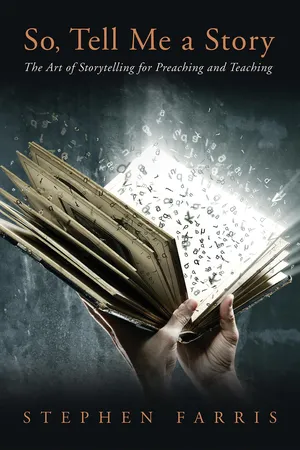
Everyone loves a good story, and So Tell Me a Story offers wise counsel to preachers and teachers who want to improve their storytelling skills. Farris, an experienced and skilled speaker, provides instruction, encouragement, and advice on how to avoid pitfalls that face storytellers. The book moves beyond the realm of the how-to manual, however, with an extensive collection of stories and reflections on Christian life that will spiritually enrich both speakers and other readers.
- 194 pages
- English
- ePUB (mobile friendly)
- Available on iOS & Android
eBook - ePub
About this book
Information
Topic
Theology & ReligionSubtopic
Christian Ministry1
What Stories Do
What Is a Story?
Perhaps a short working definition of story would be helpful.1 A story is the intersection of plot and character. In this definition, I am following literary critic of the Gospels Stephen D. Moore: “Being preoccupied with story means, most of all, being preoccupied with plot and character . . . Plot and character are inseparably bound up in the reading experience . . . Each works to produce the other. Characters are defined in and through the plot, by what they do and what they say. The plot in turn comes into view as characters act and interact. Characters are further defined by what the narrator and fellow characters say about them.2”
Stories may be contrasted with what may be called observations, for want of a better term. The dividing line between a story and an observation is fuzzy but recognizable. This is clearly an observation:
It always seems to me that it is harder to forgive others for being right than being wrong.
This is an observation that seems widely true, but no particular examples of the difficulty are supplied by the speaker in this case. Observations can be very valuable, particularly if they are more concrete than this one, appealing also to the senses. There is a whole book of such observations in the Bible, namely, the book of Proverbs. An observation begins to resemble a story when something happens and the speaker begins to describe a specific instance of what he or she has seen generally.
Have you ever watched spiders weave their webs in some difficult corner? They often fail, but they keep on trying.
One might even add the familiar phrase “If at first you don’t succeed, try, try again.” That is very close to a rudimentary story. But there can be no mistake about what this is:
The Spider
Long, long ago, hundreds of years ago, there lived a man in Scotland named Robert the Bruce. Robert the Bruce laid claim to the throne of Scotland as its king. In his time, however, the King of England sent a great army to invade Scotland and to seize it for his own. Robert the Bruce gathered a ragtag army of brave Scots to fight the English, but they were defeated. Six times, he gathered his men, and six times they were defeated by the English.
The last battle was so terrible a defeat that Robert the Bruce and his remaining men had to scatter and hide in the wilderness. Robert the Bruce himself took refuge in a cave. Tired, sad, defeated, and alone he sat by a meager fire. By the light of the fire, he saw a spider begin to weave her web by hanging a strand from the ceiling of the cave. It failed. But the spider tried again . . . and failed. Six times the spider tried and failed. “Something else knows what it is to fail six times,” thought Robert the Bruce. But the spider tried again, a seventh time. This time the strand held. And soon a magnificent web spread through the corner of the cave.
Robert the Bruce took heart, gathered his men yet again, and this time he succeeded. The Scots won a great victory. The English left their land, the Scots were free, and Robert the Bruce was their king.
If at first you don’t succeed, try, try again.
If you doubt the story, the Scots will show you the cave; in fact, they will show you several caves where the spider weaved her web! Actually the story was first told, so far as we know, five centuries after the life of Robert the Bruce, by the Scottish novelist Sir Walter Scott, and it is more moral instruction than history. That does not matter for the purposes of this book, however. The observation has become a story, an often told story, familiar especially to those of Scottish descent. The distinction between that observation and the story lies in this matter of plot and character. Stories, in order to be stories rather than observations, must have at least one character who engages in action or reflection, and something must happen in or to that person; or to say the same thing in short form, stories must have plot and character. Observations, which may lack one or other or both characteristics, are also useful in preaching and teaching, but that would take us into a different book. Or as storytellers sometimes say, “But that would be another story.” This book is about stories.
Given the length of the stories that appear in preaching and teaching, we are not talking War and Peace when it comes to complication of plot or cast of characters. One may think of Jesus’s parables here: not all the parables are stories. Some may be more rightly described as extended metaphors.3 But if we think of the most familiar and best-loved parables, for example, the so-called Prodigal Son or the Good Samaritan, we do see an intersection of plot and character. Something happens in or to the characters. The characters are few and the plot is simple, but both are there. These are stories rather than observations or extended metaphors. But even the lengthier parables are relatively short. So it will often be with the stories we tell in preaching and teaching.
By the way, something I have put in these introductory materials that stories usually don’t have: footnotes. One time, after listening to an overdeveloped and too-carefully qualified student sermon of mine, my father gently told me, “Son, you can’t footnote a sermon.” True, and you probably should not footnote a story either.
What Stories Do
The great Christian theologian and proponent of rhetoric Augustine of Hippo wrote the first textbook on scriptural Interpretation and preaching, De Doctrina Christiana, or in English, On Christian Doctrine. There he wrote, “Accordingly, a great orator has truly said that an eloquent man must speak so as to teach, delight, and persuade.”4 The “great orator” was Roman lawyer and philosopher Cicero, famed for his eloquence. Augustine is not quite accurately quoting Cicero. But the slight misquotation is actually more useful for our purposes than the original. Let me imitate Augustine and also quote my source not quite accurately: I’ll change the order of the elements slightly to say that just as in rhetoric, so in storytelling for preaching and teaching, three essential aims are to delight, to teach, and to persuade.
I will be using some of the categories of classical rhetoric, not because I am an expert on the subject, but because I think they are simple and understandable, yet profound. They can help us understand what we are doing when we are telling stories.5 But to return to the stories themselves, often stories carry out more than one of these functions; it’s not always easy to assign a single function—to delight, to teach, or to persuade—to a given story. Here is a story that fulfills the first function, however:
Stories Delight
The Luckiest Man in Canada
A number of years ago, when veterans of World War II were still both numerous and vigorous, I knew a man named Ed, himself a veteran. One day in the coffee hour after church, he said to me, “Stephen, I think I’m the luckiest man in Canada.”
“Oh, why is that, Ed?” I asked. In response, he told me, that he had joined the Canadian Army during World War II and was posted to England. While there, he developed a severe and incurable bacterial abscess on the spine. He was told that the abscess would inevitably grow until it snapped his spine and killed him. Tragically, nothing could be done about it. The army then invalided him back to his home in Winnipeg, Manitoba, to await the eventual outcome in a military hospital.
Ed said he didn’t feel particularly ill at that point. He even managed to take a couple of courses in engineering, which would later become his life work. But he knew what was coming. Then one day he was called into the office of the medical doctor in charge of the hospital. The doctor said, “They’ve sent a new medicine over from England. There are only three samples in the country, one in Montreal, another in Vancouver, and one here. We don’t know what it will do. I thought we might test it on you since, frankly, it can’t possibly do any harm to a man who’s going to die anyways. Would you be willing to give it a try for us?”
Ed thought for a minute, realized he had nothing to lose, and agreed.
The doctor said, “It has to be injected into the buttocks. Pull down your trousers and bend over.” Ed complied. It was an order, after all!
A beautiful blonde nurse came into the office with a needle that in Ed’s memory was approximately the size of a horse syringe and injected the experimental medicine. You’ve probably guessed what it was by now. After all, Ed was still around to tell me the story. It was one of the very first batches of penicillin ever used in North America. In those early days it worked like magic on bacteria that had not yet grown drug resistant, and Ed was totally cured. “That’s amazing!” I said. “You really are the luckiest man in Canada!”
Ed nodded and added, “That’s not all . . . I married the nurse!”
And he looked across the room to his wife, still beautiful after fifty years.
Then he repeated, “I am the luckiest man in Canada.”
I’ve never figured out how to work that story into a sermon or class, other than as an example of a story that delights. Perhaps it could be used in a sermon or lesson on the concepts of luck and blessing. Like most people in the church, however, I have never quite worked out the relationship between those two. It’s enough to say that Ed was blessed in several ways. But it doesn’t matter that I have never worked out an edifying use for the story. Stories are worth telling for their own sake even if they make no edifying point. It is often sufficient that they delight. Never underestimate the value of delight. It is first, not necessarily in importance, but because the delight we experience in hearing a good story will often open the way for teaching or for persuasion. Even if that does not happen, however, delight is in itself a good thing. It is, after all, a faint but genuine echo of the delight that God takes in a good creation.
In our society, the category delight might almost be replaced by the word amuse. It is possible that the kind of story most frequently told in Western society is the joke. This may be true, but it would be a sad limitation of the richness of the category to narrow delight to amusement, or to consider the main function of a story to be the provoking of laughter. It is true that listeners to the “Luckiest Man in Canada” story usually do laugh heartily at the line “I married the nurse.” I am convinced, however, that this story is something more than a joke. For one thing, in jokes we often laugh at someone or something, and the ultimate basis of the joke is often pain, even if the pain is as trivial as treading on a slippery banana peel. Here we laugh with Ed at the way the sheer goodness of life sometimes breaks in even in the midst of the most peculiar and even painful circumstances. If we attribute that in-breaking of the goodness of life to God, perhaps we have made a theological statement after all.
Stories Teach
The Casserole
Luke 10:38–42
Stories also teach in a variety of ways. This is one of the...
Table of contents
- Title Page
- Acknowledgments
- Introdsuction
- Chapter 1: What Stories Do
- Chapter 2: The Five Skills of the Storyteller
- Chapter 3: More on the Art of Storytelling
- Chapter 4: Is That Story True? Ethics and Storytelling
- Chapter 5: Through the Year in the Church
- Chapter 6: The Inn: A Story for the Times between Christmas and Easter
- Chapter 7: Church Life Stories
- Chapter 8: Stories of Grace
- Chapter 9: The Sacraments
- Chapter 10: Bicycle Stories
- Chapter 11: Telling Stories Outside the Church
- Chapter 12: Just Memories
- Conclusion
- Bibliography
Trusted by 375,005 students
Access to over 1.5 million titles for a fair monthly price.
Study more efficiently using our study tools.
Frequently asked questions
Yes, you can cancel anytime from the Subscription tab in your account settings on the Perlego website. Your subscription will stay active until the end of your current billing period. Learn how to cancel your subscription
No, books cannot be downloaded as external files, such as PDFs, for use outside of Perlego. However, you can download books within the Perlego app for offline reading on mobile or tablet. Learn how to download books offline
Perlego offers two plans: Essential and Complete
- Essential is ideal for learners and professionals who enjoy exploring a wide range of subjects. Access the Essential Library with 800,000+ trusted titles and best-sellers across business, personal growth, and the humanities. Includes unlimited reading time and Standard Read Aloud voice.
- Complete: Perfect for advanced learners and researchers needing full, unrestricted access. Unlock 1.5M+ books across hundreds of subjects, including academic and specialized titles. The Complete Plan also includes advanced features like Premium Read Aloud and Research Assistant.
We are an online textbook subscription service, where you can get access to an entire online library for less than the price of a single book per month. With over 1.5 million books across 990+ topics, we’ve got you covered! Learn about our mission
Look out for the read-aloud symbol on your next book to see if you can listen to it. The read-aloud tool reads text aloud for you, highlighting the text as it is being read. You can pause it, speed it up and slow it down. Learn more about Read Aloud
Yes! You can use the Perlego app on both iOS and Android devices to read anytime, anywhere — even offline. Perfect for commutes or when you’re on the go.
Please note we cannot support devices running on iOS 13 and Android 7 or earlier. Learn more about using the app
Please note we cannot support devices running on iOS 13 and Android 7 or earlier. Learn more about using the app
Yes, you can access So, Tell Me a Story by Stephen Farris in PDF and/or ePUB format, as well as other popular books in Theology & Religion & Christian Ministry. We have over 1.5 million books available in our catalogue for you to explore.