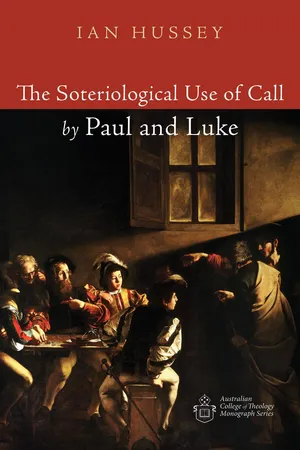
- 138 pages
- English
- ePUB (mobile friendly)
- Available on iOS & Android
eBook - ePub
The Soteriological Use of Call by Paul and Luke
About this book
The congruence of the theology of Paul and Luke is a matter of debate. In particular, according to many scholars, the soteriologies of Paul and Luke are divergent. This volume argues that the usage of ????? language by both Paul and Luke suggests that it may be a common element in their soteriologies. The author demonstrates that ????? language is an important concept in the soteriologies of Luke and Paul and that although there are contrasts, there are a number of points of comparison. Crucial to this common understanding is the association of ????? language with the OT covenants, election, covenant meals, and an expectation of the eschatological banquet. As a result of this prominent and consistent usage by Paul and Luke, the language of ????? deserves a higher place in the Christian understanding of salvation. This has implications for Christian life and practice.
Information
Topic
Theology & ReligionSubtopic
Biblical Studies1
Introduction
1.1 Called or Invited?
When I was studying the New Testament with respect to the process of conversion in the early church, I was struck by the occurrence of καλέω (“call”) and its cognates in both the parable of the Great Banquet and Paul’s description of the details of conversion in Romans 8. In Luke 14:15–24 the rich man/king “invited” (ἐκάλεσεν) the guests to the great banquet. In Romans 8:28–30 Paul wrote:
And we know that for those who love God all things work together for good, for those who are called (κλητοῖς) according to his purpose. For those whom he foreknew he also predestined to be conformed to the image of his Son, in order that he might be the firstborn among many brothers. And those whom he predestined he also called (ἐκάλεσεν), and those whom he called (ἐκάλεσεν); he also justified, and those whom he justified he also glorified.1
The different translation of καλέω and its cognates as “invite” and “call” in these salvation contexts piqued my interest and opened the broader vista of the issues related to the soteriologies of Luke and Paul, the major contributors to the New Testament.
The congruence of the theologies of Paul and Luke has been a matter of debate. In particular, according to many scholars, the soteriologies of Paul and Luke are divergent. The usage of καλέω language by both Paul and Luke suggested that it may be a common element in their soteriologies. Yet it does not emerge as one of the key soteriological terms in New Testament scholarship.
The topic of this book is, then, “What role does the call (καλέω) of God play in the soteriologies of Paul and Luke?” The book will examine the soteriological use of καλέω and its cognates in the Pauline corpus and Luke–Acts and will draw conclusions and implications from its use.
1.2 The History of Scholarship on This Topic
The question of the comparative use of καλέω in the soteriologies of Paul and Luke fits within the broader scholarship regarding the relationship between Jesus and Paul and their respective theologies. So, in reviewing the contours of the scholarship on this topic, we will move from the broader issues of Jesus and Paul, through the narrower issues related to Luke and Paul, down to the issue of their soteriologies, and then to the use and meaning of the word καλέω itself.
1.2.1 Jesus and Paul
Though Paul may have seen Jesus during his earthly ministry, there is no indication of this in his letters.2 However, according to Acts, Paul encountered Jesus and came in contact with his followers after the crucifixion. On this basis, there has been a traditional assumption that Paul was exposed to the teaching of Jesus through his disciples and that his theology was founded upon those teachings. This assumption is supported by passages such as 1 Corinthians 11:23 where Paul says he passed on what he “received from the Lord.”
However, in 1907, Wrede named Paul “the second founder of Christianity.”3 Since then many scholars have argued that the Christianity of Paul is distinct from that of Jesus of Nazareth.4 Key to this is what Wenham calls the “embarrassing” failure of Paul to make reference to the life or teaching of Jesus.5 Paul frequently refers to the death and resurrection of Jesus, but says little about his birth, baptism, miracles, parables, or transfiguration.
There is also divergence between the message of Jesus, as presented in the Gospels, and the teaching of Paul. While Jesus focuses more on the kingdom of God, Paul focuses more on the death and resurrection of Christ, and justification by faith. Paul is also distinct from Jesus in his interest in the Holy Spirit and the Gentile mission, his negative attitude towards the OT Law, and his teachings on the church as the “body” of Christ.
A subset of this issue is the apparent divergence between the theologies of Luke and Paul, the two major contributors to the New Testament.
1.2.2 Luke and Paul
Luke and Paul have traditionally been associated with one another. The early church’s ascription of the authorship of the Third Gospel and Acts to Luke and the use of “we” passages in Acts (for example, Acts 16:11) has been taken to indicate that Luke was a companion of Paul on his travels. However, some of the objections to Lukan authorship of Luke–Acts have been based on the theological differences between Acts and the Pauline Epistles.6 For example, some point to the way that Paul advocates the circumcision ...
Table of contents
- Title Page
- Acknowledgements
- Abbreviations
- Chapter 1: Introduction
- Chapter 2: Old Testament Background
- Chapter 3: The Soteriologies of Paul and Luke
- Chapter 4: Paul’s Soteriological Use of Call
- Chapter 5: Luke’s Soteriological Use of Call
- Chapter 6: Conclusions
- Bibliography
Trusted by 375,005 students
Access to over 1.5 million titles for a fair monthly price.
Study more efficiently using our study tools.
Frequently asked questions
Yes, you can cancel anytime from the Subscription tab in your account settings on the Perlego website. Your subscription will stay active until the end of your current billing period. Learn how to cancel your subscription
No, books cannot be downloaded as external files, such as PDFs, for use outside of Perlego. However, you can download books within the Perlego app for offline reading on mobile or tablet. Learn how to download books offline
Perlego offers two plans: Essential and Complete
- Essential is ideal for learners and professionals who enjoy exploring a wide range of subjects. Access the Essential Library with 800,000+ trusted titles and best-sellers across business, personal growth, and the humanities. Includes unlimited reading time and Standard Read Aloud voice.
- Complete: Perfect for advanced learners and researchers needing full, unrestricted access. Unlock 1.5M+ books across hundreds of subjects, including academic and specialized titles. The Complete Plan also includes advanced features like Premium Read Aloud and Research Assistant.
We are an online textbook subscription service, where you can get access to an entire online library for less than the price of a single book per month. With over 1.5 million books across 990+ topics, we’ve got you covered! Learn about our mission
Look out for the read-aloud symbol on your next book to see if you can listen to it. The read-aloud tool reads text aloud for you, highlighting the text as it is being read. You can pause it, speed it up and slow it down. Learn more about Read Aloud
Yes! You can use the Perlego app on both iOS and Android devices to read anytime, anywhere — even offline. Perfect for commutes or when you’re on the go.
Please note we cannot support devices running on iOS 13 and Android 7 or earlier. Learn more about using the app
Please note we cannot support devices running on iOS 13 and Android 7 or earlier. Learn more about using the app
Yes, you can access The Soteriological Use of Call by Paul and Luke by Ian Hussey in PDF and/or ePUB format, as well as other popular books in Theology & Religion & Biblical Studies. We have over 1.5 million books available in our catalogue for you to explore.