Given that Pope Francis is a popular global religious leader, and in the light of the lessons drawn from the nature, meaning, and functions of Israel’s prophets, this tripartite work historically, pastorally, and theologically examines whether, and how Francis’ teaching, visits, outreach to the poor, preaching, and recent biblically based writings (Lumen Fidei, Evangelii Gaudium, Amoris Laetitia, Laudato Si', Gaudete et Exsultate, Letters, and Messages) have had any prophetic effects or impact on contemporary society.
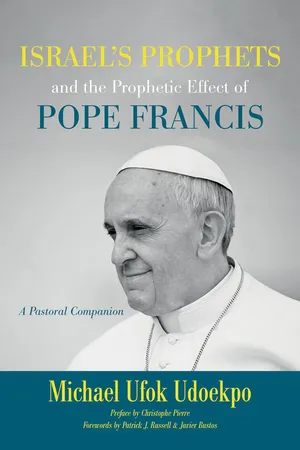
eBook - ePub
Israel's Prophets and the Prophetic Effect of Pope Francis
A Pastoral Companion
- 214 pages
- English
- ePUB (mobile friendly)
- Available on iOS & Android
eBook - ePub
About this book
Information
Topic
Theology & ReligionSubtopic
Biblical StudiesPart I
Israel’s Prophets in Light of Pope Francis
Israel’s Prophets: Meaning, Function, and Nature
Defining Israel’s prophets, their function, and their nature in light of Pope Francis requires two things. First, we must appreciate the fact that the Israelites lived within the larger context of the ancient Near East; their neighboring countries had a sense of the phenomenon of prophecy that was parallel to the Israelites’. These neighbors include the Assyrians, Egyptians, Babylonians, and Mesopotamians. Israel shared with these countries some basic practices and beliefs about “gods and heavenly rule, kings and earthly rule, as well as priests and temple.”1 Affirming this point, Gerhard von Rad writes:
We may take it for granted that men possessed by the spirit only appeared in Israel after the conquest of Canaan. In the eleventh-century Syria and Palestine there are signs of the rise of an ecstatic and mantic movement whose origins are apparently outside that area and perhaps lie in the mantic of Thrace and Asia Minor. Canaanite religion must, then, have been the medium by which the movement came to Israel.2
Vawter agrees with von Rad that, from the beginning, a common pattern of seers and diviners existed throughout the ancient Near East.3 These seers and diviners were employed in discerning the will of their protective deity.4 Huffmon also ascertains belief in the existence of such deities. He points out that, during the Old Testament period, seers and diviners who acted as prophets and intermediaries were common in royal palaces throughout the ancient Near East (Syria-Palestine, Anatolia, Mesopotamia, and Egypt). He argues that evidence abounds in stories told in Egypt and in the eighteen-century BC texts from Uruk (Southern Babylonia) and Mari (Middle Euphrates), and particularly in the Assyrian texts from the reigns of Esarhaddon (680–669 BC) and Ashurbanipal (668–627 BC).5
In studying these texts, we discover a variety of titles worn by those persons who sought to mediate the will of the gods to their kings and communities. These titles include: Āpilu/ᾱpiltu (“answerer”), Assinnu (“cult functionary”), Muḫḫȗtu (“ecstatic”), Nabȗ//nᾱbȋ (“diviners”), and Qam(m)ᾱtum (probably meaning “speaker”).6 Evidence in Babylonian temples points to the existence of bᾱrū priests, who delivered a tērtu (“a message”; probably a cognate to Hebrew Torah) to their client using liver divination. There was no distinction between prophets and priests in the ancient Near East—except in Israel. (It is worth noting that priesthood in Israel was hierarchical and hereditary, while prophecy was charismatic. Prophets like Jeremiah and Ezekiel probably were also priests, though the prophet Amos was not.7)
However, the recognition of this common pattern in the ancient Near East, especially as presented in the Mari Texts, does not detract from the uniqueness of true prophecy in the Old Testament. Rather, as noted by Leclerc, both the form and content of prophecy in the ancient Near East and in royal courts was very different from what we have in biblical Israel.
The Mari archive contains letters sent by an official who may have been instructed by the prophet to write to a king. The prophecies in these letters differ from those in the Bible in several ways. For instance, unlike biblical prophecies, the Mari letters were contaminated with other businesses and administrative issues. Additionally, the Old Testament prophecies were directly delivered to the addressee. Furthermore, while the Mari letters are privately limited to the kings, Israel’s prophecies had a broader audience (kings, the elite, priests, the poor, the rich, and all nations and kingdoms). The contents of the Mari texts concern mostly politics, the cult, and the military. In contrast, the major concerns of authentic Old Testament prophecies, even when read in light of the New Testament, are ethics, spirituality, society, and the common good.8
Besides the shared concept of prophecy between Israel and their ancient Near Eastern neighbors, when dealing with the meaning, nature, and function of Israel’s prophets and how these prophets have served as treasures to Francis’s prophetic effect, we must also consider that the words, semantics, and language used in defining prophets and prophecy could be misleading unless measured in proper perspective and used in the right context. To this second point of proper contextualization, the English words “prophets” or “prophetess” semantically and linguistically come to us from the Greek word prophētēs, which literally means “the one who speaks for another, especially for a deity.”9 In Hebrew we have the corresponding term nᾱbȋ’ in singular and nəbȋ’ȋm in plural, which is very close to the Akkadian verb nabȗ, meaning “to call, to an...
Table of contents
- Title Page
- Foreword I
- Foreword II
- Introduction
- Part I: Israel’s Prophets: Meaning, Function, and Nature
- Part II: The Life, Writings, and Ministry of Pope Francis & His Prophetic Effect
- Part III: Prophetic Effect of Francis and Challenges to Contemporary Society
- Summary and Conclusion
- Bibliography
Trusted by 375,005 students
Access to over 1.5 million titles for a fair monthly price.
Study more efficiently using our study tools.
Frequently asked questions
Yes, you can cancel anytime from the Subscription tab in your account settings on the Perlego website. Your subscription will stay active until the end of your current billing period. Learn how to cancel your subscription
No, books cannot be downloaded as external files, such as PDFs, for use outside of Perlego. However, you can download books within the Perlego app for offline reading on mobile or tablet. Learn how to download books offline
Perlego offers two plans: Essential and Complete
- Essential is ideal for learners and professionals who enjoy exploring a wide range of subjects. Access the Essential Library with 800,000+ trusted titles and best-sellers across business, personal growth, and the humanities. Includes unlimited reading time and Standard Read Aloud voice.
- Complete: Perfect for advanced learners and researchers needing full, unrestricted access. Unlock 1.5M+ books across hundreds of subjects, including academic and specialized titles. The Complete Plan also includes advanced features like Premium Read Aloud and Research Assistant.
We are an online textbook subscription service, where you can get access to an entire online library for less than the price of a single book per month. With over 1.5 million books across 990+ topics, we’ve got you covered! Learn about our mission
Look out for the read-aloud symbol on your next book to see if you can listen to it. The read-aloud tool reads text aloud for you, highlighting the text as it is being read. You can pause it, speed it up and slow it down. Learn more about Read Aloud
Yes! You can use the Perlego app on both iOS and Android devices to read anytime, anywhere — even offline. Perfect for commutes or when you’re on the go.
Please note we cannot support devices running on iOS 13 and Android 7 or earlier. Learn more about using the app
Please note we cannot support devices running on iOS 13 and Android 7 or earlier. Learn more about using the app
Yes, you can access Israel's Prophets and the Prophetic Effect of Pope Francis by Michael Ufok Udoekpo in PDF and/or ePUB format, as well as other popular books in Theology & Religion & Biblical Studies. We have over 1.5 million books available in our catalogue for you to explore.