eBook - ePub
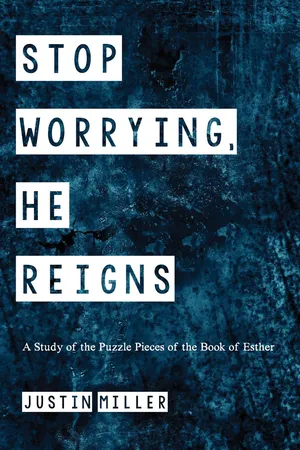
Stop Worrying, He Reigns
A Study of the Puzzle Pieces of the Book of Esther
- 96 pages
- English
- ePUB (mobile friendly)
- Available on iOS & Android
eBook - ePub
About this book
Stop worrying. That is easier said than done. One of the greatest struggles in many of our lives is anxiety, dread, fear, and the feeling of hopelessness. In Stop Worrying, He Reigns, we take a journey through the book of Esther to discover the timeless truths regarding the sovereignty of God and its practical application for our anxious hearts and heavy souls. We are compelled by a storyline where God's name is never mentioned, yet he is the main character directing every piece of the story. In these truths, we find comfort, hope, and rest, the strength to be bold even in dire times. We learn to stop worrying, for he reigns.
Information
1
The Mess of Puzzle Pieces (Esther 1–2)
The sky is falling! The sky is falling! One of my children’s favorite movies is “Chicken Little.” They love how it opens with this little teenage chicken ringing the warning bell of the town he loves and lives in while at the same time, with great angst and urgency, proclaiming to all who hear him that “The sky is falling!” Ironically enough, many in the evangelical church are ringing that same warning bell, while yelling to all who will listen, “the sky is falling, the sky is falling!” They seem to believe that the recent moral trends and political movements in our country spell almost certain doom for the church. However, is the sky really falling for the evangelical church? Should we be anxious and fearful about the future of our Western world and its relationship to Biblical Christianity? A young man into whom I spent a lot of time investing the Word would always tell me that Christianity would perish in the Western world if it did not embrace certain secular or scientific beliefs. He spoke of Christianity’s need to acknowledge macroevolution, homosexuality, etc., or it would become irrelevant. Is he right? Will Christianity become irrelevant? Is the anxious “sky is falling” talk warranted? Should immense anxiety be allowed to consume anyone claiming the name of Jesus? I do not believe so. Quite the opposite, as we will discover from our study of the book of Esther. The story of the book of Esther takes place in a time in the Jewish people’s history where it seemed that they were going to face an end to their beliefs and their way of life, and ultimately to their worship of the One True God. However, the pieces of the puzzle scattered on the board of history in Esther 1–2 ultimately brought God much glory as he showed his power over kings, kingdoms, and all people. Esther is a book that has God as the main character, though he is never mentioned. It is the book whose message practically demands us to stop worrying, he reigns.
The Mess of Puzzle Pieces
As a kid, I loved putting puzzles together, and now my oldest daughter has also taken an interest in puzzles. When she first gets the puzzle out and pours the pieces on the floor, it looks like a giant mess. Puzzle pieces are everywhere, and at first glance they have no coherent sense about them. It is amazing to watch my daughter work the puzzle and put the pieces together. She is very methodical and strategic. She will always start with the corner pieces and match up other pieces, using the box as a guide. As I watch her organize the pieces with the picture on the box, it reminds me that this is what God is doing in the world, and it is what he did in the book of Esther. God has decreed what will transpire, and he sovereignly puts the pieces of people’s actions, both sinful and not, in their places to accomplish his before-time purpose to present a picture that displays his glory to the world.
Many times, in our own lives, we may have asked the following questions of God: “Why are you doing this? Why has this happened? Why is this going on?” You look at the choices of people in positions of influence and power. You observe the choices of people in various parts of our culture. We look at the scattered puzzle pieces of human actions in our society today and think, what in the world is going on? How can God be in control? Everything is just one big mess of puzzle pieces. Just think about it. Would you say things are in order today in our country? A trillion dollars in debt, morality is increasingly being redefined. Sexual immorality is celebrated. Millions of babies have been murdered in their mother’s womb. In the first two chapters of the book of Esther, a mess of puzzle pieces (sinful actions wrought by sinful men and women) are cast out on the table of life with seemingly no coherent reason to it. However, as Esther progresses, the pieces come together to form a beautiful picture of God’s glory in his people’s redemption. We will see the pieces being put together as we move through this book.
The Book of Esther
The book of Esther helps us to understand God’s ways and workings with a fallen world filled with fallen people. Remember, this is a book which does not mention the name of God once. To say that this is strange is an understatement. For any book written in this time period to not mention things such as sacrifices, prayers, rituals, or God’s name is just abnormal.1 By not mentioning God’s name, the author is making the point that God is everywhere in the background of this book.2 The main character of the book of Esther is not Mordecai, Esther, Haman, or Xerxes. Actually, the main character is God, and the book teaches us about God’s hidden providence. We learn about God’s hidden hand guiding and moving circumstances of life. God works in the choices the people in this book make to accomplish his determined purposes. God sees the end picture, whereas we may be blessed to see some of the pieces put together. God knows how everything is going to turn out and directs the choices of people to his intended end. God is in control of it. He even decrees it. He sees the beautiful picture of history and how it points people to his glory. He alone has that view. He alone is outside of time, and yet dwells in time at the same time. We do not have that luxury. Books like Esther help us to understand that God reigns over human affairs for his glory, which should propel us toward faithfulness wherever in history we find ourselves.
It is also striking that, in this book, God uses two not-so-perfect Jews. Have you ever heard that Esther was a heroine? This is not completely true. She has been disobedient to God’s commands. She ate food she was not supposed to eat. She did not seem to have any desire to go to the homeland, as per the instructions of God. She is not portrayed like Daniel. Mordecai, her uncle and father figure, is a liar. He hides his identity. They are not picture-perfect examples of what it means to be “godly.” They are not the heroes of the story. God is. Ironically enough, you and I are not the heroes of our own story either. Jesus is. In the book of Esther, you have these two imperfect Jews who are not faithfully adhering to God’s commands as they live in the Persian kingdom. There is also this man named Haman, who is a leader in the Persian government. Haman rises up against the Jews to eradicate the Jews because he hates them. He is an Amalekite, and the Amalekites were ancient enemies of the Jews (1 Sam 15; Exod 17:14). God uses Esther and Mordecai to save the Jewish people, and even to eradicate the Jews’ enemies. It is a beautiful picture of how God works in the everyday circumstances of life to achieve his redemptive purposes.
The Puzzle Pieces of Esther 1
The book of Esther begins in verses 1–2: “Now it took place in the days of Ahasuerus, the Ahasuerus who reigned from India to Ethiopia over 127 provinces, in those days as King Ahasuerus sat on his royal throne which was at the citadel in Susa.”3 Most translations of Scripture identify the king of this story as Ahasuerus, which is the Hebrew transliteration of his name.4 The Greek transliteration of his name is Xerxes.5 Xerxes ruled from 486–465 BC, and was the son of Darius and grandson of Cyrus the Great.6 He is famous for his invasion of Greece, as depicted by Herodotus, who wrote the The Persian Wars in 445 BC.7 Perhaps you have heard the story of the three hundred Spartans who fought against the Persians and stood them off?
Xerxes is a prideful, haughty, wicked man. He is irrational, sensual, immoral, and cruel. His rule, as seen in verses 1–2, covers a vast part of the known world. At that time, this would have been the largest empire to date.
In verse 3, during the third year of his reign, Xerxes gave a banquet for all his nobles and officials. He invited all the military officers of Persia and Medea, as well as the princes and nobles of the provinces. Verse 4 tells us this feast lasts for 180 days! Xerxes filled the days by putting on a display of his wealth and splendor. The riches of Persia were legendary. Heredotus reports that Darius received over fourteen thousand talents of gold and silver as annual tribute.8 It is estimated that Alexander the Great gathered 180,000 talents of gold and silver from his conquest of Persia.9 A Greek talent is approximately fifty-seven pounds.10 That is a lot of gold and silver. Xerxes is displaying his wealth and preparing to invade the Greeks. His father, Darius, wanted to destroy Greece and never accomplished this goal before his death, and Xerxes had to wait three years to get this invasion of Greece started because Egypt and Babylon had rebelled against him.11 He sees that the time has now come, and he calls all his officials to Susa to plan a massive invasion. They strategize how they will take Greece and, at the end of the 180-day summit, they hav...
Table of contents
- Title Page
- Introduction
- Chapter 1: The Mess of Puzzle Pieces (Esther 1–2)
- Chapter 2: How Does This Make Sense? (Esther 3–4)
- Chapter 3: The Puzzle Pieces Begin to Take Shape (Esther 5–6)
- Chapter 4: God’s Providential Portrait of His Glory (Esther 7—9:19)
- Chapter 5: Stop Worrying, He Reigns (Esther 9:20—10:3)
- Bibliography
Trusted by 375,005 students
Access to over 1.5 million titles for a fair monthly price.
Study more efficiently using our study tools.
Frequently asked questions
Yes, you can cancel anytime from the Subscription tab in your account settings on the Perlego website. Your subscription will stay active until the end of your current billing period. Learn how to cancel your subscription
No, books cannot be downloaded as external files, such as PDFs, for use outside of Perlego. However, you can download books within the Perlego app for offline reading on mobile or tablet. Learn how to download books offline
Perlego offers two plans: Essential and Complete
- Essential is ideal for learners and professionals who enjoy exploring a wide range of subjects. Access the Essential Library with 800,000+ trusted titles and best-sellers across business, personal growth, and the humanities. Includes unlimited reading time and Standard Read Aloud voice.
- Complete: Perfect for advanced learners and researchers needing full, unrestricted access. Unlock 1.5M+ books across hundreds of subjects, including academic and specialized titles. The Complete Plan also includes advanced features like Premium Read Aloud and Research Assistant.
We are an online textbook subscription service, where you can get access to an entire online library for less than the price of a single book per month. With over 1.5 million books across 990+ topics, we’ve got you covered! Learn about our mission
Look out for the read-aloud symbol on your next book to see if you can listen to it. The read-aloud tool reads text aloud for you, highlighting the text as it is being read. You can pause it, speed it up and slow it down. Learn more about Read Aloud
Yes! You can use the Perlego app on both iOS and Android devices to read anytime, anywhere — even offline. Perfect for commutes or when you’re on the go.
Please note we cannot support devices running on iOS 13 and Android 7 or earlier. Learn more about using the app
Please note we cannot support devices running on iOS 13 and Android 7 or earlier. Learn more about using the app
Yes, you can access Stop Worrying, He Reigns by Justin Miller in PDF and/or ePUB format, as well as other popular books in Theology & Religion & Biblical Criticism & Interpretation. We have over 1.5 million books available in our catalogue for you to explore.