- 246 pages
- English
- ePUB (mobile friendly)
- Available on iOS & Android
eBook - ePub
Finding Faith Today
About this book
How do persons come to faith in our time? Are they active seekers or brought in by others? Is it a journey? Or is it a more sudden conversion? Are spouses, relatives, and friends most important to the process? Do clergy matter? What sorts of values, practices, and lifestyles tend to change for those who newly come to faith? What are the differences among the various religious traditions in how one comes to faith?
This book presents the findings of a multi-year study on how people come to faith in the US context. It involves about 1,800 persons who recently made a new profession of faith or some other public commitment across various religious traditions in the US. An initial study was conducted twenty-five years ago on Christian populations in England by Bishop John Finney, but surprisingly little research has been done since then. Finding Faith Today is an expansion and follow-up of that study. The book sheds new light on how people come to faith and what sort of spiritual, practical, and social changes accompany that.
The book will be a help to those seeking to open up their communities of faith to others with hospitality and integrity.
Information
Topic
Theology & ReligionSubtopic
Comparative Religion1
Christians
Who Participated in the Study?
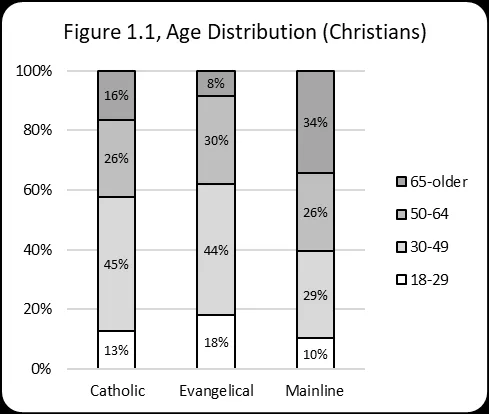
1,149 Christian adults (age eighteen and older) participated in the online survey. Among those, the median age was 46, with a slightly younger median age for Evangelicals (43) than for Catholics (46) and Mainline Protestants (49). The age distributions in our study (Figure 1.1) compare fairly well to national demographics, though with a slightly younger cohort of respondents in our study. The Pew Research Center’s 2014 Religious Landscape Study (the most recent such study to date) found the median age of all Christian adults to be 49 (up from 46 in 2007).1 While the median age of our respondents is similar to that study, it is worth noting that the average age of Christians is rising (a trend that does not bode well for the future of Christianity in the US). At the same time, younger persons are increasingly unaffiliated (those who are now often called the “nones”). The average age of those unaffiliated is 36.
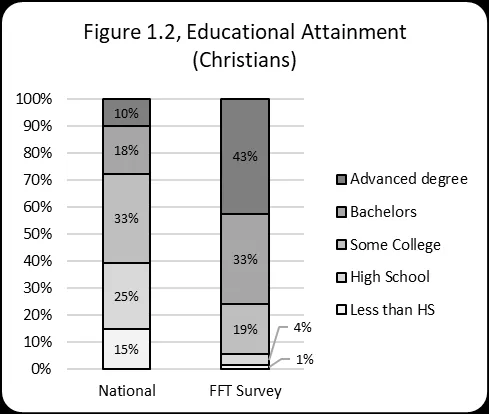
Participants in our study had a much higher level of education than the US general public (Figure 1.2). While 76 percent of Christian respondents had a college or graduate degree, that is true for only 29 percent of the US general public.2 We know that higher education rates correlate with higher wages, mobility, and civic participation rates, so one has to take those factors into account when assessing the results of our study.
One of the fascinating lessons learned from this study is the extent of significant differences among Christians in the United States. Indeed, that is a theme that will run throughout this entire book. The narrative of how people become Christians in the United States has multiple story lines. One of the reasons I distinguish throughout the book between the largest Christian family groups—Roman Catholic, Evangelical Protestant, and Mainline Protestant—is that the differences between them are striking. Christians share much in common; but their differences at key points might lead a researcher to believe she is studying different world religions at times. Even among Protestants, there are large differences, and so throughout the study I draw distinctions between Evangelical and Mainline Protestants. At times, I note unique features of Christian groups who do not always fit easily into these three large categories, but it is difficult to make substantial conclusions from our data about, for example, Orthodox Christians because of their relatively low response rates in our survey (only thirteen of the 1,149 Christians surveyed said they were Orthodox). Historically Black Protestants also have several unique features, but while 3 percent of our Christian respondents identified as Black or African American, most of those were in Evangelical or Mainline denominations so that our data does not allow us to parse out those features more closely. At times, though, the differences between those groups and other Christian groups are worth noting. At times, it is possible to group Roman Catholics and Orthodox together when their responses warrant that, as they sometimes do. But we have not identified them as distinct categories when the sample size was insufficient to draw larger conclusions.
The terms Mainline and Evangelical are sociological categories used to distinguish theological and other historic characteristics among Protestants in the United States. While Mainline denominations were once the largest and most influential group in the United States, their numbers have been almost halved in the last half century so that only about 12–15 percent of the US population now affiliates with Mainline denominations.3 These include the American Baptist Churches, the Christian Church (Disciples of Christ), the Episcopal Church, the Evangelical Lutheran Church in America, the Presbyterian Church (USA), Religious Society of Friends (Quakers), the Reformed Church in America, the United Church of Christ, and the United Methodist Church. Mainline denominations have tended to be more progressive in their stances on social issues and have historically been proponents of the ecumenical movement, symbolized in their memberships in the National Council of Churches. Evangelical Christians, by contrast, tend to be more conservative on social issues and emphasize the authority of Scripture, the need for conversion (often expressed in the term “born again”), the importance of evangelizing others, and several doctrinal affirmations related to Christ and his work. The National Association of Evangelicals is a body comprised of forty denominations along with congregations, schools, and other organizations, many of them having no particular denominational ties.
Figure 1.3 summarizes the representation from the primary Christian traditions in the US in our current Finding Faith Today study as compared to US averages more generally. A full list of denominational representation by Christian family can be found in Appendix A.
| Figure 1.3, Christian Representation | ||
| Percent of US ChristiansA | FFT Survey Respons... | |
Table of contents
- Title Page
- Introduction
- Chapter 1: Christians
- Chapter 2: Christians: Setting Out on the Journey
- Chapter 3: Christians: The Journey
- Chapter 4: Christians: Factors Leading to Faith
- Chapter 5: Christians: Is There a Change?
- Chapter 6: Judaism
- Chapter 7: Buddhism
- Chapter 8: Islam
- Chapter 9: Unitarian Universalists and Quakers
- Chapter 10: Concluding Observations
- Appendix A: Christian Representation in the Survey
- Appendix B: Factors in Coming to Faith by Tradition
- Appendix C: Changes in Attitudes and Positions on Social Issues
- Appendix D: Most Important Feature of the Congregation
- Appendix E: Active Seekers or Drawn in by Others Without Actively Seeking?
- Appendix F: Significance of Changes
- Bibliography
Trusted by 375,005 students
Access to over 1.5 million titles for a fair monthly price.
Study more efficiently using our study tools.
Frequently asked questions
Yes, you can cancel anytime from the Subscription tab in your account settings on the Perlego website. Your subscription will stay active until the end of your current billing period. Learn how to cancel your subscription
No, books cannot be downloaded as external files, such as PDFs, for use outside of Perlego. However, you can download books within the Perlego app for offline reading on mobile or tablet. Learn how to download books offline
Perlego offers two plans: Essential and Complete
- Essential is ideal for learners and professionals who enjoy exploring a wide range of subjects. Access the Essential Library with 800,000+ trusted titles and best-sellers across business, personal growth, and the humanities. Includes unlimited reading time and Standard Read Aloud voice.
- Complete: Perfect for advanced learners and researchers needing full, unrestricted access. Unlock 1.5M+ books across hundreds of subjects, including academic and specialized titles. The Complete Plan also includes advanced features like Premium Read Aloud and Research Assistant.
We are an online textbook subscription service, where you can get access to an entire online library for less than the price of a single book per month. With over 1.5 million books across 990+ topics, we’ve got you covered! Learn about our mission
Look out for the read-aloud symbol on your next book to see if you can listen to it. The read-aloud tool reads text aloud for you, highlighting the text as it is being read. You can pause it, speed it up and slow it down. Learn more about Read Aloud
Yes! You can use the Perlego app on both iOS and Android devices to read anytime, anywhere — even offline. Perfect for commutes or when you’re on the go.
Please note we cannot support devices running on iOS 13 and Android 7 or earlier. Learn more about using the app
Please note we cannot support devices running on iOS 13 and Android 7 or earlier. Learn more about using the app
Yes, you can access Finding Faith Today by Bryan P. Stone in PDF and/or ePUB format, as well as other popular books in Theology & Religion & Comparative Religion. We have over 1.5 million books available in our catalogue for you to explore.