eBook - ePub
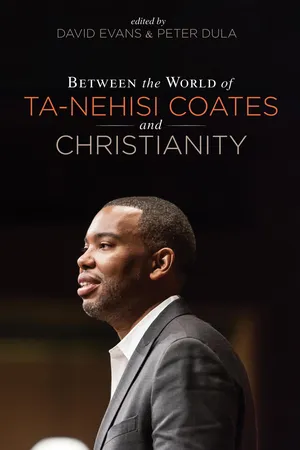
Between the World of Ta-Nehisi Coates and Christianity
- 126 pages
- English
- ePUB (mobile friendly)
- Available on iOS & Android
eBook - ePub
Between the World of Ta-Nehisi Coates and Christianity
About this book
Between the world of Ta-Nehisi Coates and Christianity there appears to be the widest difference. Coates's brief comments on Christianity in his highly acclaimed Between the World and Me make clear that religious faith is alien to his own experience. Still, Christian audiences from congregations to theological schools engaged the text for its analysis of the state of race relations in the United States. In September 2015, Ta-Nehisi Coates tweeted, "Best thing about #BetweenTheWorldAndMe is watching Christians engage the work. Serious learning experience for me." This volume takes that tweet as an invitation to theologians, ethicists, and religious studies scholars to engage the book, and as a challenge to do so in a way that is a learning experience for Coates, the authors, and readers.
Information
Topic
Theology & ReligionSubtopic
Christian Theology1
Introduction
Say, who are you that mumbles in the dark?
And who are you that draws your veil across the stars?1
Between the world of Coates and Christianity there appears to be the widest difference. Coates’s brief comments on Christianity communicate that religion is a subject that is far from his own personal experience. In Between the World and Me, Coates professes to no uplifting cosmology, “I have no praise anthems, nor old Negro spirituals. The spirit and soul are the body and brain, which are destructible—that is precisely why they are so precious.”2 Still, Christian audiences from congregations to theological schools engaged the text for its commentary on the state of race relations in the United States. In September 2015, Ta-Nehisi Coates tweeted, “Best thing about #BetweenTheWorldAndMe is watching Christians engage the work. Serious learning experience for me.” This volume can be read as a response to that tweet. The authors and editors take it as an invitation to theologians, ethicists and religious studies scholars to engage the book. At the same time, we take it as a challenge to do so in a way that is a learning experience for Coates and for us.
Coates came to fame as a blogger for The Atlantic. Beginning in 2008, he sometimes produced ten or more blogposts per week. He also responded directly to comments on his posts, which grew his readership and kept them engaged in his thoughts on the current events of the day, especially as they pertained to racial justice. He wrote on topics that ranged from police brutality, the George Zimmerman trial, the Civil War, Malcolm X and more. He sometimes expanded upon the ideas within these blog entries to make them full articles for The Atlantic. Due to his wide readership and some clever marketing, his 2014 article “The Case for Reparations” became his most widely read and acclaimed essay. It seemed as if every major media outlet and anyone casually interested in racial inequity had an opinion on the piece, which made Coates a household name.
His notoriety served him well when he released Between the World and Me. Coates had already published his first book, The Beautiful Struggle, in 2008, but it went largely unnoticed. His second book was supposed to answer the title of a piece he wrote for a special issue of The Atlantic in 2011, “Why Do So Few Blacks Study the Civil War?” However, American racial divisions made evident with the George Zimmerman trial turned Coates’s attention away from squarely looking at history. Instead, he began to put history in conversation with the contemporary racial climate in the U.S. Through writing his memoir, studying Civil War history, and investigating Trayvon Martin’s story, Coates prepared himself to write powerfully on the problem of anti-black racism in America. Moreover, the readership he gained through his work at The Atlantic made it easy to assume that his contribution to the conversation would be significant. Audiences eagerly awaited the release of Between the World and Me after Coates’s publisher released Advance Reader copies that won a comparison from Toni Morrison between Coates and James Baldwin. She said, “I’ve been wondering who might fill the intellectual void that plagued me after James Baldwin died. Clearly it is Ta-Nehisi Coates.” Morrison’s final comment on the book simply stated, “This is required reading.”3
Between the World and Me is a letter to Coates’s son, Samori, in response to the acquittal of the police officers who killed Michael Brown in Ferguson in 2014. Samori stayed up late with Coates that night to hear the verdict. Because he “was young and believed,” he, unlike Coates, had hope of an indictment. When it was announced that there would be none, Samori said, “I’ve got to go” and rose and went to his room and began crying. Coates waited a few minutes and followed him. He doesn’t attempt to comfort him or tell him everything will be okay. Instead Coates tells him what his own parents tried to tell him: “that this is your country, that this is your world, that this is your body, and you must find some way to live within the all of it. I tell you now that the question of how one should live within a black body, within a country lost in the Dream, is the question of my life, and the pursuit of this question, I have found, ultimately answers itself” (11–12).
Between the World and Me, then, is not the answer to the question “how do I live free in this black body?” It is an account of learning to live with the question. The task of this book is to get us to hear the question and to begin asking it for ourselves. When we begin to live under that question mark we will discover, not the answer but that “the greatest reward of this constant interrogation, of confrontation with the brutality of my country, is that it has freed me from ghosts and girded me against the sheer terror of disembodiment” (12). This book is the record of Coates’s own journey to this realization and his attempt to get us to journey with him.
Samori needs this letter because he is young, inexperienced and, until this evening, sheltered in many ways from the worst. But what about the rest of us? How does Coates propose to get us to where he is? He acknowledges to his son that “This must seem strange.”
But some time ago I rejected magic in all its forms. This rejection was a gift from your grandparents, who never tried to console me with ideas of an afterlife and were skeptical of preordained American glory. In accepting both the chaos of history and the fact of my total end, I was freed to truly consider how I wished to live—specifically, how do I live free in this black body? (12)
Coates wants to do for Samori what his own parents did for him—immunize him against magic. He does that by not offering him magic to help dry his tears so he will not be tempted to turn to magic the next time a police officer is acquitted for the murder of an innocent black man. But the rest of us, most of us at least, already read the news through the filters of this magic. Samori needs to be properly educated. The rest of us need to be re-educated. Here in this passage Coates is clear about two forms of magic that Samori needs to be educated away from and we need to be re-educated out of: “ideas of an afterlife and American glory,” what Coates calls “the Dream.” They are the things that plug our ears from hearing the question.
All of us, but especially “Americans who believe they are white” need this book because, as Jennifer Harvey argues in chapter 4, they need to be awakened from the Dream. “I have seen that dream all my life. It is perfect houses with nice lawns. It is Memorial Day cookouts, block associations, and driveways. The Dream is treehouses and the Cub Scouts. The Dream smells like peppermint but tastes like strawberry shortcake” (11), “unworried boys . . . , pie and pot roast . . . , white fences and green lawns nightly beamed into our television sets” (29). This is the American dream of politicians’ and marketers’ clichés and TV dramas, suburban home ownership and upward social and economic mobility for all. One problem with the Dream is simply the dubiousness of “for all.” Access to the opportunities that might realize the Dream are a product of privilege. Coates would surely agree, but his claim is more radical: “The Dream rests on our backs, the bedding made from our bodies” (12). In other words, it is not that African Americans have been prevented from achieving the Dream by a history of oppression and an endless series of discriminatory policies. It is that the Dream itself is the product of that history.
“Ideas of an afterlife” means just that—life after death, but it may also stand in for religious faith in general. Describing how he survived the violence of the Baltimore streets as a youth, he writes, “I could not retreat, as did so many, into the church and its mysteries. . . . I had no sense that any just God was on my side. . . . My understanding of the universe was physical, and its moral arc bent toward chaos then concluded in a box” (28). At the funeral for his friend, Prince Jones, who is to Coates what Michael Brown is to his son, this becomes clearest. Prince was a committed Christian with an “abiding belief that Jesus was with him” (78). But Coates listens to the sermons and testimonies and calls for forgiveness unmoved. “I have always felt great distance from the grieving rituals of my people. . . . When the assembled mourners bowed their heads in prayer, I was divided from them because I believed that the void would not answer back” (78–79).
Those two forms of magic come together in the person of Barack Obama. In many ways Between the World and Me reads like a companion volume to Dreams of My Father.4 Both are coming-of-age stories of young men discovering what it means to be black in America and in the process becoming writers. But Obama’s journey leads him to believe in both kinds of magic. When Coates writes, “My understanding of the world was physical, and its moral arc bent toward chaos then concluded in a box” (28) he is alluding to the Theodore Parker line beloved of Martin Luther King Jr., “the arc of the moral universe is long but it bends toward justice” and that Obama had woven into an Oval Office rug. What for King was an eschatological faith claim becomes for Obama an account of U.S. history and the latest mutation of American civil religion. Here is the young Illinois Senator at the 2004 Democratic National Convention. Contrasting his hope with the “blind optimism and willful ignorance” of the Bush administration, he said:
That’s not what I’m talking. I’m talking about something more substantial. It’s the hope of slaves sitting around a fire singing freedom songs; the hope of immigrants setting out for distant shores; the hope of a young naval lieutenant bravely patrolling the Mekong Delta; the hope of a mil...
Table of contents
- Title Page
- Contributors
- Chapter 1: Introduction
- Chapter 2: Echoes from the Mecca and the Capstone
- Chapter 3: Black Futures and Black Fathers
- Chapter 4: Shall We Awake?
- Chapter 5: The American Nightmare and the Gospel of Plunder
- Chapter 6: What Does He Mean by, “They Believe They Are White”?
- Chapter 7: Hope’s Vagaries
- Chapter 8: Between the Tragic and the Unhopeless
Trusted by 375,005 students
Access to over 1.5 million titles for a fair monthly price.
Study more efficiently using our study tools.
Frequently asked questions
Yes, you can cancel anytime from the Subscription tab in your account settings on the Perlego website. Your subscription will stay active until the end of your current billing period. Learn how to cancel your subscription
No, books cannot be downloaded as external files, such as PDFs, for use outside of Perlego. However, you can download books within the Perlego app for offline reading on mobile or tablet. Learn how to download books offline
Perlego offers two plans: Essential and Complete
- Essential is ideal for learners and professionals who enjoy exploring a wide range of subjects. Access the Essential Library with 800,000+ trusted titles and best-sellers across business, personal growth, and the humanities. Includes unlimited reading time and Standard Read Aloud voice.
- Complete: Perfect for advanced learners and researchers needing full, unrestricted access. Unlock 1.5M+ books across hundreds of subjects, including academic and specialized titles. The Complete Plan also includes advanced features like Premium Read Aloud and Research Assistant.
We are an online textbook subscription service, where you can get access to an entire online library for less than the price of a single book per month. With over 1.5 million books across 990+ topics, we’ve got you covered! Learn about our mission
Look out for the read-aloud symbol on your next book to see if you can listen to it. The read-aloud tool reads text aloud for you, highlighting the text as it is being read. You can pause it, speed it up and slow it down. Learn more about Read Aloud
Yes! You can use the Perlego app on both iOS and Android devices to read anytime, anywhere — even offline. Perfect for commutes or when you’re on the go.
Please note we cannot support devices running on iOS 13 and Android 7 or earlier. Learn more about using the app
Please note we cannot support devices running on iOS 13 and Android 7 or earlier. Learn more about using the app
Yes, you can access Between the World of Ta-Nehisi Coates and Christianity by David Evans,Peter Dula, Evans, Dula in PDF and/or ePUB format, as well as other popular books in Theology & Religion & Christian Theology. We have over 1.5 million books available in our catalogue for you to explore.