eBook - ePub
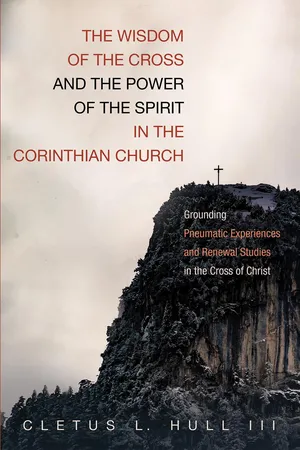
The Wisdom of the Cross and the Power of the Spirit in the Corinthian Church
Grounding Pneumatic Experiences and Renewal Studies in the Cross of Christ
- 194 pages
- English
- ePUB (mobile friendly)
- Available on iOS & Android
eBook - ePub
The Wisdom of the Cross and the Power of the Spirit in the Corinthian Church
Grounding Pneumatic Experiences and Renewal Studies in the Cross of Christ
About this book
The cross of Christ crucified symbolized the central theme of Paul's ministry. In his letter to the Corinthians, the apostle commenced his correspondence with the message about the cross and power of God (1 Cor 1:18, NRSV). The proposal for this paper utilizes the method analogia scripturae. Set within the wisdom motif of the Greco-Roman world, this study is dedicated to the examination of the apostle's Christology in the context of 1 Cor 1:18-25 and the pneumatology in 1 Cor 2:9-16 as both pericopes are juxtaposed in his epistle. Essentially, the thesis concerns the grounding of the pneumatology of Paul with his Christology in 1 Corinthians. The Corinthian church required clarification and pastoral wisdom with their pneumatic experiences; thus, Paul recognized that a strong theology of the cross complemented their encounters with the Spirit. The question for biblical studies involves a lively tension of the pneumatology of the Spirit with a robust Christology. Because the power of God throughout this passage has the cross as its paradigm, the structure of the book leads to the significance of the apostle's pneumatological contribution of the cross and Christ crucified (1 Cor 1:18; 2:2). For this reason, a strong Christology must ground the pneumatology of the Pauline corpus. This study in biblical literature commences a new discussion in ecumenical dialogue between pneumatic experiences in the church and christological issues in Scripture.
Information
Topic
Theology & ReligionSubtopic
Biblical StudiesCHAPTER 1
INTRODUCTION
The cross of Christ crucified was the central theme of Paul’s ministry and message. In his earliest extant letter to the Corinthians, the apostle commenced his correspondence with “the message about the cross” and “power of God” (1 Cor 1:18).1 As Petrus Gräbe stated in The Power of God in Paul’s Letters, “1 Cor 1:18 has a clear ‘thesis-character’”2 that became the foundation of his ministry. This message of the cross is the focal point for Paul’s teaching in 1 Corinthians. My book unpacks a study of the power of the cross in the context of 1 Cor 1:18—2:16. Why does the apostle begin his letter to the Corinthians about the subject of the cross and how does that ground the pneumatic experiences of the church? This topic calls for further consideration and scholarly research in the academy and church. As the text will be interpreted in the broader framework of the Corinthian church, the structure of the passage describes the notion of Paul’s teaching on the power of the cross as he grounds his instruction in their pneumatic experiences.
The Pauline corpus of 1 Cor 1—2 represents the initial foundation for this study. I will first present an exegetical commentary of the Pauline corpus of 1 Cor 1:18—2:16 that will buttress the “thesis-character” of the passage. The human-centered wisdom of the Corinthian society contrasts significantly with God’s wisdom demonstrated in the cross. Second, a survey of the historical background of Corinth and the church is examined. Third, an introduction to the cultural influence of the Hebrew and Hellenistic meaning of σοφίᾳ/wisdom will be observed. Fourth, the ancient conditions of the Roman colony of Corinth will expand Paul’s revelation of the δύναμις/power of God and human weakness. Fifth, the various interpretations of Paul’s Christology from church history, specifically the Reformation and modern church history will be reviewed. Sixth, his pneumatology in 1 Corinthians and church history will be probed. Seventh, the grounding of his pneumatology with his Christology will be researched. Finally, a summation of the theological ramifications of his emphasis on the power of the cross in the life of a pastor will be explored. Both the theology and practicality of the cross in healing will be investigated. 1 Cor 1:18 states that the message of the cross is crucial to restore true revival in our spheres of influence. Hence, “the power of God throughout this passage has the cross as its paradigm;”3 therefore, the setting and structure of the paper will lead to the apostle’s contribution of the significance of the cross and Christ crucified (1 Cor 1:18; 2:2).
1 Corinthians contains noteworthy information about the cross, and the Spirit. This letter of the New Testament forms a basis for a healthy church to bloom in our postmodern society. However, the application of the letter for church life and scholarship remains unearthed. This writing seeks to present a demonstration of the apostle’s foundation for correcting the Corinthian church’s pneumatic experiences with a robust theology of the cross in 1 Cor 1 and 2. Hans Conzelmann in his commentary 1 Corinthians: A Commentary on the First Epistle to the Corinthians, argues that Paul “uses his theology of the cross to bring out more clearly than in any other epistle the historic character of faith.”4 The epistle displays an approach to the apostle’s understanding of Christology, and submits that if the Corinthian believers yield their charisms to the cross of Jesus, the assembly of believers can become a vigorous and gifted ministry for the Lord. The factions fueled by partisan bickering in the church created problems, but Paul begins his letter with a grounding on the cross to correct unchecked experiences (1 Cor 1:10–18). In the opening of his letter, instead of choosing one of four parties (Apollos, Cephas, Paul, or Christ) he yields to the cross of Christ. In 1 Cor 1:18 he declares that “the message about the cross is foolishness to those who are perishing, but to us who are being saved it is the power of God.” Although the cross is an important motif in Pauline theology, the apostle expertly weaves the societal theme of σοφία into his argument for corrective and beneficial Spirit-filled encounters. The importance of this issue highlights the purpose of my book.
Specifically, three questions continue throughout this paper. (1) Why did Paul believe he needed to ground their pneumatic experiences in the cross? (2) How did he utilize the Greco-Roman sophistic rhetoric of popular Hellenistic wisdom to establish the meaning of the cross? (3) How should we apply this vital knowledge from the Corpus Paulinum to the academy and the church? In what follows, I propose that the grounding of the apostle’s pneumatology has not noticed much significance in academic writing. These three questions require investigation for an understanding of the cross and the Spirit in 1 Corinthians. The purpose of this monograph is an attempt to answer these questions.
Problem
Paul’s theology of the cross remains the centerpiece of his ministry. He connects the saving power of the cross with the Corinthians expressions of the Holy Spirit. In 1 Cor 1:18—2:16, the apostle undergirds his correspondence with the message of the cross. Michael Goulder suggests, “the fine church he had founded is now divided; only a few of its members are faithful to his noble gospel vision.”5 As the apostle directly addresses the cliquish schisms (σχίσματα) within the congregation (1 Cor 1:10–17) he also proclaims that the cross emends unhealthy theological walls that separate them. James Reese aptly writes that “Paul saw the situation at Corinth as critical.”6 The apostle aims, as a caring father, to sound the alarm concerning the wayward actions of his children. As a result, Gräbe notes that “Paul’s central thesis in this pericope is that God frustrated the wisdom of the world in the cross of Christ.”7 This message which the Corinthians called foolishness was the only solution for overcoming their factions. Thus, by establishing the purpose of the cross, at the beginning of his epistle, Paul builds the case for his Christology.
In addition, Paul’s pneumatology is prominent in the correspondence as we read that the Corinthian believers were enthusiastic about their encounters with the Holy Spirit. Their ecstatic manifestations became regular expressions in their home churches (1 Cor 12—14). However, in their enthusiasm over the Spirit’s miraculous work, the worship spiraled out of control. Even their communion services lacked a serious searching of their hearts (1 Cor 11:27–32). Paul, as the founder of the church (Acts 18:1–18), needed a corrective word for the congregation’s disturbances and addresses a number of situations in the Corinthian assembly that troubled the believers. Thus, he began his letter with a strong emphasis on the kerygma of the preaching of the cross (1 Cor 1:18) to ground their pneumatic expressions. Utilizing the Corinthian and Greco-Roman concept of σοφίᾳ, Paul masterfully states that the wisdom of the cross undergirds a healthy demonstration of Spirit-filled devotion.
Church history provides a rich tradition and basis for interpreting the cross and the Spirit. Eastern Christian leaders such as the Ca...
Table of contents
- Title Page
- Acknowledgments
- List of Abbreviations
- Chapter 1: Introduction
- PART ONE: EXEGESIS, CORINTHIAN BACKGROUND, WISDOM, POWER AND WEAKNESS, AND CHRISTOLOGY AND PNEUMATOLOGY OF PAUL
- PART TWO: THE JUXAPOSITION OF PAUL’S PNEUMATOLOGY WITH HIS CHRISTOLOGY AND CONCLUSIONS
- Bibliography
Trusted by 375,005 students
Access to over 1.5 million titles for a fair monthly price.
Study more efficiently using our study tools.
Frequently asked questions
Yes, you can cancel anytime from the Subscription tab in your account settings on the Perlego website. Your subscription will stay active until the end of your current billing period. Learn how to cancel your subscription
No, books cannot be downloaded as external files, such as PDFs, for use outside of Perlego. However, you can download books within the Perlego app for offline reading on mobile or tablet. Learn how to download books offline
Perlego offers two plans: Essential and Complete
- Essential is ideal for learners and professionals who enjoy exploring a wide range of subjects. Access the Essential Library with 800,000+ trusted titles and best-sellers across business, personal growth, and the humanities. Includes unlimited reading time and Standard Read Aloud voice.
- Complete: Perfect for advanced learners and researchers needing full, unrestricted access. Unlock 1.5M+ books across hundreds of subjects, including academic and specialized titles. The Complete Plan also includes advanced features like Premium Read Aloud and Research Assistant.
We are an online textbook subscription service, where you can get access to an entire online library for less than the price of a single book per month. With over 1.5 million books across 990+ topics, we’ve got you covered! Learn about our mission
Look out for the read-aloud symbol on your next book to see if you can listen to it. The read-aloud tool reads text aloud for you, highlighting the text as it is being read. You can pause it, speed it up and slow it down. Learn more about Read Aloud
Yes! You can use the Perlego app on both iOS and Android devices to read anytime, anywhere — even offline. Perfect for commutes or when you’re on the go.
Please note we cannot support devices running on iOS 13 and Android 7 or earlier. Learn more about using the app
Please note we cannot support devices running on iOS 13 and Android 7 or earlier. Learn more about using the app
Yes, you can access The Wisdom of the Cross and the Power of the Spirit in the Corinthian Church by Cletus L. Hull III in PDF and/or ePUB format, as well as other popular books in Theology & Religion & Biblical Studies. We have over 1.5 million books available in our catalogue for you to explore.