eBook - ePub
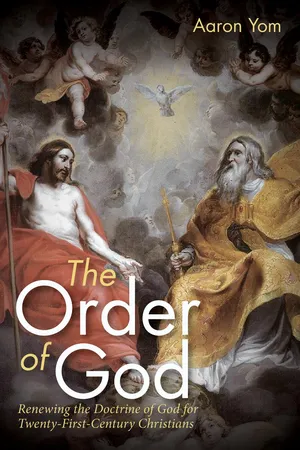
The Order of God
Renewing the Doctrine of God for Twenty-First-Century Christians
- 186 pages
- English
- ePUB (mobile friendly)
- Available on iOS & Android
eBook - ePub
About this book
In this most up-to-date study, Aaron Yom provides a comprehensive analysis of the doctrine of God, particularly from a pneumatological perspective. He focuses on retrieving the order of God that has been consistently misunderstood and mistreated by modern scholars.
The author carefully examines scholarly works of modern thinkers such as Karl Barth, Thomas Torrance, Karl Rahner, David Coffey, Jurgen Moltmann, Clark Pinnock, and Stanley Grenz, as well as ancient masters such as Augustine and Aquinas. With a critical analysis, he highlights the strengths and weaknesses of their work to lay a foundational platform for understanding God's order in the twenty-first-century theological context.
Yom proposes a holistic approach that does not marginalize the logic of the Trinity that begins with God's order of ontology rather than God's order of economy, though the former is read from the latter. He maintains the intricate balance of the immanent Trinity and the economic Trinity with his newfound principle of identity and duality. Yom offers several new theological paradigms for those who are interested in the topic of systematic theology.
Information
Topic
Theology & ReligionSubtopic
Christian TheologyChapter 1
Setting the Stage: From Nature’s Order to God’s Order
Can we discern God’s order from nature? If so, how should we approach God’s order from nature? Should we adopt a formalist, realist, historical, or transcendental approach? These are the questions I will be addressing in this chapter. My claim is that nature as God’s creation reveals the order of God though analogically and implicitly. So, for me, the starting point of the theological discussion of God’s order must begin with nature. This does not mean that I am arguing for a Spinozian uniformity principle of order. Spinoza equated the immutable laws of nature to God’s immutable order of his being.8 For him, God’s order was nature’s order, and vice versa. This is an explicit endorsement of pantheism. We cannot commit the same error by confusing nature’s order and God’s order as a non-divided whole. What we need to understand is that nature’s order is not God’s order.
Likewise, we cannot run the same scenario of reducing God’s order to nature’s order, like Ernst Troeltsch’s principle of analogy.9 Troeltsch had argued for the homogeneity of history, and with this principle, he demonstrated that there is no such thing as supernatural causality. His argument goes like this: because the miracle of resurrection is not taking place today, it did not take place in the past. Troeltsch’s claim is based on naturalistic history, in which the mechanism of nature is the measuring rod for all other events in history, including divine history. So, like many naturalistic scholars, he simply dismissed the order of God’s miracle.
As a corrective to these approaches, and at the same time, to find a way to God from nature without undervaluing God’s ontological order, I demonstrate in this chapter that God’s order in nature is distinguishable and yet consonant with nature’s order. To accomplish this task, I begin with the discussion of natural theology, or more specifically, with a question, “is natural theology possible?” Karl Barth did not think so, and I disagree with him, though I understand why natural theology can be deleterious to Christianity. So, I critically review Barth’s disclaim of natural theology and argue that, to a certain extent, natural analogues can be functionally useful to point out God’s order from nature. In fact, I show that natural theology is the basic building block for discerning God’s order “for us,” which is a necessary ingredient for discerning God’s order in himself. I also claim that natural order is the propitious ground upon which God’s order of salvation is manifested.
What follows then is a three-step presentation. The first part deals with Barth’s dismissal of natural theology. I highlight his key arguments against natural theology. Based on the first analysis, the second part concentrates on the shortcomings of Barth’s arguments. Here, I try to show that Barth’s view of nature is too narrow and misleading. Lastly, I present my own view of the principle of analogy that cautiously acknowledges nature’s order as a viable option for conceptualizing God’s order “for us.”
Is Natural Theology Possible?
As I have said before, to discuss about the possibility of natural theology, we need to dialogue with Barth, who has put forth a unique argument against natural theology. My interaction with Barth identifies the key features of natural theology, and at the same time, its shortcomings so that I can clarify the usefulness of natural theology in unveiling God’s order. Of course, I do not accept Barth’s strong denial of natural theology wholeheartedly, but nonetheless, I take his criticism seriously, for we have been reading too much of nature into God. Like Barth, I see this trend to be the greatest ill of modern theology. As a way to correct modern theological deficiencies, I turn to Barth’s celebrated criticism against natural theology.
Barth’s Misapprehensions
Barth’s theological scope is wide and broad. In addition, his theology is known to invoke controversy and dispute, which are too numerous to number. For this reason, Barth’s analysis on natural theology is kept within a specific premise here, relying on primarily selected writings from Church Dogmatics, where he provides workable data for us to think about the ontological order of God. This analysis for sure is not the last word describing what Barth was trying to say about natural theology, but nonetheless, it is an honest attempt to clarify and take advantage of Barth’s work, all the while critically engaging his thought from a pneumatological perspective.
Reading Barth’s Church Dogmatics, we can undoubtedly encounter his persistent argument against natural theology. In almost every corner of his theological presentation, the voice against natural theology is easily heard. Actually, it balances well with his christocentric paradigm. While the christocentric vision takes the central spot as the positive development of his theology, an attempt to defy all forms of natural theology is equally forceful as a negative form of his theology. So, Barth’s Christology as the positive reinforcement of Christian theology is balanced with the negative side of his theology, namely, his aversion toward natural theology. In this respect, although Barth’s negation of natural theology has been reviewed from many different perspectives, I prefer to work with a comparative approach, playing it off against Barth’s Christology. What better way is there than to compare two extreme poles of Barth’s theology? Let me begin with a christological analysis.
As Marc Cortez notes, Barth is rightfully called a christocentric theologian.10 If we compare Barth’s theology to a wheel, Jesus Christ is the hub and the remaining theological categories are the spokes that are attached to it. Even if we say that Barth’s chief theological category is revelation, it too is driven by Christology, for he believes that God reveals himself in and through Jesus Christ. In my judgment, this is a telltale sign that Barth has fallen into a theological particularism. For Barth, Jesus Christ differentiates us from the rest. Jesus Christ makes us unique. It is where we find our theological niche. We cannot blame Barth for taking this stance, since the Bible itself attests to the particularity of Christian faith. John 14:6 specifically denotes that Jesus “is the way and the truth and the life,” and “no one comes to the Father except through [him].” All is good, but Barth has taken this particularism to its limit and created a theological expanse that is excessively filled with christocentrism. I list a few examples.
First, Barth differentiates what is unreal from what is real based on his christocentric focus. For instance, Barth’s anthropology is unique in the sense that our existence is not defined by the study of biology but the study of Jesus Christ. For Barth, the study of evolutionary biology only details the phenomena of human beings. It does not explain the essence of humanity.11 Like Kant’s differentiation of phenomena and noumena, Barth’s christological viewpoint makes the difference between the phenomena of humanity and the essence of human beings. However, what we need to note is that Barth’s theological move turns the post-Kantian paradigm on its head. In the post-Kantian era, especially for those who have associated with phenomenology, the world of phenomena has been understood as real and the rest such as metaphysics and theology were cast in the dungeon of irrelevance. Taking a starkly different turn, Barth states otherwise. It is our dependence on phenomena that leads to philosophical and theological abstractions. The concreteness and essence of human nature is disclosed only through Jesus Christ.
Essentially, Barth is making a theological statement, bypassing a scientific description of humanity. He does not believe that theological issues can be resolved by the interjection of science.12 For him, human nature is fully revealed only when we understand that we are under the bondage of sin. What is sin? Again, Barth’s definition is simple. It is christocentric. Sin is unbelief. It is a rejection of Jesus Christ. He writes, “Man’s sin is unbelief in the God who was ‘in Christ reconciling the world to himself,’ who in Him elected and loved man from all eternity, who in Him created him, whose word to man from and to all eternity was and will be Jesus Christ.”13 What this means for Barth is that, if we remove Jesus Christ out of the anthropological equation, all that remains is sin. The final telos of sinful humanity is non-existence, or nothingness. In other words, without Christ, we lose our existence, because our existence can only be confirmed and sustained by God through Jesus Christ. Sin in this sense is “impossible possibility.” There are two sides to this order. On the one hand, our existence is meaningless because of sinfulness, and on the other hand, our existence cannot be meaningless because of Jesus Christ.
As a second example of Barth’s c...
Table of contents
- Title Page
- Preface
- Abbreviations
- Introduction
- Chapter 1: Setting the Stage: From Nature’s Order to God’s Order
- Chapter 2: The Prius of God’s Ontological Order
- Chapter 3: God’s Order of Communication and Its Relationship to the Unthematic Dimension of Human Existence
- Chapter 4: God’s Order of Pathos
- Epilogue
- Bibliography
Trusted by 375,005 students
Access to over 1.5 million titles for a fair monthly price.
Study more efficiently using our study tools.
Frequently asked questions
Yes, you can cancel anytime from the Subscription tab in your account settings on the Perlego website. Your subscription will stay active until the end of your current billing period. Learn how to cancel your subscription
No, books cannot be downloaded as external files, such as PDFs, for use outside of Perlego. However, you can download books within the Perlego app for offline reading on mobile or tablet. Learn how to download books offline
Perlego offers two plans: Essential and Complete
- Essential is ideal for learners and professionals who enjoy exploring a wide range of subjects. Access the Essential Library with 800,000+ trusted titles and best-sellers across business, personal growth, and the humanities. Includes unlimited reading time and Standard Read Aloud voice.
- Complete: Perfect for advanced learners and researchers needing full, unrestricted access. Unlock 1.5M+ books across hundreds of subjects, including academic and specialized titles. The Complete Plan also includes advanced features like Premium Read Aloud and Research Assistant.
We are an online textbook subscription service, where you can get access to an entire online library for less than the price of a single book per month. With over 1.5 million books across 990+ topics, we’ve got you covered! Learn about our mission
Look out for the read-aloud symbol on your next book to see if you can listen to it. The read-aloud tool reads text aloud for you, highlighting the text as it is being read. You can pause it, speed it up and slow it down. Learn more about Read Aloud
Yes! You can use the Perlego app on both iOS and Android devices to read anytime, anywhere — even offline. Perfect for commutes or when you’re on the go.
Please note we cannot support devices running on iOS 13 and Android 7 or earlier. Learn more about using the app
Please note we cannot support devices running on iOS 13 and Android 7 or earlier. Learn more about using the app
Yes, you can access The Order of God by Aaron Yom in PDF and/or ePUB format, as well as other popular books in Theology & Religion & Christian Theology. We have over 1.5 million books available in our catalogue for you to explore.