eBook - ePub
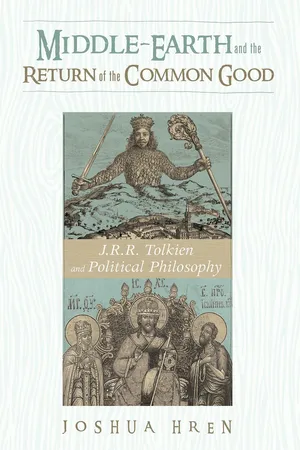
Middle-earth and the Return of the Common Good
J. R. R. Tolkien and Political Philosophy
- 212 pages
- English
- ePUB (mobile friendly)
- Available on iOS & Android
eBook - ePub
About this book
Political philosophy is nothing other than looking at things political under the aspect of eternity. This book invites us to look philosophically at political things in J.R.R. Tolkien's legendarium, demonstrating that Tolkien's potent mythology can be brought into rich, fruitful dialogue with works of political philosophy and political theology as different as Plato's Timaeus, Aquinas' De Regno, Hobbes's Leviathan, and Erik Peterson's "Monotheism as a Political Problem." It concludes that a political reading of Tolkien's work is most luminous when conducted by the harmonious lights of fides et ratio as found in the thought of Thomas Aquinas.
A broad study of Tolkien and the political is especially pertinent in that the legendarium operates on two levels. As a popular mythology it is, in the author's own words "a really long story that would hold the attention of readers, amuse them, delight them, and at times maybe excite them or deeply move them." But the stories of The Silmarillion and The Lord of the Rings contain deeper teachings that can only be drawn out when read philosophically. Written from the vantage of a mind that is deeply Christian, Tolkien's stories grant us a revelatory gaze into the major political problems of modernity--from individualism to totalitarianism, sovereignty to surveillance, terror to technocracy. As an "outsider" in modernity, Tolkien invites us to question the modern in a manner that moves beyond reaction into a vivid and compelling vision of the common good.
Information
Topic
Theology & ReligionSubtopic
Political Literary Criticism
The Gift of Death and the New Magic of Politics
Hegel and Tolkien on Sorcery and Secondary Worlds
The Gift of Death for the Bourgeois World, the Gift Stolen by the Machine
The Doom (or Gift) of Men is mortality,” Tolkien writes. Elsewhere he notes that not “even Power or Domination is the real centre of my story. It provides the theme of a War, about something dark and threatening enough to seem at that time of supreme importance, but that is mainly a ‘setting’ for characters to show themselves. The real theme is . . . Death and Immortality.”101 How important, then, that a reading of The Lord of the Rings is able to grant death and immortality their essential place in human life. In Christianity, death is a door; it marks the end of human life and the beginning of beatific immortality or the banality of damnation. Death, for Christians, does not first and foremost move human life toward a spirited support of the polis, but toward an emulation of the divine by which persons can anticipate the vita sanctorum—the life of the saints.
Moderns have lost this sense of death because in modernity death is treated as “neither an ineluctable end that must be courageously confronted, nor the gateway to salvation; it is extrinsic and alien to life and ought to be resisted and overcome.”102 Taken as a whole, the modern project aims to overcome all limitations which nature “imposes” upon human life—most especially suffering and death. Thus the rise of technocracy, by which humanity tries to conquer the natural world and secure prosperity and preservation. In consequence, certain human virtues lose their worth. Consider courage, as important to Aristotle as it is to Beowulf. In modernity success comes through the inculcation of the virtues of business, as homo economicus (economic man) eclipses Zôion politikòn (man as a political animal). Revolutionary and totalitarian movements, especially since the start of the twentieth century, have sought to disrupt the hegemony of this bourgeois world, to end the reign of radical individualism.
Still further, “Modernity’s initial premise that death is something to be overcome consequently makes power the crux of human life.”103 Tolkien mythologizes these problems of modernity. As he explains in his letters, the legendarium is largely concerned with “Fall, Mortality, and the Machine . . . the will to mere power, seeking to make itself objective by physical force and mechanism, and so inevitably by lies.”104
For the 19th century German philosopher G.F.W. Hegel, the unduly private economic interests of the bourgeois world can only be restrained and transcended through war. “War reveals the hard but necessary truth that all possessions, including one’s own body and life, are transitory,” a truth “obscured in modernity by the success of the liberal state in securing peace and opening up a realm for the proliferation of economic life.”105
When Tolkien explains that “War” provides his legendarium with “something dark and threatening enough to seem at that time of supreme importance,” something which allows characters to “show themselves,” by which he means demonstrate the classical and Anglo-Saxon virtues, he is thinking in a Hegelian mode.106 Through war the bourgeois hobbits become political animals. Through the War of the Ring their degenerated understanding of freedom morphs into “the spirited fortitude necessary to maintain free institutions.”107
And yet “war as restraint and correction” is problematized by the development of modern warfare, which is in part what Tolkien references when he notes that his tale is concerned with “the Machine.”108 The “Machine” finds its most concentrated mythical expression in the Ring, which represents the “truth that potency (or perhaps rather potentiality) if it is to be exercised, and produce results, has to be externalized and so as it were passes, to a greater or less degree, out of one‘s direct control.”109 This is not to claim, by the way, that the Ring is an allegory of, say, the nuclear bomb. To such a supposition Tolkien has already responded, stating that “Of course my story is not an allegory of Atomic power, but of Power (exerted for Domination).”110 But we risk no overly-allegorical misapprehension of Tolkien’s direct commentary on modern warfare, which comes in a January 1945 letter to his son Christopher. In a quasi-Hegelian note, he accepts that the “diabolic hour” of the current war which spells the “destruction of what should be (indeed is) the common wealth of Europe,” “mainly created by Germany” may be “necessary and inevitable.” And yet, he continues, “what a gloat! We were supposed to have reached a stage of civilization in which it might still be necessary to execute a criminal, but not to gloat, or to hang his wife and child by him while the orc-crowd hooted.”111 Still, the total destruction of Germany, made possible by modern warfare, Tolkien reads as “one of the most appalling world-catastrophes.”112 Well, he concludes:
The first War of the Machines seems to be drawing to its final inconclusive chapter—leaving, alas, everyone the poorer, many bereaved or maimed and millions dead, and only one thing triumphant: the Machines. As the servants of the Machines are becoming a privileged class, the Machines are going to be enormously more powerful.113
In the face of this tyranny of the machines, Tolkien confirms Gillespie’s sense that, in the face of modern war, the individual capitulates to his impotence: “Well, well,” he writes to his son, “you and I can do nothing about it. And that shd. be a measure of the amount of guilt that should be assumed to attach to any member of a country who is not a member of its actual Government.”114
The rise of mechanical, and nuclear, and chemical warfare creates a situation wherein, “since every individual is threatened with annihilation,” and “individual self-sacrifice is meaningless in this situation,” modern war “exacerbates the individualism” at the heart of bourgeois life. As Michael Gillespie perceptively contends, “Man is thus plunged into schizophrenia: one moment he forgets death entirely and is concerned only with his present pleasure and advantage; the next moment he recognizes its imminence and dedicates himself to abolishing the weapons ...
Table of contents
- Title Page
- Acknowledgments
- Introduction
- Chapter 1:The Gift of Death and the New Magic of Politics
- Chapter 2: The Political Theology of Catastrophe
- Chapter 3: Burglar and Bourgeois?
- Chapter 4: Hobbes, Hobbits, and the Modern State of Mordor
- Chapter 5: Middle-earth and the Return of the Common Good
- Chapter 6: Epilogue
- Bibliography
Trusted by 375,005 students
Access to over 1.5 million titles for a fair monthly price.
Study more efficiently using our study tools.
Frequently asked questions
Yes, you can cancel anytime from the Subscription tab in your account settings on the Perlego website. Your subscription will stay active until the end of your current billing period. Learn how to cancel your subscription
No, books cannot be downloaded as external files, such as PDFs, for use outside of Perlego. However, you can download books within the Perlego app for offline reading on mobile or tablet. Learn how to download books offline
Perlego offers two plans: Essential and Complete
- Essential is ideal for learners and professionals who enjoy exploring a wide range of subjects. Access the Essential Library with 800,000+ trusted titles and best-sellers across business, personal growth, and the humanities. Includes unlimited reading time and Standard Read Aloud voice.
- Complete: Perfect for advanced learners and researchers needing full, unrestricted access. Unlock 1.5M+ books across hundreds of subjects, including academic and specialized titles. The Complete Plan also includes advanced features like Premium Read Aloud and Research Assistant.
We are an online textbook subscription service, where you can get access to an entire online library for less than the price of a single book per month. With over 1.5 million books across 990+ topics, we’ve got you covered! Learn about our mission
Look out for the read-aloud symbol on your next book to see if you can listen to it. The read-aloud tool reads text aloud for you, highlighting the text as it is being read. You can pause it, speed it up and slow it down. Learn more about Read Aloud
Yes! You can use the Perlego app on both iOS and Android devices to read anytime, anywhere — even offline. Perfect for commutes or when you’re on the go.
Please note we cannot support devices running on iOS 13 and Android 7 or earlier. Learn more about using the app
Please note we cannot support devices running on iOS 13 and Android 7 or earlier. Learn more about using the app
Yes, you can access Middle-earth and the Return of the Common Good by Joshua Hren in PDF and/or ePUB format, as well as other popular books in Theology & Religion & Political Literary Criticism. We have over 1.5 million books available in our catalogue for you to explore.