- 174 pages
- English
- ePUB (mobile friendly)
- Available on iOS & Android
eBook - ePub
About this book
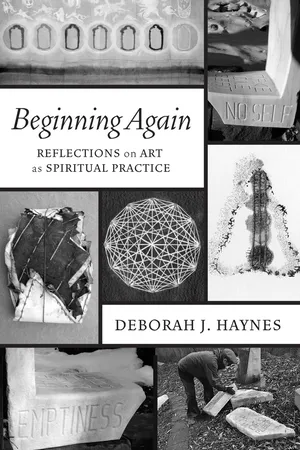
What does it mean to become and work as an artist today? What unique challenges do artists face in the twenty-first century, and what skills are required to overcome them? How might art become an expression of spiritual life? In addressing these and other questions, Deborah J. Haynes offers reflections that range from the practical to the deeply philosophical. She explores challenging ideas: impermanence, suffering, and the inevitability of death; the virtues of generosity, kindness, and compassion; and more abstract concepts such as negative capability, groundlessness, and wisdom. Individual chapters are framed by personal stories and images from the artist's work.
Beginning Again: Reflections on Art as Spiritual Practice is a personal statement, born from the author's experience as an artist, writer, teacher, and Buddhist practitioner. Haynes writes for artists--and for all exploring the relationship of their creativity to the inner life. For Haynes, making and looking at art can be a form of meditation and prayer, a space for solitude, silence, and living in the present.
Information
Topic
Teología y religiónSubtopic
Arte general1
The Artist
To contribute toward the future, the artist must have a compassionate spirit, keen intellect, and strong body, as well as developed inner vision and far-reaching outer sight. Keep your eye simultaneously on your next step and on the long horizon.
Cultivate stamina, for the artist’s vocation is strenuous. It is not for everyone.
Artist is what I call a five-dollar word. Unlike cheap ten-cent nouns such as car or cookie, artist is a big word. It can be full of pretension, or it can carry profound resonance. In an attempt to counter the pretenders, poet Carl Sandburg reputedly said that artist is a praise word, a designation that should only be applied by the community to a select few who embody certain accepted ideals. The national poet laureate and the Japanese potter identified as a national treasure are artists because they are recognized within their national communities. Only a few people can be true artists from this perspective.
Artist Joseph Beuys took an opposite approach in defining who could be an artist. Based on his lifetime of innovative creative work, Beuys repeatedly said that everyone is an artist. Art is not the special province of the cultural elite, defined by an even more elect few, but an arena open to all. In today’s world, Beuys’s definition is much more compelling than Sandburg’s. Like Beuys, I believe that artists are not born with special talents, though some people do have inherent gifts and proclivities that would seem to make their learning easier. Regardless of such gifts, I am convinced that artists are made primarily out of intention, imagination, and creative action, so if you want to be an artist, develop your aspiration first. Practice will follow.
To be an artist means doing everything as well as you can. I first learned this phrase as a young student from art educator Tom Ballinger. He told us that in practicing their arts, the Balinese would say, “We have no art. We do everything as best we can.” This idea has long had veracity for me, and in our present cultural context, where the production of art for gain, fame, and consumption dominates, such an idea suggests another range of possibilities. All the acts of daily life are an arena for the aesthetic if we use this broad definition.
What do you feel called to become or do in the world? Another way to ask this is, what is your vocation? This is not a frivolous question, for the concept we hold of our work profoundly affects what we create. The word vocation has a complex history that reflects cultural changes over nearly two thousand years. Consequently, its meaning has evolved dramatically. The Latin vocatio, which means “a call,” had a distinctly Christian tenor and referred to grace from God and renunciation. For early Christians, it was blended with the idea of a special religious profession based on aptitude and right intention. But the medieval mystic Meister Eckhart suggested that this notion of a call from God should be independent of the monastic life and entrance into a religious order. He claimed that secular work, such as serving the needy, could be the arena for one’s vocatio. In the sixteenth century, Martin Luther helped to effect a complete reversal of the term’s original meaning when he asserted that only through work in the world could one realize a calling from God. Today, the word vocation is virtually synonymous with “job” and “labor for pay.”
It is worthwhile to study the implications of that history when considering your own role as an artist. Artists serve and have performed many functions in cultures around the world and across time, from artisan and civil servant to entertainer, illustrator, genius, hero, creator of consumer goods, healer, critic, prophet, and visionary. Over many years of study and writing about this, I have concluded that there is a great need for artists who can cultivate their visionary imagination as well as their critical and prophetic faculties.
What if the artistic vocation were seen as a special profession based on right intention and right livelihood? What if artists were to reclaim some of the earlier resonances embedded in the word artist? What if artists took their vocation as seriously as those in the twelfth century who devoted their lives to the service of others? This would shift the attention and weight we give to our work and would result in a new art.
A unique way of conceptualizing the artist’s work was suggested to me by Hannah Arendt’s discussion of labor, work, and action. All three might be understood as categories for describing particular kinds of art. Artists labor in cyclical and repetitive processes to produce the artifacts needed to feed, shelter, and clothe both family and community. The gardener, weaver, and potter labor to create what we use each day. Artists work to create material objects that we live with in our daily lives. Paintings, prints, or sculptures that enhance our surroundings might be seen as the result of such work.
Action refers to another level of activity, a new conceptualization of the art-making process. Art as action seeks to establish new self-other relationships in this mysterious and interdependent world that is the context for all of life. To understand art as a form of action means that there is less concern with consumable products, though they may result from creative processes. The artist who engages in such creative action may or may not choose to make objects. But to paraphrase Arendt, the most important thing is to think what you are doing.
But where might you find inspiration as an artist? Having had the opportunity to study and teach about the arts of diverse world cultures, I am fascinated by artistic practices and views of the artist that emerged within Native American traditions, such as the Navajo and Haida, and within Greek and Russian Orthodoxy, Islam, and Himalayan Buddhism. All these traditions link the artist to religious life, and I have been most curious about similarities between Orthodox and Buddhist approaches to making art.
Regardless of their background, Orthodox icon writers (painters) and Buddhist thangka painters work under canonical authority and strong artistic tradition. Technical aids to painting include fixed patterns, spray stencils, imprints, illustrations in manuscripts, block prints, texts (especially when a life history is to be portrayed), and painter’s manuals containing further data about color and other details. Nevertheless, opportunities for individual expression can still be found in the design and decorative details, such as landscape and ornamentation.
Beyond these technical issues, the thangka painter or icon writer is urged to embody certain personal qualities, including restraint, compassion, patience, and little concern for wealth. Such a painter should be scrupulous in conduct and able to work in a sustained manner without procrastination. When a thangka or icon is completed, the painter must be able to explain it clearly to the patron, which means that the artist must have a strong understanding of religious tradition. In both historical and contemporary settings, there is little place for the kind of individual artistic expression that characterizes post-Renaissance Western artistic traditions
The dialogue of religious aspiration and artistic practice that continues to shape such traditions has provided me with alternative models for rethinking my own creative process. I offer these introductory definitions of the artist from American, European, Balinese, Himalayan Buddhist, and Orthodox Christian cultures as a way of opening up the question of who and what an artist might be. The main point is to reflect critically about what direction your own calling toward the arts might take. To be an artist means integrating heart and hands, body and soul, mind and spirit. To be an artist means integrating one’s art and one’s life.
How will you cultivate the stamina for this complex task? Common sense suggests paying attention to diet, exercise, and sleep. Most of us know the importance of these aspects of daily life that enhance stamina, but we often fail to implement processes of self-care, especially when caring for others or in contexts of demanding work. Yes, physical stamina is a crucial part of this process, but so is self-reflection and the discipline to carry out and give form to our aspirations. All dimensions of our being are called forth in this process, including the mind and intellect, as well as the five senses.
In particular, our capacity for inner vision—for fostering insight, imagination, and the ability to visualize—is directly linked to how we use outer sight and the other senses. In the era of the screen many of us are myopic. Learning to extend outer vision is an antidote for this. I recommend that you actively seek opportunities to look into the far distance, at what I call the “long horizon.” Of course, this phrase carries both visual and conceptual implications, for we can also think about the long horizon of a lifetime with its many journeys and byways. I love to stretch my own gaze by looking into the far distance on a clear day or by lying on the ground to observe clouds.
Many skills will help you bring the arts into your daily life and make life itself an arena for aesthetic and ethical acts. Here, at the outset of the book, I ask you to reflect about such issues related to what it means to be an artist and how to deepen your artistic intention and experience. Drawing, writing, and reading are among the most basic prerequisites.
2
Drawing
If you are an artist or aspire to become an artist, cultivate your eye-hand coordination by looking at the world and by representing what you experience.
Create your own challenges and follow through. Draw to give your self-reflection visual form.
You may find it curious that I emphasize drawing so early in this book about art and spirituality. In contemporary American society, we often hear that students must learn the basics—reading, writing, and arithmetic—with the assumption that reading comes first. Somehow, we are led to think that reading is a prerequisite for all other intellectual endeavors. I disagree with this assumption. Before they could read, human beings made marks. And I concur with sculptor David Smith’s assertion that drawing, as a form of mark-making, came first in human experience, even before song. Writing is also a form of mark-making, and reading can teach us to create more complex marks. It is probably a fallacy to assert that one activity is preliminary to another, but I know, through my own experience and through extensive teaching, that drawing, writing, and reading nurture each other.
In my studio practice, I draw from life—the human figure and objects such as tractors or a bulb of garlic. I draw my nighttime dreams. I love to draw natural phenomena, so I draw, or try to draw, a moving creek, clouds skimming through a cerulean sky, and snow landing on dandelions that have just opened. I draw using language, reciting prayers while forming the letters with graphite and colored crayons. I have long worked on developing what I call an “iconographic language,” a set of symbols unique to my experience. Having studied symbolic systems of diverse peoples around the world—and forms of their art such as Buddhist thangkas, Russian Orthodox icons, Navajo rituals and sandpaintings, Islamic manuscripts such as the Shahnameh, and Indian manuscripts such as the Devi Mahatmya—I am fascinated by the meanings associated with numbers, colors, and cultural symbols. In particular, trying to find or create adequate symbols to visualize my daily meditation practice remains a task that I embrace with enthusiasm. You might experiment with some of these types of drawing for yourself.
Since my years as a college un...
Table of contents
- Title Page
- Preface
- Acknowledgments
- Chapter 1: The Artist
- Chapter 2: Drawing
- Chapter 3: Writing
- Chapter 4: Reading
- Chapter 5: The Fire of Adversity
- Chapter 6: Inner Work
- Chapter 7: Ritual
- Chapter 8: Closing This Place: A Ritual in Parts
- Chapter 9: Sacred Space
- Chapter 10: The Studio
- Chapter 11: Religion and Spirituality
- Chapter 12: The Teacher
- Chapter 13: Mind Training
- Chapter 14: Meditation and Art
- Chapter 15: Whose Tradition?
- Chapter 16: Knowing and Being
- Chapter 17: Values and Virtues
- Chapter 18: Nature
- Chapter 19: Taking Your Seat
- Chapter 20: Art and Life
- Chapter 21: Art as a Path of Wisdom
- Appendix: A Manifesto
- References and Suggested Reading
- About the Author
Trusted by 375,005 students
Access to over 1.5 million titles for a fair monthly price.
Study more efficiently using our study tools.
Frequently asked questions
Yes, you can cancel anytime from the Subscription tab in your account settings on the Perlego website. Your subscription will stay active until the end of your current billing period. Learn how to cancel your subscription
No, books cannot be downloaded as external files, such as PDFs, for use outside of Perlego. However, you can download books within the Perlego app for offline reading on mobile or tablet. Learn how to download books offline
Perlego offers two plans: Essential and Complete
- Essential is ideal for learners and professionals who enjoy exploring a wide range of subjects. Access the Essential Library with 800,000+ trusted titles and best-sellers across business, personal growth, and the humanities. Includes unlimited reading time and Standard Read Aloud voice.
- Complete: Perfect for advanced learners and researchers needing full, unrestricted access. Unlock 1.5M+ books across hundreds of subjects, including academic and specialized titles. The Complete Plan also includes advanced features like Premium Read Aloud and Research Assistant.
We are an online textbook subscription service, where you can get access to an entire online library for less than the price of a single book per month. With over 1.5 million books across 990+ topics, we’ve got you covered! Learn about our mission
Look out for the read-aloud symbol on your next book to see if you can listen to it. The read-aloud tool reads text aloud for you, highlighting the text as it is being read. You can pause it, speed it up and slow it down. Learn more about Read Aloud
Yes! You can use the Perlego app on both iOS and Android devices to read anytime, anywhere — even offline. Perfect for commutes or when you’re on the go.
Please note we cannot support devices running on iOS 13 and Android 7 or earlier. Learn more about using the app
Please note we cannot support devices running on iOS 13 and Android 7 or earlier. Learn more about using the app
Yes, you can access Beginning Again by Deborah J. Haynes in PDF and/or ePUB format, as well as other popular books in Teología y religión & Arte general. We have over 1.5 million books available in our catalogue for you to explore.