- 276 pages
- English
- ePUB (mobile friendly)
- Available on iOS & Android
eBook - ePub
About this book
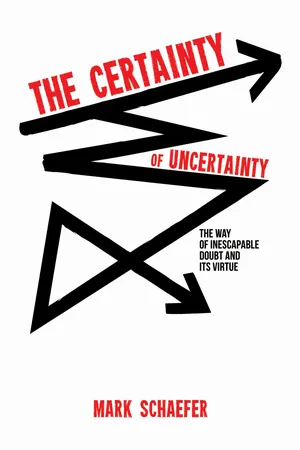
The world is full of people who are very certain--in politics, in religion, in all manner of things. In addition, political, religious, and social organizations are marketing certainty as a cure all to all life's problems. But is such certainty possible? Or even good?
The Certainty of Uncertainty explores the question of certainty by looking at the reasons human beings crave certainty and the religious responses we frequently fashion to help meet that need. The book takes an in-depth view of religion, language, our senses, our science, and our world to explore the inescapable uncertainties they reveal. We find that the certainty we crave does not exist.
As we reflect on the unavoidable uncertainties in our world, we come to understand that letting go of certainty is not only necessary, it's beneficial. For, in embracing doubt and uncertainty, we find a more meaningful and courageous religious faith, a deeper encounter with mystery, and a way to build strong relationships across religious and philosophical lines. In The Certainty of Uncertainty, we see that embracing our belief systems with humility and uncertainty can be transformative for ourselves and for our world.
Information
Topic
Theology & ReligionSubtopic
Christian TheologyPart I
The Quest for Certainty
Chapter 1
The One Thing Certain
By the time you finish reading this book, you could be dead.
It’s not that long a book, but even so, a car accident, a slip and fall, a random crime, a plane crash, a sudden and devastating disease, a heart attack, a brain aneurysm, or any other random lethal misfortune could claim your life before you get to the final page. Or not. The problem is that you don’t know which fate awaits you.
We, perhaps alone among the creatures that inhabit the globe with us, can contemplate our own mortality. We are aware of the basic fact that one day we will cease to exist. We are conscious of the reality of our inevitable deaths, but we don’t know what it all means or what, if anything, lies beyond death.
The Spanish philosopher and writer Miguel de Unamuno wrote that our fears and anxieties around death drove us to try to figure out what would become of us when we die. Would we “die utterly” and cease to exist? That would lead us to despair. Would we live on in some way? That would lead us to become resigned to our fate. But the fact that we can never really know one way or the other leads us to an uncomfortable in-between: a “resigned despair.”1
Unamuno refers to this “resigned despair” as “the tragic sense of life.” For Unamuno, this tragic sense of life created a drive to understand the “whys and wherefores” of existence, to understand the causes, but also the purposes, of life. The terror of extinction pushes us to try to make a name for ourselves and to seek glory as the only way to “escape being nothing.”2
There is an additional consequence to our mortality beyond this “resigned despair” and the “tragic sense of life.” Our awareness of our own mortality also creates a great deal of anxiety. Because we know neither the date nor the manner of our own deaths, we are left with unknowing and uncertainty, and are plagued by angst on an existential level.
There are two basic responses to that anxiety: acceptance and resistance. We could accept the reality of death, given that the mortality rate has remained unchanged at exactly one per person regardless of our attitudes toward death or attempts to deny it. But we seem to prefer resistance. This is not surprising; we have too many millions of years of evolutionary survival programming in us to surrender to non-existence without at least putting up something of a fight, even if we cannot ultimately win that fight. And when death does come, we bury and keep our dead, as if refusing to hand them over to the indifferent ground without one last act of defiant resistance.3
Some psychologists maintain that practically everything we do is a kind of resistance in reaction to our awareness of our mortality.4 This terror management theory posits that our desire for self-preservation coupled with our cognitive awareness of our inevitable deaths leads to a “terror” that can only be mitigated in two ways. First, we mitigate this terror with self-esteem—the belief that each of us is an object of primary value in a meaningful universe. Second, we mitigate our terror by placing a good deal of faith in our cultural worldview. The faith we put in a cultural worldview gives us a feeling of calm in the midst of dread. Our commitment to an understanding of the world around us makes us feel safe and secure in the face of our looming mortality.
However, when those same worldviews are threatened, so too is that feeling of calm. For that reason, we have to defend our worldviews at all cost because they protect us from facing the terror of our mortal lives.5 Preserving our worldviews is so central to staving off our existential dread that it turns out that the more we think about death and oblivion, the more invested we become in preserving those worldviews.6
It seems that one of our preferred methods of defending our worldviews and fending off this core terror is the attempt to establish as many certainties as possible, to know that there is something we can be certain of. In an effort to deny our mortality and the recognition that we are not ultimately in control of our own destinies, we try to control our world and one another and we seek to cling to as many certain truths as we can along the way.
We might be comfortable with uncertainties when they are restricted to trivial concerns or are unthreatening: the uncertainty of the solution to a crossword puzzle, or a sudoku, or a mystery novel are acceptable, and the resolution of those uncertainties with the solution to the puzzle or mystery brings a measure of emotional satisfaction. However, when the uncertainties involved deal with “real world” issues—whether we’ll have a long and healthy life, whether our beloved will be faithful to us, whether we’ll have job security, or whether we’ll find or maintain happiness—we are not as comfortable. In fact, we are more inclined to anxiety.7
This is especially true for the anxiety we feel about any of what psychotherapist Irvin Yalom calls the “four ultimate concerns”: death, freedom, existential isolation, and meaninglessness.8 We’re anxious about death. We’re anxious about the choices we have to make. We’re anxious about the fact that we enter and leave the world alone. And we’re anxious because we fear that life has no intrinsic meaning. All of this creates in us a desire to obtain as much control and certainty as we can. We become increasingly concerned with getting “closure” and resolving our uncertainty.9
Even when we’re not consciously looking for certainty to resolve our anxieties, we seek it out. It’s not that we’re even always consciously aware of our need for certainty; much of the drive to be certain is deep in our psychology. We are driven to be certain as a consequence of the fact that our thought processes are divided into two basic domains. As psychologist Daniel Kahneman argues, there is a fast-moving, automatic “system” that we’re barely aware of (System 1), and a slower, effort-filled process that includes deliberative thought and complex calculation (System 2).10 System 1 is designed for quick thinking and does not keep track of alternatives; conscious doubt is not a part of its functioning. System 2, on the other hand, embraces uncertainty and doubt, challenges assumptions, and is the source of critical thinking and the testing of hypotheses. However, System 2 requires a great deal more processing power and energy, and it can easily be derailed by distraction or competing demands on our brain power. Kahneman writes:
System 1 is not prone to doubt. It suppresses ambiguity and spontaneously constructs stories that are as coherent as possible. . . . System 2 is capable of doubt, because it can maintain incompatible possibilities at the same time. However, sustaining doubt is harder work than sliding into certainty.11
In short, certainty is easier on the brain than uncertainty is; uncertainty requires more mental effort.
Even beyond this function of the way our brains work, the human need to be certain is reinforced by the expectations of others. Experts are not paid high ...
Table of contents
- Title Page
- Author’s Preface
- Acknowledgments
- Abbreviations
- Part I: The Quest for Certainty
- Part II: The Inescapable Uncertainty
- The Inescapability of Uncertainty
- Part III: The Uncertain Way Forward
- Ending: The Certainty of Uncertainty
- Bibliography
Trusted by 375,005 students
Access to over 1.5 million titles for a fair monthly price.
Study more efficiently using our study tools.
Frequently asked questions
Yes, you can cancel anytime from the Subscription tab in your account settings on the Perlego website. Your subscription will stay active until the end of your current billing period. Learn how to cancel your subscription
No, books cannot be downloaded as external files, such as PDFs, for use outside of Perlego. However, you can download books within the Perlego app for offline reading on mobile or tablet. Learn how to download books offline
Perlego offers two plans: Essential and Complete
- Essential is ideal for learners and professionals who enjoy exploring a wide range of subjects. Access the Essential Library with 800,000+ trusted titles and best-sellers across business, personal growth, and the humanities. Includes unlimited reading time and Standard Read Aloud voice.
- Complete: Perfect for advanced learners and researchers needing full, unrestricted access. Unlock 1.5M+ books across hundreds of subjects, including academic and specialized titles. The Complete Plan also includes advanced features like Premium Read Aloud and Research Assistant.
We are an online textbook subscription service, where you can get access to an entire online library for less than the price of a single book per month. With over 1.5 million books across 990+ topics, we’ve got you covered! Learn about our mission
Look out for the read-aloud symbol on your next book to see if you can listen to it. The read-aloud tool reads text aloud for you, highlighting the text as it is being read. You can pause it, speed it up and slow it down. Learn more about Read Aloud
Yes! You can use the Perlego app on both iOS and Android devices to read anytime, anywhere — even offline. Perfect for commutes or when you’re on the go.
Please note we cannot support devices running on iOS 13 and Android 7 or earlier. Learn more about using the app
Please note we cannot support devices running on iOS 13 and Android 7 or earlier. Learn more about using the app
Yes, you can access The Certainty of Uncertainty by Mark Schaefer in PDF and/or ePUB format, as well as other popular books in Theology & Religion & Christian Theology. We have over 1.5 million books available in our catalogue for you to explore.