- 96 pages
- English
- ePUB (mobile friendly)
- Available on iOS & Android
eBook - ePub
About this book
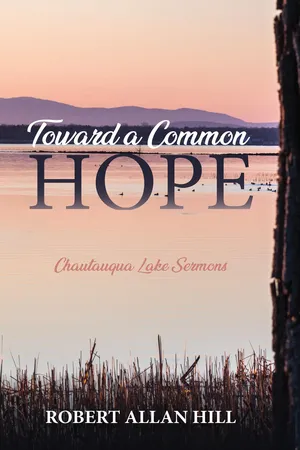
Our churches and our country long for an expression of common hope. Over the last century, venerable voices in affirmation of a common faith and a common ground have been lifted and heard in Boston, such as those of John Dewey and Howard Thurman. The Dean of Marsh Chapel, Robert Allan Hill, has preached on themes related to a common hope since 2006. Hill has lifted the theology of hope, of a common hope, at the marrow of the gospel. We cherish our forebears, who taught about a common faith and preached a common ground. In church and culture today in America, it is the prospect of a lasting, sturdy, shared hope, more purple than either blue or red, for which we hunger. The sermons about a common hope collected here were preached at the Chautauqua Institution in August of 2017.
Information
Topic
Theologie & ReligionSubtopic
Christlicher DienstCome Down Zacchaeus!
Luke 19:1–10
Sunday, October 30th, 2016
Reformation Sunday
Marsh Chapel at Boston University
Did we in our own strength confide Our striving would be losing Were not the Right Man on our side The Man of God’s own choosing Dost as who that may be?Christ Jesus it is He Lord Sabaoth His name From age to age the same And he must win the battle.51
It is hard for me to tell, from this angle, which tree you are in. Given the troubles of this autumn, it is hard for me to tell which tree I am in myself, day to day. Has life chased you up the tree of doubt? Or are you treed in the branches of idolatry—idol-a-tree? Are we shaking (or shaking in) the money tree? Or stuck without faith in the religion tree? Jesus calls us today, to come down out of the treeforts of our own making, and accept a loving relationship with Him. May we measure all with a measure of love.
Doubting Zacchaeus
Perhaps the presence of unexplained wrong provokes you to doubt the benevolence in life or the goodness in God. To doubt that “God is at work in the world to make and to keep human life human.”52 Randomness may have treed you.
No one can explain why terrible things happen as they do. But if you will come down a limb or two from your philosophical tree of doubt, the tree of the knowledge of good and evil, you may hear faith. God can bring good out of evil, and make bad things work to good. This is not a theological declamation, and certainly not a paean to providence. It is just something we can notice together.
We played golf one day. On the last hole, I pulled out a three wood and hit a grounder that, nonetheless, rolled right to the green. If I had connected, I would have smashed the clubhouse window, for it was way too much club. Sometimes a bad thing, a worm-burner golf shot, interferes with a really bad thing—a $1000 broken window.
One Sunday, years ago, I drove late to church. I used to run early Sunday and finish memorizing the sermon along the way, as I did on that Lord’s Day. I just forgot the time. We raced to church and, in so doing, I cut a corner, literally, and popped a car tire. I was not happy to hear my son say, “Haste makes waste.” You know, though, both rear tires were thin. I had replaced the front two months earlier and forgot about the rear ones. I have to admit, it was good that I had reason to replace them, before I had a blowout on the highway. Sometimes it happens that a bad thing prevents a really terrible thing from happening.
Joseph was thrown into a pit and sold into slavery. He had to find his way, as a Jew, in the service of the mighty Pharaoh. He did so with skill and rose to a position of influence, even with Potiphar’s wife chasing him around in his underwear. Then, a full generation later, a great famine came upon those brothers who had earlier sold Joseph down the river. They went to Pharaoh, looking for food. And who met them, as they came to plead? There was Joseph. He so memorably said, as written in Genesis: “You meant this for evil, but God meant it for good, that many might be saved” (Gen 50:20). Sometimes it happens that a bad thing in one generation prevents starvation in the next.
So in Jericho, as Jesus found the little man up in the tree, his fellows grumbled (Luke 19:8). Why would he take time with such a greedy, selfish person, who makes his living off the sweat of others’ brows? That hurts, to see divine attention given to those who have harmed you. Why would he have a meal with someone who takes no thought for the hurt of God’s people? This is bad! And it is. We miss the power of the parable if we do not see this. This is Jesus taking up with those who have wished the church ill, who have used the church for their own very well intended but nonetheless self-centered reasons. This is Jesus consorting with sinners. But sometimes a bad thing in the little brings a good thing in the large. Zacchaeus changes and, in so doing, provides great wealth for others’ benefit.
Come down from this one tree, doubting Zacchaeus. I know that bad things happen to good people and, as a pastor, hardly anything troubles me more. Sometimes, though, sometimes—not always, just sometimes—a bad thing early averts a really bad thing late. I have seen it and you have too. It is enough to give someone up the doubting tree a reason to come down at least a branch. Think of it as existential vaccination.
It is the labor of faith to trust that where sin abounds, grace over-abounds. Even in this autumn of anxiety and depression. But one of the redeeming possibilities in this season of cultural demise is the chance that, as a result, enough of us, now, will become committed to the realization of a just, participatory, and sustainable world, that these darker days will move us toward a fuller light. Sometimes a bad thing in one part of history protects us from a worse thing in another part.
Let us not lose sight of the horizons of biblical hope, as improbable as they can seem. The lion and the lamb. No crying or thirst. The crooked straight. All flesh.
The divine delight still comes from saving the lost, including the forgotten, seeking the outcast, retrieving the wayward sons and daughters of Abraham. God wants your salvation. Your salvation “has personal, domestic, social, and economic consequences.”53 Jesus Christ saves us from doubt.
So come down, Zacchaeus, come down from your perch in that comfortable sycamore tree, that comfortable pew, that skeptical reserve, that doubt. Come down, Zacchaeus! The Lord Jesus Christ has need of your household and your money, and He responds to your doubt.
Idolatrous Zacchaeus
Come down, Zacchaeus, down from your overly zealous leanings, hanging out on the branch of life. Idolatry comes when we make one or more of the lesser, though significant, loyalties in life to become a shadow of the one great loyalty, that which the heart alone owes to God. Zacchaeus had governmental responsibility, community status, a welcoming home, and a fine family; we can suspect he was loyal in these regards. Curious as he was, up on his branch, he had no relationship with the divine. Jesus invites him into this relationship. More precisely, Jesus invites himself into relationship with a man up a tree. He is invited into a whole new life, a new world of loving and faithful relationships that stem from the one great loyalty.
We need to be careful about lesser loyalties this fall.
Remember last week and our prayer for forgiveness of sin? We confessed lust, gluttony, avarice, sloth, anger, envy, and “integrity without humility”—pride. Say you were an attorney general in a state with a governor’s election ten days away. You find a folder on your desk, empty, but with a pending potential investigation. You feel that your integrity requires that you tell the whole inhabited earth about a pending possible investigation about which you know nothing. You remember your Boy Scout law (trustworthy, loyal, helpful, friendly, courteous, kind, obedient, cheerful, thrifty, brave, clean, and reverent), and decide your integrity requires a statement. But what of your humility? (The scout motto—a good turn daily—not just the law.) Humility would require you to consider due process, to consider past practice near elections, to consider the advice of your colleagues in law enforcement, and to consider the nuances of the situation and your conscience. Integrity alone bulldozes, blazes, and blasts past all these. Harm is done. Integrity without humility is the worst of the seven deadly sins—pride. When we grow up, sometimes, we recognize the peril of integrity alone, the great steed of integrity, without the bit, bridle, and saddle of humility—pride.
Yet all of this involves a lesser loyalty than the one owed to God. If we are not careful, we can forget whose water we were baptized into....
Table of contents
- Title Page
- Preface
- The Sermon on the Mound
- Marks of the New Age
- Exit or Voice?
- Sweet Chariot
- Forgiven
- Theological Temptations
- A Tradition of Principled Resistance
- A Little Summer Beauty
- Let Freedom Ring!
- Persistence in Prayer
- Come Down Zacchaeus!
- Bibliography
Trusted by 375,005 students
Access to over 1.5 million titles for a fair monthly price.
Study more efficiently using our study tools.
Frequently asked questions
Yes, you can cancel anytime from the Subscription tab in your account settings on the Perlego website. Your subscription will stay active until the end of your current billing period. Learn how to cancel your subscription
No, books cannot be downloaded as external files, such as PDFs, for use outside of Perlego. However, you can download books within the Perlego app for offline reading on mobile or tablet. Learn how to download books offline
Perlego offers two plans: Essential and Complete
- Essential is ideal for learners and professionals who enjoy exploring a wide range of subjects. Access the Essential Library with 800,000+ trusted titles and best-sellers across business, personal growth, and the humanities. Includes unlimited reading time and Standard Read Aloud voice.
- Complete: Perfect for advanced learners and researchers needing full, unrestricted access. Unlock 1.5M+ books across hundreds of subjects, including academic and specialized titles. The Complete Plan also includes advanced features like Premium Read Aloud and Research Assistant.
We are an online textbook subscription service, where you can get access to an entire online library for less than the price of a single book per month. With over 1.5 million books across 990+ topics, we’ve got you covered! Learn about our mission
Look out for the read-aloud symbol on your next book to see if you can listen to it. The read-aloud tool reads text aloud for you, highlighting the text as it is being read. You can pause it, speed it up and slow it down. Learn more about Read Aloud
Yes! You can use the Perlego app on both iOS and Android devices to read anytime, anywhere — even offline. Perfect for commutes or when you’re on the go.
Please note we cannot support devices running on iOS 13 and Android 7 or earlier. Learn more about using the app
Please note we cannot support devices running on iOS 13 and Android 7 or earlier. Learn more about using the app
Yes, you can access Toward a Common Hope by Robert Allan Hill in PDF and/or ePUB format, as well as other popular books in Theologie & Religion & Christlicher Dienst. We have over 1.5 million books available in our catalogue for you to explore.