- 130 pages
- English
- ePUB (mobile friendly)
- Available on iOS & Android
eBook - ePub
About this book
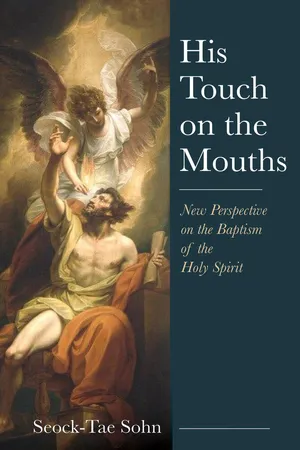
At Pentecost there was no fire. The divided tongues like fire came down to each one of the disciples and they spoke different languages so that all the people there could understand what they said without translators. In the OT times, God appointed his prophets by touching their mouths and putting his word into their mouths so that they might declare it to his people. Therefore, a prophet was the spokesman of God, and is usually called "the mouth of the Lord." Jesus, called the Word as well as God, came into this world as the great prophet for the ministry of the word. He taught the kingdom of God to his people and trained his disciples to be prophets after his departure. The risen Christ appointed his disciples to be prophets, giving them the ministerial task of the word and asking the Father to seal them as his prophets. Thus, the baptism of the Holy Spirit was the installation ceremony for the disciples to be the new covenant prophets, as it was for the prophets of OT times. The disciples were to go out to the ends of the earth to proclaim his word. Those baptized by water are simultaneously baptized by the Holy Spirit and are given the office of the new covenant prophet.
Information
Topic
Theology & ReligionSubtopic
Christian Church1
The Baptism of the Holy Spirit
The Promise of the Baptism of the Holy Spirit
The risen Christ appeared to his disciples in Jerusalem before his ascension and gave them his final instructions and commissions. After using the scriptures to explain the necessity of his death and resurrection (Luke 24:45–46), he declared that he had been given all authority and that “. . . repentance and forgiveness of sins should be proclaimed in his name to all nations, beginning from Jerusalem” (Luke 24:47). He further commanded them to stay in Jerusalem until they were “. . . clothed with power from on high” (Luke 24:49). In this way, Jesus appointed his disciples to be his worldwide witnesses, and he let them know that they would be empowered by the Holy Spirit to accomplish the mission he had given them. Jesus’ command to remain in Jerusalem (Luke 24:48–49) is repeated and expanded in Acts 1:4–5. The promise of the Holy Spirit closes the last scene of the Gospel of Luke and opens the first page of the book of Acts.
While staying with his disciples, Jesus ordered them not to depart from Jerusalem, but to wait for the baptism of the Holy Spirit, the promise of the Father which they heard from him (Acts 1:5). And in verse 8, Jesus again told his disciples that they are to be his witnesses: “You will receive power when the Holy Spirit has come upon you, and you will be my witnesses in Jerusalem and in all Judea and Samaria, and to the end of the earth.” In this commandment, Jesus linked the event of Pentecost to his appointment of the disciples as his worldwide witnesses. It should be noted that when Jesus was baptized with water, the Holy Spirit descended on him in bodily form like a dove (Luke 3:22), and this marked the beginning of his messianic ministry. In Acts 1, the disciples were told that they too would receive the Holy Spirit at the outset of their ministry. The Bible refers to this event as “baptism” accompanied with the Holy Spirit. The baptism of the Holy Spirit seemed to be a necessary condition and step in the process of becoming a servant of the Lord, and the event of Pentecost is basically related to the beginning of disciples’ ministry of the word.
The Coming of the Holy Spirit
The coming of the Holy Spirit at Pentecost was accompanied by the three unusual phenomena (Acts 2:2–4). First, there was an audible sound like a mighty rushing wind that came from heaven and filled the entire house. There was no actual mighty rushing wind, but rather simply a sound like the wind. The sound seems to have been a signal to capture the attention of the disciples in the room.1 Since both ruaḥ in the Old Testament and pneuma in the NT carry double meanings of wind and spirit, and Jesus also compares the Spirit to the wind (John 3:8), the disciples might have recognized this as the appearance and presence of the Spirit coming upon them. In Ezek 37: 9–11, the prophet describes the vision God gave him in which the wind, the breath of the Lord, comes down to the dry bones and breathes new life into them. Thus, the sound of a mighty rushing wind is a fanfare announcing the coming of the Holy Spirit and his presence among the disciples.2
Second, there was a visible phenomenon: divided tongues as of fire rested on those who were in the upper room. The Greek text for Acts 2:3, “kai ōpthēsan autois diamerizomenai glōssai hōsei pyros kai ekathisen ep’ hena hekaston autōn,” can be translated as “and the divided tongues as of fire appeared to them and rested on each of them.” However, some versions take the translation of “diamerizomenai glōssai hosei pyros” to mean “tongues of fire that separated” (NIV). This means that the fire, like divided tongues, came from above and rested on each one of them. This would certainly have been a spectacular and dramatic scene, if it truly happened this way. If this were the case, the fire could possibly refer to God’s presence and rest among them (Exod 3:2; 19:18; 1 Kgs 18:38; Ezek 1:27).3 However, there was no actual fire. Rather, there were “divided tongues like fire.” A number of translations convey the correct literal meaning: ESV, “divided tongues like as of fire”; NET, “tongues spreading out like a fire”; NAS, “tongues as of fire distributing themselves”; KJV, “cloven tongues like as of fire.” Num 9:15–16 gives us a hint for this translation. There was no fire of cloud, rather “was the appearence of fire on the tabernacle”(yiheh ’al-hammiškān kemar’ēh-’ēš) when it was set up. Calvin translated it as follows: “And they saw cloven tongues, as it were of fire, and it sat upon every one of them.”4 Many modern scholars, however, translate this as the NIV does, drawing various interpretations from it. As he explains the baptism of the Holy Spirit, Gaffin states that “the presence of the fire in the form of a tongue” rested upon the disciples of Jerusalem.5
What is the meaning of the cloven tongues coming down to the disciples and why were the tongues in the form of fire? For this answer, we need to remind the scene of God’s calling his prophets in the Old Testament.
Moses was called by the angel of the Lord in a flame of fire out of the midst of a bush that was burning, yet was not consumed (Exod 3:3). The Lord said to him as he turned aside to see the great sight, “Do not come near, take your sandals off your feet, for the place on which you are standing is holy ground.” The Lord called Moses in the flame of burning fire on the holy ground. Samuel was called in the house of the Lord, when the lamp of God has not yet gone out (1 Sam 3:3–4).
Isaiah was called in the temple, where the Lord was sitting upon a high and lifted throne and the seraphim were praising and flying around the Lord and the foundation of the threshold was shaking at the voice of him who called and the house was filled with smoke.
Ezekiel saw a divine vision at the Kebar river in the land of Babylonia. He saw a windstorm coming from the north—enormous clouds, with lightning flashing. In the fire were what looked like four living beings with four faces and four wheels. Over the heads of the living beings there was a something like platform and above the platform, which was something like a sapphire-shaped throne. High above on the throne was a form that appeared to be a man. From his waist up was an amber glow like a fire and from his waist down was a brilliant light around it. It looked like the glory of the Lord. This scene of the temple in the universe that Ezekiel saw was more glorious than that of heavenly temple Isaiah saw. Ezekiel was called from this background of universal temple (Ezek 1).
When he began his all-out prophetic ministry, Daniel saw four winds of the sky stirring up the great sea and four large beasts coming up from sea. The heavenly thrones of God were set up and his throne was ablaze with fire and its wheels were all aflame. A river of fire was streaming forth and proceeding from his presence (Dan 7:9–10). From this background he saw “one like a son of man was approaching” with the cloud of the sky.
As we observe the scenes of God calling his prophets, fire or fire-like images accompany them. The glory, grandeur, an...
Table of contents
- Title Page
- Preface
- Abbreviations
- Introduction
- Chapter 1: The Baptism of the Holy Spirit
- Chapter 2: The Prophets: The Mouth of the Lord
- Chapter 3: The Great Prophet
- Chapter 4: The Great Prophet Appoints His Disciples as Prophets
- Chapter 5: The Activities of the New Covenant Prophets
- Chapter 6: The Related Themes and Their Applications
- Conclusion
- Bibliography
Trusted by 375,005 students
Access to over 1.5 million titles for a fair monthly price.
Study more efficiently using our study tools.
Frequently asked questions
Yes, you can cancel anytime from the Subscription tab in your account settings on the Perlego website. Your subscription will stay active until the end of your current billing period. Learn how to cancel your subscription
No, books cannot be downloaded as external files, such as PDFs, for use outside of Perlego. However, you can download books within the Perlego app for offline reading on mobile or tablet. Learn how to download books offline
Perlego offers two plans: Essential and Complete
- Essential is ideal for learners and professionals who enjoy exploring a wide range of subjects. Access the Essential Library with 800,000+ trusted titles and best-sellers across business, personal growth, and the humanities. Includes unlimited reading time and Standard Read Aloud voice.
- Complete: Perfect for advanced learners and researchers needing full, unrestricted access. Unlock 1.5M+ books across hundreds of subjects, including academic and specialized titles. The Complete Plan also includes advanced features like Premium Read Aloud and Research Assistant.
We are an online textbook subscription service, where you can get access to an entire online library for less than the price of a single book per month. With over 1.5 million books across 990+ topics, we’ve got you covered! Learn about our mission
Look out for the read-aloud symbol on your next book to see if you can listen to it. The read-aloud tool reads text aloud for you, highlighting the text as it is being read. You can pause it, speed it up and slow it down. Learn more about Read Aloud
Yes! You can use the Perlego app on both iOS and Android devices to read anytime, anywhere — even offline. Perfect for commutes or when you’re on the go.
Please note we cannot support devices running on iOS 13 and Android 7 or earlier. Learn more about using the app
Please note we cannot support devices running on iOS 13 and Android 7 or earlier. Learn more about using the app
Yes, you can access His Touch on the Mouths by Seock-Tae Sohn in PDF and/or ePUB format, as well as other popular books in Theology & Religion & Christian Church. We have over 1.5 million books available in our catalogue for you to explore.