eBook - ePub
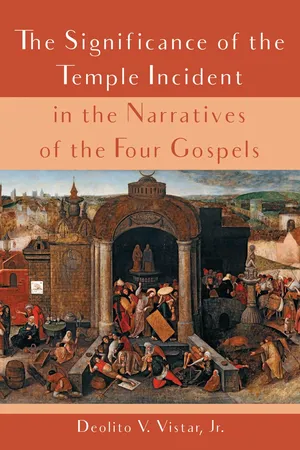
The Significance of the Temple Incident in the Narratives of the Four Gospels
- 164 pages
- English
- ePUB (mobile friendly)
- Available on iOS & Android
eBook - ePub
The Significance of the Temple Incident in the Narratives of the Four Gospels
About this book
Deolito Vistar brings a new perspective to the interpretation of the temple incident--a key event in Jesus' life--by approaching the subject not from the "historical Jesus" point of view but from that of the authors of the Gospels. Using composition criticism as a method, Vistar sensitively analyzes the four Gospels' accounts of the incident and shows areas of commonalities and crucial areas where the four evangelists have their own distinctive understanding of what Jesus meant by his protest in the temple. This book is a helpful example of the use of composition analysis in the exegesis of Gospel texts. It is also a helpful study of what is now generally taken for granted in Gospel scholarship: that the four evangelists were both historians and theologians.
Information
1
Introduction
Introductory Remarks
Jesus’ protest in the temple, referred to here simply as the temple incident,1 recorded by all four evangelists,2 can provide much insight for our understanding of Jesus, Judaism, and the relations between the two. It is perhaps for this reason that a host of interpreters have engaged this pericope for a very long time now with varying results.3 Treatments of this subject have appeared in monographs and journals, and many commentaries have unsurprisingly also taken it up at length.4
Two observations can be made about most of these scholarly efforts. First, scholars have focused their attention mainly on the question of the probable motivation of the historical Jesus for his actions. Why did Jesus protest in the temple precincts? What was he protesting against? This focus has resulted in several varying, and often conflicting, proposals and conclusions. What seems clear, however, is that, insofar as the records of the evangelists are concerned, Jesus seemed to have had multiple purposes or motivations (though not of equal importance).5 So it seems that scholarly preoccupation on the probable motivation of the historical Jesus has had its run, and that it is time for a shift of focus.
Second, one such area that has not yet been sufficiently investigated is the narratival meaning or significance that the temple incident plays in the Gospels. Put differently, what significance has each evangelist sought to invest into the temple incident as he composed his respective Gospel? I am here using the word “significance” to mean meaning. Hence in this study the question “What is the significance of the temple incident according to John?” is equivalent to the question of the meaning of the incident within the narrative of John’s Gospel. The reason for this decision is apparent: “meaning” is itself a very fluid, ambiguous, and confusing word. So it is helpful here to define it by the word “significance” and to locate that within the whole of a given narrative itself.
It is now a general consensus that the evangelists were historians and theologians alike.6 Long gone is the assumption that the evangelists were disinteresred “copy-paste” editors or collectors of first-century traditions. The evangelists composed their respective Gospel accounts with predetermined goals and emphases, which are accessible to us via the Gospel texts.
Aim and Objectives
The aim of this study is to contribute to a better understanding of the significance of the temple incident in each of the canonical Gospels. To achieve this, the following objectives will be pursued.
First, we will identify, state, and analyze the immediate and broader contexts of each Gospel. By broader contexts I mean the big picture of the Gospels, and in pursuit of that we need to touch on issues of probable authorship, dating, recipients, occasion of writing, purposes, emphases, and outline. Immediate contexts pertain to what immediately surrounds the temple incident pericope. For example, in the case of the Mattean temple incident (21:12–13), the immediate contexts include Jesus’ entry into Jerusalem (21:1–11) and his acts of healing in the temple (21:14–17).
Second, we will analyze the language and thought of the subject-pericope and express its main idea. Third, we will try to establish the connections of the main idea to the overall message and main emphasis of each Gospel. Finally, we will enunciate the meaning of the temple incident in the light of all of the above.
Central Argument
The central theoretical argument of this book is that the significance of the temple incident is established by each evangelist according to his literary and theological purposes. Therefore, its significance (“meaning”) varies from one evangelist to another.
The significance of the temple incident in Matthew is that it assists the readers to see Jesus as the prophesied Davidic Messiah who has authority over and concern for the temple. Jesus expresses that authority and concern not by cursing the temple but by clearing it of sellers and buyers, allowing the blind and the lame into the temple and healing them there, and receiving acclaim from children gathered in the temple precincts who acclaim him as the Son of David.
The significance of the temple incident in Mark is that it symbolizes God’s sovereign and righteous judgment upon the temple for its apparent failure to produce fruits that God had desired. Jesus’ actions—driving out the sellers and buyers and the animals, overturning tables and chairs, and blockading the passage of goods—must be seen not as acts of cleansing but as symbolic of the dissolution of the temple as a result of God’s judgment.
The significance of the incident in Luke lies in its balancing two realities about the temple: that it is under God’s rightful judgment and that, nevertheless, it still serves as a venue for Jesus’ ministry of teaching and healing.
Finally, the significance of the incident in John lies in what it affirms about John’s view of Jesus as not only the ultimate sacrifice for the salvation of the world, but also as the new temple superseding the temple in Jerusalem.
Presuppositions and Methodology
The main methodology employed in this study is a variation of composition criticism. According to Randall Tan, composition criticism is a kind of redaction criticism that “locates the patterns and emphases of the evangelists without systematically identifying or separating out redaction from tradition,” in contrast to another kind of redaction criticism that “looks for the evangelists’ theology in the redactional text after separating out redaction from tradition by means of source and form criticism.”7 Some works that have employed composition criticism are O’Toole’s study of Luke (1984) and Kingsbury’s study of Matthew (1975). More recent works include Willits (2007) and Hood (2011).
Specifically, composition criticism employed in this study will be characterized by the following. First, a focus on the work itself, that is, on the final text rather on the putative sources. The working presupposition is that “the work itself, viewed vigorously and persistently in its entirety, becomes the primary context for interpreting any part of it.”8 Second,...
Table of contents
- Title Page
- Acknowledgments
- Abbreviations
- Chapter 1: Introduction
- Chapter 2: The Significance of the Matthean Temple Incident
- Chapter 3: The Significance of the Marcan Temple Incident
- Chapter 4: The Significance of the Lucan Temple Incident
- Chapter 5: The Significance of the Johannine Temple Incident
- Chapter 6: Synthesis and Conclusions
- Appendix 1: Summative Comparison of the Four Gospels’ Reports of the Temple Incident
- Appendix 2: Comparison of the Synoptic Gospels’ Accounts of the Temple Incident
- Appendix 3: Comparison of Mark’s and John’s Accounts of the Temple Incident
- Bibliography
Trusted by 375,005 students
Access to over 1.5 million titles for a fair monthly price.
Study more efficiently using our study tools.
Frequently asked questions
Yes, you can cancel anytime from the Subscription tab in your account settings on the Perlego website. Your subscription will stay active until the end of your current billing period. Learn how to cancel your subscription
No, books cannot be downloaded as external files, such as PDFs, for use outside of Perlego. However, you can download books within the Perlego app for offline reading on mobile or tablet. Learn how to download books offline
Perlego offers two plans: Essential and Complete
- Essential is ideal for learners and professionals who enjoy exploring a wide range of subjects. Access the Essential Library with 800,000+ trusted titles and best-sellers across business, personal growth, and the humanities. Includes unlimited reading time and Standard Read Aloud voice.
- Complete: Perfect for advanced learners and researchers needing full, unrestricted access. Unlock 1.5M+ books across hundreds of subjects, including academic and specialized titles. The Complete Plan also includes advanced features like Premium Read Aloud and Research Assistant.
We are an online textbook subscription service, where you can get access to an entire online library for less than the price of a single book per month. With over 1.5 million books across 990+ topics, we’ve got you covered! Learn about our mission
Look out for the read-aloud symbol on your next book to see if you can listen to it. The read-aloud tool reads text aloud for you, highlighting the text as it is being read. You can pause it, speed it up and slow it down. Learn more about Read Aloud
Yes! You can use the Perlego app on both iOS and Android devices to read anytime, anywhere — even offline. Perfect for commutes or when you’re on the go.
Please note we cannot support devices running on iOS 13 and Android 7 or earlier. Learn more about using the app
Please note we cannot support devices running on iOS 13 and Android 7 or earlier. Learn more about using the app
Yes, you can access The Significance of the Temple Incident in the Narratives of the Four Gospels by Deolito V. Vistar Jr. in PDF and/or ePUB format, as well as other popular books in Théologie et religion & Critique et interprétation bibliques. We have over 1.5 million books available in our catalogue for you to explore.