- 190 pages
- English
- ePUB (mobile friendly)
- Available on iOS & Android
eBook - ePub
About this book
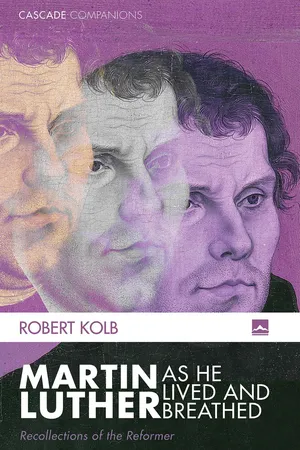
Luther's oft-recounted life made a profound impact on his contemporaries. Some revered him; some hated him. This volume provides a brief narrative of the unfolding events that took place from his birth to a young entrepreneurial family through his turbulent career as university professor and public figure to his death while on a mission to reconcile a feuding princely family. Following parts of this narrative come "interviews" with friends and foes of his time, taken from a variety of sixteenth-century sources that present this dominating reformer and the passions that possessed both those who found him to be God's end-time prophet and those who hated all that he stood for because they believed it was destroying their world.
Information
Topic
Teología y religiónSubtopic
Denominaciones cristianasChapter 1
Stations of Childhood and Youth
Late medieval custom around the village of Möhra, nestled in the hill country at the northwest corner of the Thuringian Forest, dictated that the youngest son inherit the farm. Therefore, Hans Luder, eldest son of one of the four most well-off peasant families in the village, on his mother’s side grandson of the Zieglers, perhaps the most prosperous in Möhra, left home to seek his livelihood elsewhere. He married Margarete Lindemann from Eisenach, a town a little less than ten miles north of Möhra, where his father may well have gotten to know the Lindemann family as he took his produce to market there. The Lindemanns, a merchant family, had sent at least one son on for university education at the University of Leipzig and a career as a counselor at the Saxon ducal court.
Why Hans and Margarete moved north to the county of Mansfeld, first to Eisleben, where their son Martin was born and then to the town of Mansfeld, where he grew up, is unclear. Mansfeld county was boom country at the time. New mining techniques enabled men to penetrate more deeply into the earth to find the stores of metals, copper among them, in Mansfeld. Margarete’s uncle Anton Lindemann had come to Mansfeld and established himself as a smelter-master at the end of fifteenth century. He may have aided the young couple in finding a place in the hustle and bustle of the developing industry in Mansfeld.
In any case, Hans Luder moved quickly from mining the earth to smelting copper ore. He sometimes struggled with bankers practicing the developing procedures of early modern capitalism, but he succeeded in building a business that he passed on to his younger son Jacob. His older son, Martin, he had destined for a university education in law, perhaps following consciously the model of his Lindemann relatives. He was hoping for a lawyer who could administer his growing business or win a fine post in the early modern bureaucracy of the Mansfeld counts or their Saxon ducal neighbors. Yet his business fell on hard times, and his son rose even higher in the late medieval world, to become a university professor, a professor in the queen of the sciences, theology.
Born November 10, 1483, and baptized the next day, the festival of Saint Martin, the first of Hans’s and Margarete’s nine (or more) children, Martin changed the spelling of his name to Luther in his midthirties. He was following the custom of blossoming scholars at the time by taking a Greek model for his name—transforming “Luder” into “Luther” because his theological development was liberating him from old scholastic methods through the insights of those called biblical “humanists,” and he saw himself a “free man” (in Greek, eleutherios). Almost three decades earlier, little Martin had begun school at age seven, walking the couple hundred meters up the hill, past the doors of Saint George’s Church, to the school, just across the valley from the counts’ castle perched high on the opposite bluff. Castle, church, school, and the bustle of a boomtown with its peasant miners formed Martin Luther’s consciousness.
His religious upbringing in a home with typical medieval piety cultivated in him a sense that he needed to perform the sacred rites and other religious activities that would endear him to God. Divine favor could be expected in return for little Martin’s proper attention to his religious duties. Bible stories shaped his thinking as he heard them told at home, in school, and in church. But he probably did not distinguish David battling Goliath sharply from the mythical tale of Saint George slaying the dragon, as the latter’s story was depicted in the church up the hill. Little Martin learned that his attendance at mass and occasional confession of his sins to the priest would contribute to guaranteeing his pathway through life and purgatory into heaven.
His image of what it means to be Christian took form in the pious practices of his home and the basic religious instruction in the school. Changes in that image had certainly taken place in the seven centuries since Frankish conquerors had baptized whole villages and clans of Thuringian residents, but the structures of the faith had retained forms inherited from ancient Germanic religions. The church had lacked adequate personnel to catechize and preach in the first centuries of Thuringian Christianity. This resulted in Christian names and concepts being placed into the traditional religious configuration of human life. This worldview inherited from the earlier Germanic religious perception of reality presumed that contact with the divine was established and maintained by human beings through proper performance of sacred rituals and religious activities. Moral performance played a role as well in practicing the faith in a way that pleased God. But it was attending mass, observing appointed fast days, going on pilgrimages to sacred places near or far, and similar religious activities played the key roles in the individual’s relationship to God. God’s grace was more often mentioned than understood.
All Christians had access to heaven if they received absolution for mortal sins from their priest. But all anticipated extensive time in purgatory on their way to heaven. There they would receive the temporal punishment earned by their sins. The guilt of these sins had theoretically been taken away by the absolution pronounced by their priest. The shorter but steeper path toward heaven lay through the monastery or service as a priest. Those in the holy orders or in callings of priest, monk, or nun were obligated to keep the “evangelical counsels” above and beyond God’s commandments. These “counsels” included strict obedience to superiors, abstinence from all sexual relationships, and poverty. Observing these counsels would accelerate the winning of the merit necessary to come before God’s terrible throne of judgment. Hans Luder, like most of his contemporaries, occasionally expressed his contempt for priests, but he supported the local church. He paid his dues as a member of a fraternity in Mansfeld that funded masses for departed members to help win their release from purgatory.
The fifteenth century witnessed a growing spiritual restlessness. More and more people were striving harder and harder to do sufficient good works to merit God’s grace. They hoped that their striving would bring forgiveness and the ability to perform truly good works that would please God and qualify them for heaven. But uncertainty about the true worth of their performance haunted them. Therefore, church officials were making grace easier and easier to obtain. For instance, they reduced the required performance or cash payment for “indulgences.” Indulgences released those who purchased them from obligations that met God’s demand for temporal punishment after sins had been forgiven by a priest in the sacrament of penance.
Hans and Margarete Luder’s son grew up with an extremely sensitive conscience that found cheaper grace no help for himself, a poor sinner in the presence of a rightfully angry and unaccepting God. Young Martin saw this God depicted on many an altarpiece as Christ with the sword of judgment in hand. Luther’s world took seriously the invasion of daily life not only by the straying of the pious themselves but also by the demonic. In addition, demons took possession of people or interfered with the normal processes of nature and human activity. But his perception of his own failings and shortcomings dominated young Martin’s consciousness. Life was fragile, death an imminent and horrific threat.
Little Martin learned the basics of Latin grammar and a smattering of rhetoric and logic in Mansfeld. Then he went off with his friend Hans Reinecke to attend school in Magdeburg, one of the five largest metropolises in the German empire, for a year, 1497–1498. After that year he made his way to his mother’s hometown, Eisenach, to gain solid preparation for university education. His three years in Eisenach provided him a firm basis for his further education. Whether or not one of his instructors at Eisenach’s Latin school, attached to the church of Saint George, actually doffed his hat out of respect for the future accomplishments of his pupils (as some sixteenth-century reports relate), Martin received his grounding in the basics of medieval learning by studying the trivium—the language arts of grammar, logic or dialectic, and rhetoric—and the quadrivium—the mathematical arts of arithmetic, geometry, astronomy, and music.
Why he did not live with his Lindemann relatives is not known. The family of Heinrich Schalbe, with whom he did board, provided him with a loving atmosphere and a stimulating spiritual environment. Heinrich Schalbe was entering into the last of his four years as the chief mayor of Eisenach; it is likely that a place in his home came only with the kind of connections that the Lindemann family could have supplied. As part of the leading circles of civic government, and fitting for their station in life, the Schalbes were absorbing the fruits of the new methods of teaching and learning generated by groups of “biblical humanists.” These were scholars interested in the humanities, committed to recovering and reading original sources from the ancient world in the ancient languages: Latin, Greek, and Hebrew. They cultivated good communication, emphasizing rhetoric because they found it necessary to turn what could be logically formulated into words that persuaded and moved hearers. In Heinrich Schalbe’s household his daughter Ursula and her husband Kunz von Cotta also befriended the family’s young boarder. Ursula’s little brother Caspar and Martin trekked together to the school of Saint George nearby each day.
The Schalbes had organized a circle of pious friends, and they turned to friars from the Franciscan cloister in the town to direct their meditation and pious exercises. Confined in the Franciscan cloister at the time was a charismatic brother, Johann Hilten, who died during Luther’s time in the town. The young schoolboy may never have met Hilten, but he undoubtedly heard of his call for reform according to a strict adherence to monastic discipline. Young Martin must also have heard of Hilten’s prediction that soon, as the world was about to come to its end, a prophet would arise to prepare the way for Christ’s return.
Among Eisenach’s churches, the foundation of Saint Mary also offered pupils a source of spiritual care. Foundation churches were established ...
Table of contents
- Title Page
- Introduction
- Chapter 1: Stations of Childhood and Youth
- Chapter 2: The Cloister and Further Studies
- Chapter 3: The Maturation of a Theologian
- Chapter 4: The Media Revolution and the Thickets of Controversy
- Chapter 5: Worms, the Wartburg, and Wittenberg
- Chapter 6: 1525, a Year of Crisis
- Chapter 7: The Institutionalization of the Movement
- Chapter 8: The New Normal of the 1530s and 1540s
Trusted by 375,005 students
Access to over 1.5 million titles for a fair monthly price.
Study more efficiently using our study tools.
Frequently asked questions
Yes, you can cancel anytime from the Subscription tab in your account settings on the Perlego website. Your subscription will stay active until the end of your current billing period. Learn how to cancel your subscription
No, books cannot be downloaded as external files, such as PDFs, for use outside of Perlego. However, you can download books within the Perlego app for offline reading on mobile or tablet. Learn how to download books offline
Perlego offers two plans: Essential and Complete
- Essential is ideal for learners and professionals who enjoy exploring a wide range of subjects. Access the Essential Library with 800,000+ trusted titles and best-sellers across business, personal growth, and the humanities. Includes unlimited reading time and Standard Read Aloud voice.
- Complete: Perfect for advanced learners and researchers needing full, unrestricted access. Unlock 1.5M+ books across hundreds of subjects, including academic and specialized titles. The Complete Plan also includes advanced features like Premium Read Aloud and Research Assistant.
We are an online textbook subscription service, where you can get access to an entire online library for less than the price of a single book per month. With over 1.5 million books across 990+ topics, we’ve got you covered! Learn about our mission
Look out for the read-aloud symbol on your next book to see if you can listen to it. The read-aloud tool reads text aloud for you, highlighting the text as it is being read. You can pause it, speed it up and slow it down. Learn more about Read Aloud
Yes! You can use the Perlego app on both iOS and Android devices to read anytime, anywhere — even offline. Perfect for commutes or when you’re on the go.
Please note we cannot support devices running on iOS 13 and Android 7 or earlier. Learn more about using the app
Please note we cannot support devices running on iOS 13 and Android 7 or earlier. Learn more about using the app
Yes, you can access Martin Luther as He Lived and Breathed by Robert Kolb in PDF and/or ePUB format, as well as other popular books in Teología y religión & Denominaciones cristianas. We have over 1.5 million books available in our catalogue for you to explore.