eBook - ePub
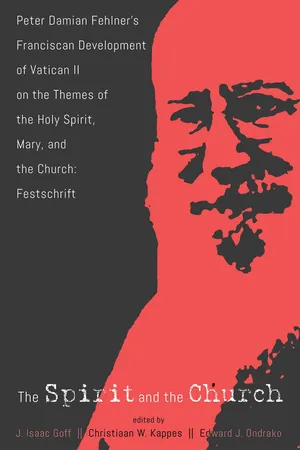
The Spirit and the Church
Peter Damian Fehlner’s Franciscan Development of Vatican II on the Themes of the Holy Spirit, Mary, and the Church—Festschrift
- 296 pages
- English
- ePUB (mobile friendly)
- Available on iOS & Android
eBook - ePub
The Spirit and the Church
Peter Damian Fehlner’s Franciscan Development of Vatican II on the Themes of the Holy Spirit, Mary, and the Church—Festschrift
About this book
The Spirit and the Church celebrates the life and legacy of Peter Damian Fehlner, OFM Conv., who for the past six decades has carried the torch of the Franciscan theological and philosophical vision in the fields of ecclesiology, pneumatology, Mariology, and anthropology. Articles by colleagues, former students, and associates fall into three broad categories, corresponding with several of the main areas in which Fehlner has made a longstanding scholarly contribution: the Church's Magisterium and development of doctrine, anthropology,comma and creation; the relation between Mariology, pneumatology, and ecclesiology; and scholarly seeds planted by Fehlner now being cultivated and harvested by younger scholars. All of the essays in this volume engage with Fehlner, evaluate his contributions, and build upon and expand in new directions the contributions of our honoree. The essays in this volume manifest the contemporary relevance of Fehlner's Franciscan vision in terms of his invitation to renew the theology of the Church in a Marian mode in the light of Vatican II.
Information
Topic
Theology & ReligionSubtopic
Christian DenominationsPart 1
The Church, the Dignity of the Person, and Creation
1
The Franciscan Thesis as Presented by Father Peter Damian Fehlner and the Magisterium
I. The Franciscan Thesis as Articulated by Father Peter Damian
In the course of almost thirty years I have learned a great deal about Mariology from Father Peter Damian Fehlner. He is a disciple and master of that uniquely Franciscan approach to the doctrine of the joint predestination of Jesus and Mary known as the Franciscan thesis. His exposition of this doctrine on the Mariology and scholarly achievement of Father Juniper B. Carol (1911–1990) at the convention of the Mariological Society of America in 19921 made a deep impression on me. In introducing the contribution of Juniper Carol, he found it appropriate to treat of the accomplishment of Father Juniper’s master and guide in the field of Franciscan Mariology, Father Carlo Balić (1899–1977):
Fr. Balić’s contribution to Mariology is, therefore, unabashedly Franciscan in inspiration. It takes its cue from the so-called Franciscan thesis: the absolute primacy of the Word Incarnate (Kingship of Christ) and his Blessed Mother’s association uno eodemque decreto in that primacy (qua Immaculate Queen of heaven and Earth), an association particularly evident at three points in the life of the Virgin: her conception, her cooperation in the work of salvation, her triumph in heaven or put doctrinally: the Immaculate Conception; the universal maternal mediation of Mary; and her glorious Assumption and Coronation in heaven as Queen of the Universe.2
The allusion, of course, to uno eodemque decreto is a shorthand reference to the famous text wherein the Franciscan thesis passed into the papal magisterium in Blessed Pius IX’s Apostolic Constitution Ineffabilis Deus in which he solemnly declared the dogma of the Immaculate Conception. In that authoritative document Pius stated that God
by one and the same decree, had established the origin of Mary and the Incarnation of Divine Wisdom [ad illius Virginis primordia transferre, quæ uno eodemque decreto cum divinæ Sapientiæ incarnatione fuerant præstituta].3
This is to say that from all eternity in willing the Incarnation of the Word, the second person of the Most Blessed Trinity, God also willed Mary. This may seem to be a simple and obvious statement in itself until one begins to realize that God could have brought the Incarnation about in any way that he wished since he needed no one to accomplish it, but he willed to “need” Mary. This position in based on the union of the woman of Genesis 3:15 with her offspring. Together, though not on an equal par, they will overcome the serpent. But first of all, they are willed for themselves as the crown of the material creation. Thus, as Father Peter Damian tells us, the joint predestination of Jesus and Mary is “at the very center of the divine counsels of salvation”4 and for this reason “the mode of the Incarnation is Marian, not only in its first moment, but in every moment, above all the last.”5 This statement, then, by Blessed Pius IX in Ineffabilis Deus marks the first time that this position, long sustained and taught by Franciscan theologians, entered into the papal magisterium. This theological conviction in fact is not original to Franciscan theologians because, as Father Peter Damian explains, its roots
antedate both Scotus and Francis himself. It is Franciscan, not by reason of origin (in this it is rather Catholic), but by reason of its promotion, of its being rendered more explicit and then more effectively incorporated into the life of the Church, as St. Maximilian Kolbe would say.6
The statement that Father Peter makes in parenthesis is very important. This position is ultimately Catholic and we owe our gratitude to the Franciscan family for having consistently sustained it and taught it. Ultimately, as he explains:
Mary in some intrinsic manner pertains as no other person to the order of the hypostatic union, the grace of graces and source of all order and intelligibility both in the economy of salvation and in creation. To this fact and to the special place enjoyed by Mary in the economy of salvation, both in relation to the mystery of Jesus and of the Church (cf. Lumen Gentium, ch. 8, title), the whole of revelation affords abundant witness (as sketched out in Lumen Gentium, nn. 55ff).7
In the first part of his magisterial article, “The Predestination of the Virgin Mother and Her Immaculate Conception” in the Mariology volume edited by Mark Miravalle Father Peter laments the fact that treatment of the predestination of Mary has all but disappeared from Mariological study.8 We are grateful that his study in that volume once more presents it to a wide audience. From the perspective of Blessed John Duns Scotus (c. 1266–1308), whose faithful disciple Father Peter has ever remained, he explains that
Whereas the fullness of grace in Mary is in view of the foreseen merits of her Son, the participation in grace by all others is in view of the mediation of Jesus and Mary. Because of the fact of sin on the part of Adam and Eve, that mediation of Christ, when realized historically after the tragic event of original sin and the fall of the angels, is in fact redemptive as well as saving: preservatively in Mary (and in a subordinate way in the angels who did not fall) and liberatively in all others. In Mary redemption is her Immaculate Conception; in us it is our liberation from sin. In both cases redemption is the term of divine mercy: more perfectly, however, in Mary than in us, and in us dependently on its realization in the Immaculate.9
Father Peter goes on to underscore a point often overlooked by the critics of Scotus.
In the joint predestination of Jesus and Mary, the distinctive personal roles of Jesus and Mary are not confused, nor does their coordination with a single work of mediation put Mary on a par with Jesus, any more than the capacity of the blessed to think and love in the mode of divine persons (a kind of coordination, anticipated in the divine indwelling by grace) put them on a par with the divine persons. Such coordination, heart of the supernatural order of grace, rests ever on a radical subordination. In this joint predestination Jesus is ordained absolutely for his own sake, and Mary for the sake of Jesus and no other, not even herself. Yet in virtue of the very grace of the Immaculate Conception whereby she totally belongs to Jesus and to the Church as Mother, she is ennobled in a most personal way, thereby revealing how grace transforms and perfects the person.10
While it would be possible to outline Father Peter Damian’s thought on this topic more extensively, I trust that this serves as a useful foundation. One can find more in the vast number of his Mariological works, especially in his article in Mariology.
II. The Confirmation of the Thesis in the Magisterium
Since the statement by Blessed Pius IX that by one and the same decree, God established the Incarnation of Divine Wisdom and the origin of Mary, this conviction has been restated on numerous occasions in the papal and concili...
Table of contents
- Title Page
- Contributors
- Homage to Fr. Peter Damian Fehlner
- Editors’ Acknowledgments
- Introduction
- The Writings of Peter Damian Fehlner, FI/OFM Conv. (1960–2018)
- Part 1: The Church, the Dignity of the Person, and Creation
- Part 2: Mary and the Holy Spirit
- Part 3: Scholarly Explorations in the Spirit of Peter Damian Fehlner
Trusted by 375,005 students
Access to over 1.5 million titles for a fair monthly price.
Study more efficiently using our study tools.
Frequently asked questions
Yes, you can cancel anytime from the Subscription tab in your account settings on the Perlego website. Your subscription will stay active until the end of your current billing period. Learn how to cancel your subscription
No, books cannot be downloaded as external files, such as PDFs, for use outside of Perlego. However, you can download books within the Perlego app for offline reading on mobile or tablet. Learn how to download books offline
Perlego offers two plans: Essential and Complete
- Essential is ideal for learners and professionals who enjoy exploring a wide range of subjects. Access the Essential Library with 800,000+ trusted titles and best-sellers across business, personal growth, and the humanities. Includes unlimited reading time and Standard Read Aloud voice.
- Complete: Perfect for advanced learners and researchers needing full, unrestricted access. Unlock 1.5M+ books across hundreds of subjects, including academic and specialized titles. The Complete Plan also includes advanced features like Premium Read Aloud and Research Assistant.
We are an online textbook subscription service, where you can get access to an entire online library for less than the price of a single book per month. With over 1.5 million books across 990+ topics, we’ve got you covered! Learn about our mission
Look out for the read-aloud symbol on your next book to see if you can listen to it. The read-aloud tool reads text aloud for you, highlighting the text as it is being read. You can pause it, speed it up and slow it down. Learn more about Read Aloud
Yes! You can use the Perlego app on both iOS and Android devices to read anytime, anywhere — even offline. Perfect for commutes or when you’re on the go.
Please note we cannot support devices running on iOS 13 and Android 7 or earlier. Learn more about using the app
Please note we cannot support devices running on iOS 13 and Android 7 or earlier. Learn more about using the app
Yes, you can access The Spirit and the Church by J. Isaac Goff, Christiaan W. Kappes, Edward J. Ondrako, J. Isaac Goff,Christiaan W. Kappes,Edward J. Ondrako, Goff, Kappes in PDF and/or ePUB format, as well as other popular books in Theology & Religion & Christian Denominations. We have over 1.5 million books available in our catalogue for you to explore.