- 140 pages
- English
- ePUB (mobile friendly)
- Available on iOS & Android
eBook - ePub
About this book
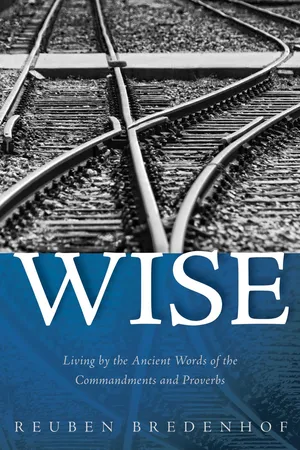
How can we find our way through the complexities of life in the twenty-first century? Many Christians are familiar with the pointed directives of the Ten Commandments, and many will regularly read Proverbs for bite-sized pieces of God's wisdom. When we study Proverbs within the framework of the Ten Commandments, we hear both parts of God's Word speaking in ways that are refreshingly practical and eminently memorable. Wise shows how these ancient words relate to such diverse areas of life as worship and prayer, our words and money, marriage and sexuality, and our fears, loves, and desires. This book will instruct and encourage with the wisdom that comes from fearing God.
Information
Topic
Theology & ReligionSubtopic
Biblical Studies1
The Beginning of Knowledge
Searching for Wisdom
What do you do when you want to know something? You’ve got a how-to question, you’re curious about some subject, you need a piece of information—so where do you look? If you’re like most people these days, you Google it: What is fracking? How do you cook quinoa? Who is Banksy? Type it in, and within a split second you’ve got thousands of pieces of information to sift through. Knowledge is so readily accessible; there’s little that you can’t find out, and in a hurry.
Where does Proverbs fit in a modern world like ours? We know it as an ancient book of wisdom, but it’s more than a collection of platitudes and clichés, like those bland fortune cookie messages: “Every exit is an entrance to something new.” It’s also more than some database of knowledge, able to yield 28,000,000 results in 0.79 seconds. Proverbs is about a certain style of life, one in relationship with God. It’s a book that addresses many topics for living before God’s face: work and leisure, earning and spending, laziness and discipline, drinking and eating, marriage and parenting, fear, desire, love, and trust. In relation to each of these topics and many more besides, Proverbs presents a sharp contrast between God’s wisdom and worldly folly. It’s not just about enjoying the fruits of education versus stumbling in ignorance; it’s about living in righteousness or living in wickedness.
Proverbs 1:7 serves as the cornerstone of it all: “The fear of the LORD is the beginning of knowledge.” If you want a definite course for your life, you first have to walk humbly with God through his Son Jesus Christ, through the daily guiding of the Holy Spirit. True knowledge consists of making godly choices, and wisdom is seen in that moment of deciding between a good behavior and one that is evil. Google probably can’t help you in that moment, but God can. This is what James writes: “If any of you lacks wisdom, let him ask God, who gives generously to all without reproach, and it will be given him” (1:5). This is good news: wisdom is available!
Wisdom through the Word
The way of wisdom is not hidden from us, for it’s the way of God’s laws, encapsulated in the Ten Commandments (Exod 20:1–17; Deut 5:6–21). Once you start looking, you see that the book of Proverbs helps us to navigate the same territory as the Ten Commandments do. They both teach the two fundamentals for our existence on earth: how to rightly serve God (Commandments 1–4), and how to properly relate to the people in our life (Commandments 5–10). It’s apparent that the authors of this book—Solomon, Agur, Lemuel, and others—have probed deeply into the law. They’ve reflected on their own experiences in applying God’s commandments, and now they share the results with their students and readers. Reading Proverbs within the framework of the Ten Commandments enables both of these parts of God’s Word to speak in fresh and practical ways. Their combined wisdom offers ample instruction to those who want practical guidance for a life of devotion to God. Together with the humble prayer that God may help us grow in wisdom, let’s begin our study of these two ancient guides for life. We’ll start by considering what kind of book is Proverbs, and how in a similar way to God’s law it instructs, warns, and corrects those who are willing to listen.
Learning Not to Forget
Proverbs is a father’s instruction to his son. From the opening of chapter 1, we can picture Solomon speaking these words to his child, taking him aside and teaching him wisdom. As he says in 1:4, he wants to “give prudence to the simple, knowledge and discretion to the youth.” That’s not just Solomon’s aim; it is God’s purpose throughout Proverbs: to put an end to the folly and immaturity of youth. God wants the young to be taught, because children can be naïve about many things. Isn’t it true that a youth can become confused about what’s essential in life, and can cave under wrong pressures? Sometimes as adults we look back on those years and shake our heads with regret: “You wouldn’t believe how ignorant I was about things. The things I used to say . . .” Or once we get to our thirties we might finally admit, “I did a lot in my teenage years that I’m ashamed about now.” We wistfully echo the Psalm 25 prayer: “Sins of youth, remember not!” That hasn’t changed at all today, for a young person can still lose his way.
This drifting is why next to Proverbs’s positive lessons and instructions, it gives warnings and corrections. For instance, chapter 3 opens with the warning: “My son, do not forget my teaching, but let your heart keep my commandments” (v. 1). Solomon knows that this is the tendency of his own son, and every son and daughter: to forget. We have short memories, so we soon forget the good teaching we once received. We lose our grip on holy wisdom and start to think and behave like fools.
We’re not just talking about the young in age—those of fewer years and less experience—but this warning is for all of us who still struggle with spiritual immaturity. We’re all children in some ways, sons and daughters of God who have to fight every day against the pull of our sinful desires, who have to struggle to keep our grip on God’s Word. It’s frightening how forgetful we can be when it comes to those important lessons that we once received; we’re easily convinced of wrong ideas, quickly persuaded by corrupt invitations. We have much to learn about living in God’s way.
Our Own Understanding
The problem is that we’re generally so sure of what we know, sure of our opinions, sure that what we’re doing is perfectly fine. As an example, what do you do when an alluring temptation presents itself to your eyeballs, and no one is peering over your shoulder to see how you react? Or how do you manage your money each month, especially when there’s the latest something-or-other that you’d really like to buy for yourself? Or what do you say to your daughter at that tense moment over the dinner table? And how do you approach the tedious assignment at the office? In all these circumstances, we’re liable to act simply according to what seems right to us. As Solomon puts it, we like to “lean on [our] own understanding” (Prov 3:5).
We even have our own wisdom that we like to apply, mental tricks to help with those daily ethical decisions and moments of testing. Faced with a situation where we need to make a choice or decide on a path of conduct, we say (or we think) things like, “The main thing is that I’m happy.” We respond, “She started it!” We conclude, “If no one gets hurt by this, it’s probably OK.” Or we console ourselves: “Lots of people do worse things than this.” But these adages all amount to what Solomon denounces: that we’re leaning on our own understanding. This is earthly wisdom, which is no wisdom at all. This is how James describes it: “If you have bitter jealousy and selfish ambition in your hearts, do not boast and be false to the truth. This is not wisdom that comes down from above, but is earthly, unspiritual, demonic” (3:14–15). We’re all ready to believe the deceitfulness of sin, prepared to buy into the insights of an unbelieving world, even to accept the devil’s lies.
Solomon teaches the hard truth that our own opinions can be very wrong. “Whoever trusts in his own mind is a fool,” he writes in Proverbs 28:26, “but he who walks in wisdom will be delivered.” Part of true wisdom before God, then, is admitting that you’re not wise. If you finally acknowledge that your own heart is not a reliable guide to life, you’re at last getting onto the path of understanding. In the lure of temptation, in that just-erupting argument with your spouse, or even in the slow grind of ordinary days, don’t trust your heart. Don’t be wise in your own eyes and assume that the sins that have ruined many people will not ruin you. Instead, we should seek true wisdom in the Word.
Dying for Lack of Discipline
Our yielding to sin is usually directly proportionate to how much we’re reading the Word of God—or not reading it. There’s a close correspondence: it’s not really surprising that when we’re not reading Scripture in a prayerful and meaningful way, we’re more amenable to breaking God’s commandments. Solomon would say that we’ve forgotten God’s law, or at any rate, his law isn’t close enough to our heart and mind to help us. This is what Solomon observes can happen to a sinner: “He dies for lack of discipline, and because of his great folly he is led astray” (Prov 5:23, NIV). Dying for lack of discipline—so sad, because it’s so avoidable. There is instruction that God gives in his Word, wisdom that is accessible and relevant and life-changing, yet we choose to stay in our folly. It’s because we’re afflicted with spiritual amnesia, a condition exacerbated by spiritual inertia. We don’t remember what God said, and we don’t really have the desire to take Scripture and read it again.
In Proverbs 29 it says, “Where there is no revelation, people cast off restraint” (v. 18, NIV). Notice how those two run so closely together: revelation and restraint. When we’re willing to hear the Word of God and submit to it, we can enjoy a huge boost in our self-control. A memorized verse of Scripture can become like an emergency brake on our evil desires: stop, and obey! As Psalm 119 asks: “How can a young man keep his way pure?” And it answers, “By guarding it according to your word” (v. 9). Without that restraint, we will careen wildly into sin, but a remembered commandment can arrest our sinful passions.
That’s a requirement for every believer, then, whether we’re young or old or middle-aged: to grow in Scripture, so that we do not forget the Bible’s teaching. Solomon says in Proverbs 1:5 that the process of godly instruction needs to continue for all of life: “Let the wise hear and increase in learning.” The children of God should develop this all-important knowledge by listening to the Word of God in a faithful church, Sunday after Sunday. We can increase in learning by being immersed in Scripture, week by week—it is correction and instruction that we need.
The Pain of Correction
Probably no one likes to have their shortcomings pointed out. It’s true that God’s correction can be painful, but if we’re going to mature and grow, it’s necessary. For God, this is something that he does out of his great love: “For the LORD reproves him whom he loves, as a father the son in whom he delights” (Prov 3:12). Because he cares for us, God wants to keep us on the path of life, and to correct us when we stray. If we’re listening with any honesty at all, then, Scripture will admonish us. At times it can be humbling just how accurate is God’s Word in describing the sinful ways of our heart; it’s got us figured out, and it tells us the truth about ourselves. We know that Scripture is compared to a light, or a lamp to our feet (see Ps 119:105). In the same way, this is what Proverbs 20:27 says: “The lamp of the LORD searches the spirit of a man; it searches out his inmost being” (NIV 1984). The Word of God is revealing, for it exposes the thoughts and intentions of our hearts (Heb 4:12). It even uncovers things we weren’t aware of, or things we didn’t want to see.
Now, many Christians listen ...
Table of contents
- Title Page
- Introduction
- Chapter 1: The Beginning of Knowledge
- Chapter 2: Trust in God Alone
- Chapter 3: True Worship through the Word
- Chapter 4: God’s Name Is a Strong Tower
- Chapter 5: What Are You Doing on the Lord’s Day?
- Chapter 6: Righteousness Exalts a Nation
- Chapter 7: Give Me Your Heart
- Chapter 8: Fear God, Love Your Neighbor
- Chapter 9: Drink Water from Your Own Cistern
- Chapter 10: Honor God with Your Possessions
- Chapter 11: Use Your Words Wisely
- Chapter 12: Keep Your Heart with All Vigilance
- Conclusion
- Bibliography
Trusted by 375,005 students
Access to over 1.5 million titles for a fair monthly price.
Study more efficiently using our study tools.
Frequently asked questions
Yes, you can cancel anytime from the Subscription tab in your account settings on the Perlego website. Your subscription will stay active until the end of your current billing period. Learn how to cancel your subscription
No, books cannot be downloaded as external files, such as PDFs, for use outside of Perlego. However, you can download books within the Perlego app for offline reading on mobile or tablet. Learn how to download books offline
Perlego offers two plans: Essential and Complete
- Essential is ideal for learners and professionals who enjoy exploring a wide range of subjects. Access the Essential Library with 800,000+ trusted titles and best-sellers across business, personal growth, and the humanities. Includes unlimited reading time and Standard Read Aloud voice.
- Complete: Perfect for advanced learners and researchers needing full, unrestricted access. Unlock 1.5M+ books across hundreds of subjects, including academic and specialized titles. The Complete Plan also includes advanced features like Premium Read Aloud and Research Assistant.
We are an online textbook subscription service, where you can get access to an entire online library for less than the price of a single book per month. With over 1.5 million books across 990+ topics, we’ve got you covered! Learn about our mission
Look out for the read-aloud symbol on your next book to see if you can listen to it. The read-aloud tool reads text aloud for you, highlighting the text as it is being read. You can pause it, speed it up and slow it down. Learn more about Read Aloud
Yes! You can use the Perlego app on both iOS and Android devices to read anytime, anywhere — even offline. Perfect for commutes or when you’re on the go.
Please note we cannot support devices running on iOS 13 and Android 7 or earlier. Learn more about using the app
Please note we cannot support devices running on iOS 13 and Android 7 or earlier. Learn more about using the app
Yes, you can access Wise by Reuben Bredenhof in PDF and/or ePUB format, as well as other popular books in Theology & Religion & Biblical Studies. We have over 1.5 million books available in our catalogue for you to explore.