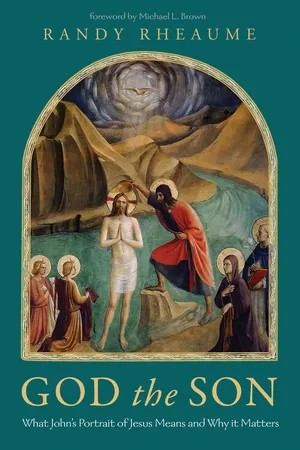
- 216 pages
- English
- ePUB (mobile friendly)
- Available on iOS & Android
eBook - ePub
About this book
John's portrait of Jesus is breathtaking yet bewildering. In the first verse he's called "God." At the climax of the book he's worshiped as Lord and God (20:28). On the other hand, he says he can't do a thing without the okay of his Father (5:19, 30). How are we to understand this profound yet puzzling figure?
Uniquely equipped as both a New Testament scholar and engaging pastoral communicator, Randy Rheaume shows how the contrasts in John's portrait of Jesus (especially his deity and his sonship) fit together and are meaningful and helpful for the Christian life. Is Jesus really God? If so, what difference does it make? How can he be God and yet in submission to God? Why didn't he ever say, "I am God! Worship me!"? How does the Son's role differ from the Father's? If God is more than one person, how do prayer and worship work? How can I know God better? What will make eternity with God so fun that we'll never get bored? Is the Trinity truly biblical? And where does the Holy Spirit come into the picture? Rheaume's exploration probes John's Gospel and provides profound insight into these and related questions.
Information
Chapter 1
Entering John’s World
The Gospel of John a weird and confusing book? When I first heard John characterized this way, it was like a punch in the gut. The description came from an unchurched coworker named Mike. I met and became friends with Mike while I was working a summer job before I entered college. In an attempt to share with Mike about Jesus, I had given him a New Testament (NT for short) and suggested he start by reading John’s Gospel. I did so because I had always heard John was the best ice-breaker Bible book for an unbeliever. John is the clearest and most direct at explaining Jesus’ identity and God’s plan of salvation. In fact, it was written for the express purpose of convincing people to believe Jesus is the Christ, the Son of God (20:31).
All true! But Mike had no experience reading the Bible and knew next to nothing about Jesus and Christianity. To my surprise the opening sentences of John sounded otherworldly, philosophical, and mystical to Mike. John begins by saying,
In the beginning was the Word, and the Word was with God, and the Word was God. He was with God in the beginning. Through him all things were made; without him nothing was made that has been made. In him was life, and that life was the light of all mankind. The light shines in the darkness, and the darkness has not overcome it. (Jn 1:1–5)
“I don’t get it,” he said frankly. “The author is talking in circles. And what or who is this ‘Word’? What’s this all supposed to mean?” I was a newbie Jesus follower back then, and yet I had already faced numerous objections to my faith—from skeptics, Jehovah’s Witnesses, and many others. But Mike was not objecting as much as sincerely questioning the meaning of words that were so familiar to and cherished by me. I assumed their face-value meaning could be easily understood by anyone who would simply read them. This was a wake-up call, reminding me that a gap of two thousand years and half the globe’s distance separates our world from John’s.
Since that conversation with Mike decades ago, John’s Gospel has become an intense object of study for me. I have immersed myself in John’s world. In my earliest days as a Christ-follower, I was thunderstruck by the awesomeness of John’s Jesus, and I’ve never recovered. He both alarms and dazzles me. He freshens my faith and whets my appetite for worship. He also puzzles me with his enigmatic and elusive sayings. Just when I think I’ve figured him out in one place, he baffles me in another. John’s Jesus simply refuses to be tamed.
As a senior pastor for decades, I’ve taught John’s Gospel in countless Bible studies, sermons, and courses. With sheer delight I’ve used Jesus’ words in John to lead many to embrace Jesus as Lord and Savior and have counseled many a troubled person. As a scholar of the NT, I have read though John (and the entire NT) numerous times in its original Greek and have earned a PhD studying John’s unique view of Jesus in relation to God the Father. To me every book of the Bible is precious, like a cherished mentor and friend, but as far as I’m concerned, nothing in Scripture compares to the four NT Gospels—Matthew, Mark, Luke, and John. They reveal to us God’s personal visit to this planet as one of us, along with his matchless teachings, his atoning sacrifice for our sins, and his triumph over death. How could anything top that? For me, John is the first among equals. If the books of the Bible were mountain ranges, the Gospels would be the Himalayas, and John would be Mount Everest. And yet even after decades of basking in John’s awesomeness and studying it at the highest level, I still think back to Mike’s perplexity nearly every time I launch afresh into John 1. The “Word” we meet there is distinct from God and yet somehow the same. What does this mean and why does it matter to us? Addressing that question is what this book is about.
Is this Book for You?
Does knowing God in a profound and personal way interest you? If so, do you desire God enough to think long and hard about him? If not, this book will not appeal to you. Don’t bother reading any further. Does digging into Scripture deeply to discover the author’s original meaning interest you? If not, don’t bother reading any further.
Many Christian books about Jesus on the market today are devotional in style. They explain scriptural concepts with interesting stories and clever analogies but little interaction with the nuts and bolts of the biblical text. Other books are focused more on biblical study or theological concerns without much application to your everyday walk with the Lord. Books of both sorts can be extremely useful.
In this book, however, my target is both your intellect as well as your daily relationship with God—to look carefully at the biblical text of John to discover its original meaning and then to draw out its practical implications for your life. Prepare to stretch your mind by diving into the culture and history of John’s Jesus. Our understanding and application of Scripture must be grounded in a firm grasp of the author’s meaning (i.e., his original intent)—not our cultural biases or traditions that have accrued over the centuries. John’s Gospel is all about revealing God to us through his Son, Jesus. Prepare to expand your mind and enlarge your soul by encountering John’s challenge to know the Father as Jesus knows him.
You can read this book as either a novice or an advanced student of Scripture. For those of you who are new to biblical studies, I’ve tried to keep the technical jargon to a bare minimum, and when I use more specialized terms, I explain them as simply as I can. If you’re a seasoned Bible researcher, you’ll find further explanations and documentation in the footnotes, which I’ve also tried to keep to a minimum.1
For full disclosure, I am an evangelical, Trinitarian follower of Jesus. Like everyone else, I have my own biases. All of us come with a background of experiences (both good and bad) and beliefs (whether true or false). One of my working assumptions is that the Christian faith, rightly understood, can withstand the toughest scrutiny. I have devoted my adult life to carefully examining and testing the foundations of my worldview. I have embraced the Bible as God’s written revelation—his fully trustworthy and authoritative word. I begin from a Christian worldview in which Jesus’ full deity (i.e., his “godness”) is believed as a central truth revealed in sacred Scripture. Regarding the topic of this book, I have made it my goal, especially in this lifelong study, to check my biases and consider contrary viewpoints as fairly and objectively as I can. My aim is to go where the evidence leads, even if it takes me where I would not prefer to go. My sincere desire is to learn from those who disagree with me as we dialogue as friends. Whether you agree or disagree with me, I welcome your company in this conversation.
Who’s the Word?
The opening eighteen verses of John’s Gospel (often called the Prologue) inform us that Jesus is the key that unlocks the door to knowing God genuinely and deeply. Again verse 1 says, “In the beginning was the Word, and the Word was with God, and the Word was God” (Jn 1:1).
Picture John’s Gospel as a play. When the curtain opens on the first scene, only two characters are present on an otherwise empty stage—the Word and God. Nothing else exists because the universe has yet to be created. The Word and God are together, two distinct entities. But then comes the explosive third clause of the narrator’s first line: “and the Word was God.” This five-word statement has puzzled many a brilliant mind. Are the Word and God two distinct characters or somehow the same? In verse 3 we’re told that “all things” were made “through” the Word. Emphatically, John insists that nothing has ever been created apart from this Word. Somehow the Word participated in making all creation. Apparently, the Word is not a created thing, but exists with God outside of the realm of creation. But what or who is this Word?
If you’re familiar with the biblical story of creation found in Genesis 1, you can hear a conspicuous echo of it here in John 1. Joh...
Table of contents
- Title Page
- Permissions
- Foreword
- Preface
- Acknowledgments
- Abbreviations
- Chapter 1: Entering John’s World
- Chapter 2: The World Behind John’s World
- Chapter 3: God’s Feature Film
- Chapter 4: God’s Equal
- Chapter 5: God’s Junior Partner
- Chapter 6: The Son Before the Sun
- Chapter 7: Life on Steroids
- Chapter 8: God’s Big Secret
- Chapter 9: Earthquake of the Soul
- Chapter 10: Enter the Holy Spirit
- Bibliography
Trusted by 375,005 students
Access to over 1.5 million titles for a fair monthly price.
Study more efficiently using our study tools.
Frequently asked questions
Yes, you can cancel anytime from the Subscription tab in your account settings on the Perlego website. Your subscription will stay active until the end of your current billing period. Learn how to cancel your subscription
No, books cannot be downloaded as external files, such as PDFs, for use outside of Perlego. However, you can download books within the Perlego app for offline reading on mobile or tablet. Learn how to download books offline
Perlego offers two plans: Essential and Complete
- Essential is ideal for learners and professionals who enjoy exploring a wide range of subjects. Access the Essential Library with 800,000+ trusted titles and best-sellers across business, personal growth, and the humanities. Includes unlimited reading time and Standard Read Aloud voice.
- Complete: Perfect for advanced learners and researchers needing full, unrestricted access. Unlock 1.5M+ books across hundreds of subjects, including academic and specialized titles. The Complete Plan also includes advanced features like Premium Read Aloud and Research Assistant.
We are an online textbook subscription service, where you can get access to an entire online library for less than the price of a single book per month. With over 1.5 million books across 990+ topics, we’ve got you covered! Learn about our mission
Look out for the read-aloud symbol on your next book to see if you can listen to it. The read-aloud tool reads text aloud for you, highlighting the text as it is being read. You can pause it, speed it up and slow it down. Learn more about Read Aloud
Yes! You can use the Perlego app on both iOS and Android devices to read anytime, anywhere — even offline. Perfect for commutes or when you’re on the go.
Please note we cannot support devices running on iOS 13 and Android 7 or earlier. Learn more about using the app
Please note we cannot support devices running on iOS 13 and Android 7 or earlier. Learn more about using the app
Yes, you can access God the Son by Randy Rheaume in PDF and/or ePUB format, as well as other popular books in Theology & Religion & Biblical Criticism & Interpretation. We have over 1.5 million books available in our catalogue for you to explore.