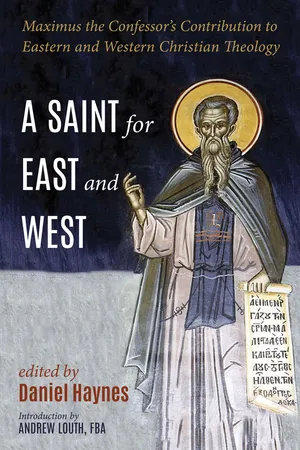
eBook - ePub
A Saint for East and West
Maximus the Confessor’s Contribution to Eastern and Western Christian Theology
- 308 pages
- English
- ePUB (mobile friendly)
- Available on iOS & Android
eBook - ePub
A Saint for East and West
Maximus the Confessor’s Contribution to Eastern and Western Christian Theology
About this book
In 1054 CE, the Great Schism between Eastern and Western Christianity occurred, and the official break of communion between the two ancient branches of the church continues to this day. There have been numerous church commissions and academic groups created to try and bridge the ecumenical divides between East and West, yet official communion is still just out of reach. The thought of St. Maximus the Confessor, a saint of both churches, provides a unique theological lens through which to map out a path of ecumenical understanding and, hopefully, reconciliation and union. Through an exposition of the intellectual history of Maximus' theological influence, his moral and spiritual theology, and his metaphysical vision of creation, a common Christianity emerges. This book brings together leading scholars and thinkers from both traditions around the theology of St. Maximus to cultivate greater union between Eastern and Western Christianity.
Information
Subtopic
Dénominations chrétiennesPart One
Reception and Influence
1
Eriugena’s Appropriation of Maximus Confessor’s Anthropology
This essay looks at the way John Scottus Eriugena appropriates and constructively employs Maximus Confessor’s anthropology. It claims that the fivefold division of being, appropriated from Maximus Confessor’s Ambiguum 41, constitutes the framework of the Periphyseon. In my understanding, Maximus Confessor’s vision of the human being as the “workshop of creation,” as the synthesis of all aspects of creation, as the agent of unification, provides the anthropological premise for Eriugena’s own dialectical division of the genus of nature. It is within the framework of Maximus’ ontology centered on “man as the workshop of creation,” that Eriugena has recourse to the tradition of the liberal arts. Therefore, the division of the genus of nature, as an exercise of dialectic, has to be understood within the framework of Eriugena’s appropriation of Maximus Confessor’s fivefold division of being and its corollary, the anthropology of the officina omnium. The project of the Periphyseon is driven by the possibility that through the application of the arts man could become the officina omnium in spite of the Fall; if intellectual knowledge of creation can be achieved, then the return of all creation to the unity of the intelligible human being and ultimately to God will be warranted.
Introduction
Previous studies by E. Jeauneau1 and I-P. Sheldon Williams2 have noted the Greek influences on John the Scot. This essay builds on their insights by trying to see how Eriugena appropriates and uses the Greek fathers, and especially Maximus Confessor.
The reason for this analysis is not to try to gauge in an exact manner who has more influence or to argue that Eriugena’s merit is to have managed to bring together such disparate sources, although the latter is no small merit in itself. Among the medieval thinkers, only Thomas Aquinas can match this great feat of consensus building (consensus machinari) displayed by the great Irishman.3 Nevertheless, by focusing on the Greek sources I do not mean to say that these are more important than Augustine or Ambrose for the project of Eriugena.
This essay will focus on Eriugena’s main discussion and exposition of Maximus Confessor’s Ambiguum 414 as found in Book II of the Periphyseon.5 In Book II, after reviewing the fourfold division of being offered at the beginning of Book I, the Nutritor6 introduces another division of being by way of a complementary example. This division, and Eriugena’s way of appropriating and expounding it will become the fundamental framework of the entire work and is responsible for giving the project its clear structure. My claim is that Books III through V of the Periphyseon are an extensive exploration and clarification of several important points made by Maximus the Confessor in Ambiguum 41. First, there is the fivefold division of beings. Second, Maximus’ anthropology according to which the human being is seen as the workshop of creation (i.e., the place where all aspects are unified and therefore responsible for the unification of the cosmos.). Thirdly, Maximus provides the Irishman with a fundamental methodological insight: both Scripture and the cosmos are places of divine manifestation. One needs to train oneself in order to gain the right vision and be able to distinguish the divine presence.
Thus, Maximus provides Eriugena with an arsenal of conceptual tools that will provide the armature for his magnum opus. The great insight of Eriugena is to weave these together with the liberal arts tradition in which he stands by virtue of his education. The task of this essay will be to expound the way Eriugena interprets Ambiguum 41 and manages to wean out an ontological framework, which allows him to expand the purview of his own division of the genus of nature—the initial project of the Periphyseon—to a cosmic scale.
Maximus’ Anthropology
Eriugena starts Book II with a recapitulation of the fourfold division of the genus natura. After this, almost as an aside, he presents Maximus’ division of being found in Ambiguum 41. Why does Eriugena introduce Maximus into the discussion? The answer provided by the texts themselves is that it is both out of a desire to confirm his position but also in order to offer a slightly different vantage point.7 He will devote a lengthy exposition to Maximus’ division, but my claim is that in the Periphyseon, the Maximian division will gain a greater importance than just an example or an alternative view.
The first of these fivefold divisions of universal nature (σύμπασα φύσις) is between created and uncreated. The second division is between the intelligible and the sensible. The third division is the division of the sensible between heaven and earth. In the fourth division, earth is divided between paradise and the inhabited world. In the fifth division, man, the workshop (officina) of creation,8 is divided into man and woman. Eriugena describes what Maximus does here as “the division of the substance of all things that have been made from the Supreme Cause.”9 In his view, Maximus’ division is similar to his own; the only difference is that he splits the third element, created nature, into three and does not distinguish the fourth from the first. Moreover, the Nutritor thinks that Maximus’ division complements his own.
According to Maximus’ account, the human being is introduced last because it is the “natural link, everywhere mediating between the extremes through their proper parts and reducing to a unity in himself things which in nature are widely disparate.”10 Thus, the crucial element of the unification of creation is Maximus’ view of the human being as the synthesis of creation. He calls the human being the laboratory of all creation because all the aspects of creation—sensible, intellectual, and vegetative—are present in it. Humans span all the ontological levels of creation. “For he is composed of the two universal parts of created nature by way of a wonderful union. For he is the conjunction of the sensible and the intelligible, that is, the extremities of all creation.”11 As the synthesis and recapitulation of creation, the true vocation of the human being is to mediate and harmonize the different levels of creation by “supply[ing] a middle term between the extreme elements of creation; for in i...
Table of contents
- Title Page
- Preface
- Acknowledgements
- Contributors
- Abbreviations
- Introduction
- Part One: Reception and Influence
- Part Two: Anthropology, Christology, and Spirituality
- Part Three: Ontology and Metaphysics
- Bibliography
Trusted by 375,005 students
Access to over 1.5 million titles for a fair monthly price.
Study more efficiently using our study tools.
Frequently asked questions
Yes, you can cancel anytime from the Subscription tab in your account settings on the Perlego website. Your subscription will stay active until the end of your current billing period. Learn how to cancel your subscription
No, books cannot be downloaded as external files, such as PDFs, for use outside of Perlego. However, you can download books within the Perlego app for offline reading on mobile or tablet. Learn how to download books offline
Perlego offers two plans: Essential and Complete
- Essential is ideal for learners and professionals who enjoy exploring a wide range of subjects. Access the Essential Library with 800,000+ trusted titles and best-sellers across business, personal growth, and the humanities. Includes unlimited reading time and Standard Read Aloud voice.
- Complete: Perfect for advanced learners and researchers needing full, unrestricted access. Unlock 1.5M+ books across hundreds of subjects, including academic and specialized titles. The Complete Plan also includes advanced features like Premium Read Aloud and Research Assistant.
We are an online textbook subscription service, where you can get access to an entire online library for less than the price of a single book per month. With over 1.5 million books across 990+ topics, we’ve got you covered! Learn about our mission
Look out for the read-aloud symbol on your next book to see if you can listen to it. The read-aloud tool reads text aloud for you, highlighting the text as it is being read. You can pause it, speed it up and slow it down. Learn more about Read Aloud
Yes! You can use the Perlego app on both iOS and Android devices to read anytime, anywhere — even offline. Perfect for commutes or when you’re on the go.
Please note we cannot support devices running on iOS 13 and Android 7 or earlier. Learn more about using the app
Please note we cannot support devices running on iOS 13 and Android 7 or earlier. Learn more about using the app
Yes, you can access A Saint for East and West by Daniel Haynes in PDF and/or ePUB format, as well as other popular books in Théologie et religion & Dénominations chrétiennes. We have over 1.5 million books available in our catalogue for you to explore.