eBook - ePub
Jazz and Christian Freedom
Improvising against the Grain of the West
- 244 pages
- English
- ePUB (mobile friendly)
- Available on iOS & Android
eBook - ePub
About this book
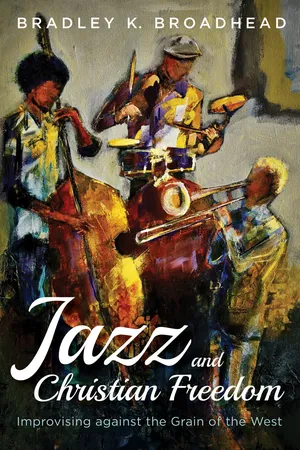
Contemporary Western society has a strange relationship with freedom. Unbridled subjective liberty and narrow fundamentalism pull away from each other in mutual loathing while sociological forces seek to manipulate both sides. The church needs to recover and reconstruct a theology of freedom to navigate between the perils of both extremes and to avoid being manipulated by these forces. Just as biblical figures are taught through parables and metaphors, this book uses jazz improvisation as an analogy for Christian freedom. Just as jazz improvisation relies on successfully navigating constraints such as the history and traditions of jazz, jazz theory, and musical instruments, so Christian freedom also relies on constraints such as the biblical canon, church history, theology, and the church itself. Through understanding the freedom jazz musicians enjoy in making music together, we can better understand how Christian freedom might be enacted in daily life. If Western churches discover and enact Christian freedom in a meaningful way, the songs that they improvise will be as siren calls to people in chains.
Information
Topic
Theology & ReligionSubtopic
Christian Theology1
The Problem of Freedom in the Postmodern West
Enacting Christian freedom in the Western world is like Christian’s journey through the Valley of the Shadow of Death in John Bunyan’s The Pilgrim’s Progress, a journey in the dark on a narrow path bounded by a ditch on one side and a mire on the other. In the ditch one plummets into the situation of the postmodern-self as it abandons tradition and overt authority in favor of self-discovery and formation.62 In the mire, one sinks under the morass of the multiplied constraints found in authoritarian-fundamentalism.63 And the “discouraging clouds of confusion” are the alienating forces of technique and capitalism that overshadow the Western horizon. Unlike Christian, I must pause to consider these pitfalls, dangling a lantern over each side of the path to expose their danger and their appeal (not everyone has the same perspective as Christian).64 To help shed this light I draw on two influential figures in the world of jazz and the challenges faced by contemporary jazz pedagogy.
For my purposes, Ornette Coleman and Wynton Marsalis represent a bifurcation of dealing with freedom in the jazz tradition: Coleman pushes aside the governing constraints of the jazz tradition, while Marsalis valorizes the tradition to the point where he has to form a protective hedge around it. Naturally, neither musician can be reduced to being merely the type of what I employ them for; life is always more subtle and complex than categories allow. Furthermore, both musicians have had an undeniable and substantial impact on the history of jazz. Yet certain aspects of their diverging approaches to music can be productively used to illustrate the postmodern-self and authoritarian-fundamentalism respectively. I see a parallel between Coleman’s emancipation from the constraints of the jazz tradition and a similar endeavor on the part of the postmodern-self to be liberated from all constraints, especially the authority found in traditional communities and religious faith. I see another parallel between the endeavors of Marsalis and authoritarian-fundamentalism. This form of fundamentalism is an attempt “to recover the pristine message of the Messiah or the Prophet”65 and to impose “uniformity of belief and practice”66 via unassailable contemporary leadership in reaction to undesired developments in the dominant culture. It reacts to the relativism espoused by the postmodern-self with strong assertions of tradition, authority, and order. With a tightly clenched fist, it attempts to minimize freedom. The conflict between the desire of the postmodern-self for liberation on the one hand and the desire of the authoritarian fundamentalist to adopt constraints that will shield them from this liberation on the other is deeply felt; abandoning one often entails embracing the other.67 Meanwhile, hanging over this bifurcation are the ubiquitous forces of technique (as described by Jacques Ellul)68 and alienation (as described by Karl Marx).69
Jazz is shaped by the same forces of modernity that gave rise to the postmodern-self and the reaction of authoritarian-fundamentalism.70 As such, it provides an instructive analogy for the contemporary problem of freedom. In the succeeding chapters, I show that it can also aid in the quest for a solution. I begin by describing the plight of the postmodern-self with reference to Coleman, and the nature of authoritarian-fundamentalism with reference to Marsalis. I then show the mutually reinforcing nature of these two opposing poles and conclude with a discussion of technique and alienation in the light of contemporary struggles in jazz pedagogy.
Ornette Coleman and the Postmodern-self
Ornette Coleman’s rise to fame marks a turning point in the history of jazz. According to biographer John Litweiler, his approach to improvisation served “to overturn the very foundations of jazz for its entire previous existence.”71 What separates Coleman from prior innovators in jazz are the ways he downplays, or even tries to sever, ties with traditional approaches to playing an instrument, improvisation, and music theory. Many of those who first heard him when he began to gain some notoriety in the jazz world complained that he was out of tune.72 Coleman responded that he played the way he did deliberately.73 In his self-taught approaches to the trumpet and violin, he goes even further. He completely disregards developed ways of playing these instruments. According to Litweiler, “He had no teachers or guides to show him how to play trumpet and violin and purposely avoided learning standard techniques, for his objective was to create as spontaneously as possible.”74 Jazz improvisation prior to Coleman was based on improvising with the chords that accompany a given melody. Coleman threw this out the window, insisting that soloists and accompanists negotiate tonality in real time.
His struggle with conventional theory is illustrated in the difficulties he encountered in the lessons he took from composer Gunther Schuller. Schuller relates that, “I think what happened was, he caught a glimpse of what I was talking about in terms of accurate reading and notation and it was . . . disturbing because it meant everything he had learned up to then was ‘wrong.’”75 In place of conventional theory Coleman devised his own theory, harmolodics, but never ended up writing an authoritative account of it; Coleman’s comments on his theory are notoriously cryptic.76 All of these factors combined leads to an approach to making music that places “attention on the musician’s powers of subjective expression above all else,” mirroring the postmodern-self’s turn to subjective evaluation.77A determined individualist, Coleman pursued his own course through discouragement and persecution. Decades after his most influential recordings, he continues to represent the avant-garde of jazz. His attempts to construct a de novo approach to music mirror the self-construction of the postmodern-self.
The self-constructed nature of the postmodern-self is necessitated by what it desires to be free from. In Dale S. Kuehne’s reading of John Ashcroft, contemporary Western societies desire “freedom from nature,” “freedom from authority,” and “freedom from want.”78 Describing the liberation of the postmodern-self from these constraints (with the exception of liberation from want, which is, ironically, something many desire, but few attain) necessitates a brief look at the emergence of this self in Western history. According to Peter Berger, the Christian synthesis of “Hellenic and Israelite traditions” marks the point at which the latent roots of individuality in each tradition came together and began to be worked out “in earnest.”79 In particular, Berger points to Paul’s declaration in Gal 3:28—“There is no longer Jew or Greek, there is no...
Table of contents
- Title Page
- Acknowledgments
- Introduction
- Chapter 1: The Problem of Freedom in the Postmodern West
- Chapter 2: Theology on Christian Freedom
- Chapter 3: Constructing a Biblical Theology of Freedom
- Chapter 4: Jazz Improvisation
- Chapter 5: From Jazz Improvisation to Christian Freedom
- Chapter 6: A Jazz-Shaped Approach to the Problem of Freedom
- Chapter 7: Tying Up the Analogy
- Conclusion
- Appendix
- Discography
- Bibliography
Trusted by 375,005 students
Access to over 1.5 million titles for a fair monthly price.
Study more efficiently using our study tools.
Frequently asked questions
Yes, you can cancel anytime from the Subscription tab in your account settings on the Perlego website. Your subscription will stay active until the end of your current billing period. Learn how to cancel your subscription
No, books cannot be downloaded as external files, such as PDFs, for use outside of Perlego. However, you can download books within the Perlego app for offline reading on mobile or tablet. Learn how to download books offline
Perlego offers two plans: Essential and Complete
- Essential is ideal for learners and professionals who enjoy exploring a wide range of subjects. Access the Essential Library with 800,000+ trusted titles and best-sellers across business, personal growth, and the humanities. Includes unlimited reading time and Standard Read Aloud voice.
- Complete: Perfect for advanced learners and researchers needing full, unrestricted access. Unlock 1.5M+ books across hundreds of subjects, including academic and specialized titles. The Complete Plan also includes advanced features like Premium Read Aloud and Research Assistant.
We are an online textbook subscription service, where you can get access to an entire online library for less than the price of a single book per month. With over 1.5 million books across 990+ topics, we’ve got you covered! Learn about our mission
Look out for the read-aloud symbol on your next book to see if you can listen to it. The read-aloud tool reads text aloud for you, highlighting the text as it is being read. You can pause it, speed it up and slow it down. Learn more about Read Aloud
Yes! You can use the Perlego app on both iOS and Android devices to read anytime, anywhere — even offline. Perfect for commutes or when you’re on the go.
Please note we cannot support devices running on iOS 13 and Android 7 or earlier. Learn more about using the app
Please note we cannot support devices running on iOS 13 and Android 7 or earlier. Learn more about using the app
Yes, you can access Jazz and Christian Freedom by Bradley K. Broadhead in PDF and/or ePUB format, as well as other popular books in Theology & Religion & Christian Theology. We have over 1.5 million books available in our catalogue for you to explore.