When writing to the Corinthians, the Apostle Paul used figurative temple language repeatedly to shape the identity of his audience (“Temple of God,” “Temple of the Holy Spirit,” and “Temple of the Living God”). While other scholars have identified the place of the Jerusalem temple in Paul’s thinking or the impact of temples in the life of Corinth, there has been no comprehensive study of the way that figurative temple language in philosophy could have influenced the Corinthians’ worldview. Hellenistic philosophy was pervasive in the first century and provided theological guidance for faith and practice to Paul’s Gentile audience before their conversion.
Philip N. Richardson provides a comprehensive survey of figurative temple language in Hellenistic philosophy, shedding light on the way that the kinds of philosophical thought known in cities like Corinth may have influenced the Corinthians to think about figurative temple language. This study throws into sharp relief the similarities and differences between Paul’s use of temple language and that of philosophy, and illuminates Paul’s setting of this language in the wider framework of 1–2 Corinthians and his purpose for its use in the argument of the letters.
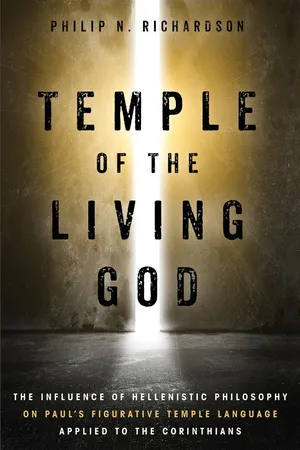
eBook - ePub
Temple of the Living God
The Influence of Hellenistic Philosophy on Paul’s Figurative Temple Language Applied to the Corinthians
- 330 pages
- English
- ePUB (mobile friendly)
- Available on iOS & Android
eBook - ePub
Temple of the Living God
The Influence of Hellenistic Philosophy on Paul’s Figurative Temple Language Applied to the Corinthians
About this book
Information
1
Introduction and History of Research
1.1 The Focus of the Book
In three places in the Corinthian correspondence the apostle Paul uses figurative temple language to define the identity of his readers. Although when people thought about temples they normally thought about humanly constructed buildings of materials such as stone or wood, Paul and others also used a figurative or symbolic extension of that conventional image.1 In 1 Cor 3:16 and 6:19 the readers are described as a temple in which God’s Spirit dwells and in 2 Cor 6:16 Paul includes himself with his readers as “the temple of the living God.”2 While Paul uses cultic language figuratively in a number of his letters,3 Paul only uses figurative temple language repeatedly to shape the identity of his audience when writing to the Corinthians.4 For Paul, a former Pharisee (Phil 3:5; cf. Acts 23:6; 26:5), the image of the temple had primary reference to the temple in Jerusalem: the place where God had promised to dwell, where worshippers longed to meet with God and where his glory had dwelt (1 Kgs 9:3; 2 Chr 5:14; 7:1; Pss 26:8; 43:3) and one day might dwell again (Ezek 43–48).
However, Paul’s audience came from a very different context. There are clear indicators that the majority of the readers were Gentiles (1 Cor 6:9–11; 8:7; 12:2), although according to Acts 18:1–11, the church had its origins in the synagogue,5 so it very likely had a Diaspora Jewish component as well.6 As residents of a very cosmopolitan and pluralistic city, Corinth, they would have been exposed to a variety of religious, cultural and philosophical influences, such as Roman temples to various gods and the feasts held there on various social and religious occasions, the presence of the Imperial cult, the bi-annual Isthmian games, the customs of Roman law, and the behavior of sophists and their followers, among others.7 While Paul clearly had no hesitation in using OT traditions and expecting his audience to understand his allusions (e.g., 1 Cor 5:7–8 and 10:1–13), how would such temple language have spoken to them in the context of Corinth itself? Charles H. Talbert, drawing on the work of literary critic Peter J. T. Rabinowitz, enagages with “audience-oriented criticism” in his own studies of Luke-Acts to speak of an “authorial audience” presupposed by the text, stating “To read as authorial audience is to attempt to answer the question: ‘If the literary work fell into the hands of an audience that closely matched the author’s target audience in terms of knowledge brought to the text, how would they have understood the work?’”8 Talbert notes that it is important to reconstruct the conceptual world used in the creation and original reception of the text. Material from the milieu can be used as data for reconstructing the reader who might have heard the text in a certain way. Talbert is not claiming that ancient readers would be consciously aware of these actual texts but “Rather these texts help to establish the most likely conceptual world of the readers, the authorial audience.”9
Of all Paul’s letters, only 1 Corinthians contains a lengthy discussion of the temptations posed by idol food, especially the prospect of eating in or around local temples (8:1—11:1, especially 8:10; 10:14). This fact, at the very least, suggests that Paul’s figurative temple language would have pointedly contrasted with the reality of Corinth with its many temples.10 How would this language have compared with the Corinthians’ understanding of temples prior to their conversion? What would have been the chief influences on the thinking of the Corinthians when they read Paul’s figurative temple language?11 The evidence of 1 Cor 8:1—11:1 draws our attention to the religious influences in Corinth and the many opportunities to consume idol food in temple settings. This is clearly an important factor in understanding the social and cultural context of the audience and relates to 1 Cor 3:16; 6:19 and 2 Cor 6:16. However, 1 Cor 8:1—11:1 does not use figurative temple language and because this context to Paul’s discussion has been covered so extensively in numerous articles and published monographs, particularly in the last twenty years, it will not be the focus of this book.12
It has long been recognized that in order to interpret Paul’s letters to the Corinthians, scholars ne...
Table of contents
- Title Page
- Acknowledgments
- Abbreviations
- Chapter 1: Introduction and History of Research
- Chapter 2: Figurative Temple Language in Hellenistic Philosophy
- Chapter 3: Figurative Temple Language in Philo of Alexandria
- Chapter 4: Figurative Temple Language in 1 Corinthians
- Chapter 5: Figurative Temple Language in 2 Corinthians
- Chapter 6: Conclusions
- Bibliography
Trusted by 375,005 students
Access to over 1.5 million titles for a fair monthly price.
Study more efficiently using our study tools.
Frequently asked questions
Yes, you can cancel anytime from the Subscription tab in your account settings on the Perlego website. Your subscription will stay active until the end of your current billing period. Learn how to cancel your subscription
No, books cannot be downloaded as external files, such as PDFs, for use outside of Perlego. However, you can download books within the Perlego app for offline reading on mobile or tablet. Learn how to download books offline
Perlego offers two plans: Essential and Complete
- Essential is ideal for learners and professionals who enjoy exploring a wide range of subjects. Access the Essential Library with 800,000+ trusted titles and best-sellers across business, personal growth, and the humanities. Includes unlimited reading time and Standard Read Aloud voice.
- Complete: Perfect for advanced learners and researchers needing full, unrestricted access. Unlock 1.5M+ books across hundreds of subjects, including academic and specialized titles. The Complete Plan also includes advanced features like Premium Read Aloud and Research Assistant.
We are an online textbook subscription service, where you can get access to an entire online library for less than the price of a single book per month. With over 1.5 million books across 990+ topics, we’ve got you covered! Learn about our mission
Look out for the read-aloud symbol on your next book to see if you can listen to it. The read-aloud tool reads text aloud for you, highlighting the text as it is being read. You can pause it, speed it up and slow it down. Learn more about Read Aloud
Yes! You can use the Perlego app on both iOS and Android devices to read anytime, anywhere — even offline. Perfect for commutes or when you’re on the go.
Please note we cannot support devices running on iOS 13 and Android 7 or earlier. Learn more about using the app
Please note we cannot support devices running on iOS 13 and Android 7 or earlier. Learn more about using the app
Yes, you can access Temple of the Living God by Philip N. Richardson in PDF and/or ePUB format, as well as other popular books in Theology & Religion & Biblical Criticism & Interpretation. We have over 1.5 million books available in our catalogue for you to explore.