eBook - ePub
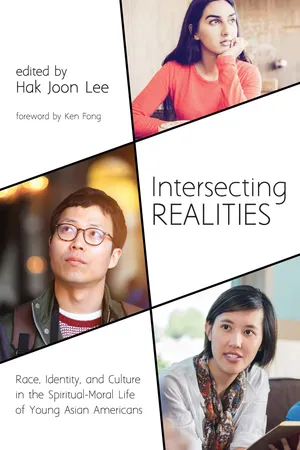
Intersecting Realities
Race, Identity, and Culture in the Spiritual-Moral Life of Young Asian Americans
- 178 pages
- English
- ePUB (mobile friendly)
- Available on iOS & Android
eBook - ePub
Intersecting Realities
Race, Identity, and Culture in the Spiritual-Moral Life of Young Asian Americans
About this book
Experiencing racial marginalization in society and pressures for success in family, Asian American Christian young adults must negotiate being socially underpowered, culturally dissonant, and politically marginal. To avoid misunderstandings and conflicts within and without their communities, more often than not they hide their true thoughts and emotions and hesitate to engage in authentic conversations outside their very close-knit circle of friends. In addition, these young adults might not find their church or Christian fellowship to be a safe and hospitable place to openly struggle with all of these sorts of questions, all the while lacking adequate vocabulary or resources to organize their thoughts. This book responds to these spiritual-moral struggles of Asian American young people by theologically addressing the issues that most intimately and immediately affect Asian American youths' sense of identity--God, race, family, sex, gender, friendship, money, vocation, the model minority myth, and community-- uniquely and consistently from the contexts of Asian American young adult life. Its goal is to help young Asian Americans develop a healthy, balanced, organic sense of identity grounded in a fresh and deeper understanding of the Christian faith.
Information
Topic
Theology & ReligionSubtopic
Christian Theology1
God
That would be hell.” This is what a young Korean American man said at a retreat when we were talking about how heaven would be a place where we will be with God all the time forever. Before this conversation, I had suggested that we might imagine God as someone like our father and that heaven would be like spending all eternity with God in the same room. My point was that whether we are aware of it or not, we often do think of God as someone like our earthly father or mother. The puzzling aspect of this young man’s faith was that he would say that he still “loved” God. However, this “love” was the same love with which he loved his father. Over the years, I have talked to so many young Asian Americans who assure me of their “love” for their fathers and mothers, but do not “like” them, nor associate them with joy or pleasure. Their filial “love” was more about honoring, respecting, and being dutiful. With this kind of “love” much can be accomplished, i.e., commitment, obedience, and maybe even sacrifice. And yet, all that would fall short of the kind of genuine covenant interaction God is seeking with us.
For many Asian American Christians this idea of loving God, but not liking him, is often inevitable if this dynamic also characterizes their relationship with their parents.10 Our earliest relational attachments become patterns and templates for our intimate relationships for the rest of our lives, unless we are able to consciously revise them.11 This chapter focuses on some of the problematic aspects of our cultural matrix that impact our closest relationships as well as our thoughts about God. While I refer to parental relationships here, chapter 5 will examine the topic of parents more extensively.
It seems as though the easy solution for this God representation problem would be to correct or replace false images with biblically and theologically informed ones. However, these familial images are much more deeply ingrained and difficult to unseat, even impacting our scriptural interpretation and theological reflection, especially if we cannot precisely name them. We can talk about God loving us and us loving God, but even these words can be understood in a different light. All this is happening mostly unconsciously with well-meaning people, even pastors and ministry leaders. We are talking about how culture impacts the gospel. Culture runs deep, just as blood is thicker than water.
The idea of a cultural captivity of the gospel has been around since the Reformation, when Martin Luther declared a “Babylonian captivity” of the church.12 Luther used this term in his attacks against distorted views and uses of the sacraments, but later theologians began using it to describe how culture domesticates and distorts the gospel. In fact, no context is immune to these distortions and they occur continually because we always try to tame God for our own purposes, knowingly or unknowingly.
Recently, many missional theologians began reflecting how the Western, and more specifically American culture, has unwittingly subverted the gospel.13 What these theologians named as virulent forces, such as consumerism and privatization of faith, for example, applies in general to Asian Americans as well. However, as Asian Americans, our faith is also influenced and impacted by our Asian cultural heritage. These Asian cultural, religious, and philosophical heritages are part of Asian American lives, in varying ways and degrees, whether we are conscious of it or not.14 They are often the deepest parts of us, distant and perhaps primal parts that many of us have no words to describe. This is true even when some Asian Americans would like to abandon or repress their Asianness so they can fit in better and be accepted as “real” Americans.
Before we continue, it is crucial to note that we are not honing in on Asian heritage because of its seemingly foreign and “pagan” nature.15 That kind of attitude would be falling victim to the pervasive Orientalism that still exists in our society, an ideology that portrays Asian culture as backwards, exotic, or grotesque. As we proceed, we must presuppose that there are redemptive elements present in every culture, American or Asian of various sorts, as well as distortions and perversions of God’s gift of good creation. For example, we can point to the Japanese aesthetic of wabi-sabi, in which beauty is found in imperfection. The art of kintsugi, which mends broken pottery with gold, expresses this surprising beauty. This might serve as an analogy for God’s redemptive grace. Or we might contemplate how the Korean cultural notion of han, defined as deep unresolved resentment and helplessness, could expand the doctrine of sin with its deep insights into the sticky and structural nature of human brokenness.16 While an extended discussion of culture is beyond the scope of this chapter, I provide these examples to clarify that the problematic aspects of Asian heritage are not definitive of the whole.17 Given this important caveat, cultural distortions of the gospel are real and must be addressed, whether they arise from Western culture or from various Asian heritages.
We begin by noting that there is no simple panacea for this problem of cultural distortion, because our cultural context is all-pervasive; we are surrounded like fish in water. Our only hope is to become aware of this murky water that we are swimming in and ask God’s guidance and correction again and again. Theologian Darrell Guder describes this process of divine critique and correction as a continuing conversion from culture’s gospel truncations.18 We need to be converted by God’s Word over and over again to be faithful. We never really grasp the gospel fully and completely until we see God face to face.
So, getting back to knowing a God whom we enjoy loving, we turn to what an Asian American cultural captivity might look like.
What Kind of God?
John Calvin begins his famous Institutes by saying that the knowledge of ourselves and knowledge of God are intertwined.19 When we know God, we truly know ourselves. Our identity is found in God, but what is our God really like? Having a true knowledge of God is more difficult than it sounds, even for those who grew up in church, because this knowledge is not about what we profess to believe. Rather, the knowledge that matters is the one out of which we live.
For example, a simple spiritual exercise can reveal this discrepancy between our professed faith and implicit faith. In their edited collection, Devotional Classics, Richard Foster and James Bryan Smith recommend fasting from spiritual disciplines:
Abandon your spiritual disciplines for one week. While this may seem like a radical exercise, it may serve to free you from several hidden demons, such as the performance trap, pride in your spiritual works, religious addiction, and the judging of those who do less than you. Use the time to relax and enjoy God.20
Initially this experience appears puzzling or even dangerous. What would being a Christian mean if we did not read the Bible, pray, or go to church? We can add here ministry responsibilities and roles as well. However, there is deep wisdom in this fast from spiritual disciplines, because so often we confuse godliness with God. The point of spiritual practices is to open ourselves up to God’s presence, encountering God in and through these acts. In other words, they are tools, a means to an end. They are not meaningful in and of themselves, because then they could become idols replacing God. Without this reminder, these practices can become terrible tyrants oppressing us with their demands of spiritual performance. Richard Foster warns that our spiritual disciplines can turn into “soul-killing laws . . . [that] breathe death.”21
Martin Luther says that without knowing the gracious God revealed in Christ, our God can be a demon who demands obedience, while threatening punishment and hell. Luther was talking about Christians, not unbelievers, whose God functioned like a devil that we fear.22 This is the God that we believe we have to love, but do not like or even secretly hate.
This is why church, ironically, can be a perfect place to miss God. Why? Because there are so many spiritual, godly activities in church that we can so easily substitute for God. We can actually miss the living God and get sidetracked by godliness. Diabolically speaking, what could be simpler, but absolutely detrimental, than confusing God with spir...
Table of contents
- Title Page
- Contributors
- Foreword
- Preface
- Introduction
- Chapter 1: God
- Chapter 2: Parents
- Chapter 3: Friendship and Social Networks
- Chapter 4: Money
- Chapter 5: Vocation
- Chapter 6: Racial Identity
- Chapter 7: Sex
- Chapter 8: Gender
- Chapter 9: Myth of Model Minority
- Chapter 10: Community
- Bibliography
Trusted by 375,005 students
Access to over 1.5 million titles for a fair monthly price.
Study more efficiently using our study tools.
Frequently asked questions
Yes, you can cancel anytime from the Subscription tab in your account settings on the Perlego website. Your subscription will stay active until the end of your current billing period. Learn how to cancel your subscription
No, books cannot be downloaded as external files, such as PDFs, for use outside of Perlego. However, you can download books within the Perlego app for offline reading on mobile or tablet. Learn how to download books offline
Perlego offers two plans: Essential and Complete
- Essential is ideal for learners and professionals who enjoy exploring a wide range of subjects. Access the Essential Library with 800,000+ trusted titles and best-sellers across business, personal growth, and the humanities. Includes unlimited reading time and Standard Read Aloud voice.
- Complete: Perfect for advanced learners and researchers needing full, unrestricted access. Unlock 1.5M+ books across hundreds of subjects, including academic and specialized titles. The Complete Plan also includes advanced features like Premium Read Aloud and Research Assistant.
We are an online textbook subscription service, where you can get access to an entire online library for less than the price of a single book per month. With over 1.5 million books across 990+ topics, we’ve got you covered! Learn about our mission
Look out for the read-aloud symbol on your next book to see if you can listen to it. The read-aloud tool reads text aloud for you, highlighting the text as it is being read. You can pause it, speed it up and slow it down. Learn more about Read Aloud
Yes! You can use the Perlego app on both iOS and Android devices to read anytime, anywhere — even offline. Perfect for commutes or when you’re on the go.
Please note we cannot support devices running on iOS 13 and Android 7 or earlier. Learn more about using the app
Please note we cannot support devices running on iOS 13 and Android 7 or earlier. Learn more about using the app
Yes, you can access Intersecting Realities by Hak Joon Lee in PDF and/or ePUB format, as well as other popular books in Theology & Religion & Christian Theology. We have over 1.5 million books available in our catalogue for you to explore.