- 384 pages
- English
- ePUB (mobile friendly)
- Available on iOS & Android
eBook - ePub
About this book
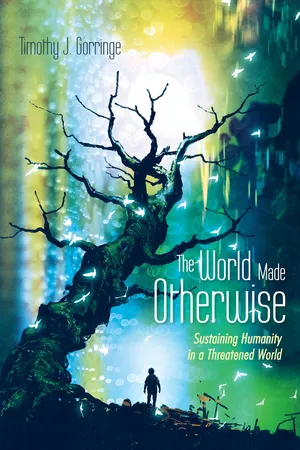
Many natural scientists believe climate change will bring civilizational collapse. Tim Gorringe argues that behind this threat is a commitment to false values, embodied in our political, economic, and farming systems. At the same time, millions of people the world over--perhaps the majority--are committed to alternative values and practices. This book explores how these values, already foreshadowed in people's movements all over the world, can produce different political and economic realities which can underwrite a safe and prosperous future for all.
Information
Topic
Theology & ReligionSubtopic
Christian TheologyPRACTICES
Chapter Four
The Shape of the Human Home
To consider oneself, according to eternal civil law, as an associate member of the cosmopolitan society is the most sublime idea a person can have of his destination. One cannot think of it without enthusiasm.
—Immanuel Kant
I have argued in the previous chapter that the tradition of the virtues is the most promising way to think about sustaining our humanity, but it is easily misunderstood in an individualist way. Through education, in the broadest sense (which includes family upbringing), I may become an admirable human being. But as we saw, both Plato and Aristotle understood that humans exist in groups—which they called “polities.” Virtues and vices are acquired within societies, and we cannot think of them outside these social and political structures. At the same time I argued in the first chapter that the problems arising from crossing planetary boundaries are primarily moral and political—that neither technological fixes nor tweaking of the present economic system are sufficient to address them. The rich world is currently already experiencing high levels of immigration and there are attempts on all hands to pull up the drawbridge and keep migrants out: migration is currently the issue that is pushing politics to the right all over the world. But if current analyses of ice-level melt in Antarctica are correct, we can expect much greater migration by the end of the century. The question, then, is how we manage politically without a regression into barbarism—whether local warlordism or worse. The problems outlined in the first chapter are all global in scope—none of them can be solved, or even addressed, by states in isolation. What is the best political base from which to address them? This is a question about the most just and sustainable shape of the human home. In terms of the discussion of the past two chapters I am asking about what values inform political order, and what practices we should be pursuing. MacIntyre speaks of practices as the school of the virtues—but there are practices of the vices also, which are not individual, but embedded in structures. In this chapter and the next I am considering political structures in the narrow sense, though economic structures (the theme of chapters 6 to 8) are also profoundly political. In this chapter I consider the shape of the “state,” and in the next the governance of the state, though in bringing about the necessary changes the same practices are required. Hence the practices sketched in this chapter will be elaborated in the next.
Hedley Bull noted forty years ago, in response to the question of how to address urgent problems, that if immediate action was necessary, it was not helpful “to maintain at the same time that effective action can only be taken by political institutions fundamentally different from those which obtain in the present world.” In the short run, he argued, it was only national governments that have the information, the experience, and the resources to act effectively in relation to serious crises.314 One can see the point, but I shall argue that the conditions for very different political structures are in place and in fact here and there are emerging, and that with good will they could become dominant and provide the structures necessary to deal with the planetary emergency.
It may seem odd to regard the shape of the state as a “practice” that shapes virtues or vices, but Plato and Aristotle thought of the polis of their day like this, and both proposed alternatives. In considering the accounts of Hobbes, Hegel, and today of Roger Scruton and Paul Kahn, I hope it will become clear how the nation state can be construed as functioning as a “practice” that shapes a moral stance. This practice I consider to foster idolatry, and therefore propose an alternative.
I begin with a discussion of order and freedom as fundamental values that underlie any polity. I go on to discuss whether “nation states” should be normative, and if not, what the alternative might be. I argue that the best base to address the crossing of planetary boundaries would be federations of small states, based on what I am calling “rights cosmopolitanism.” I conclude by asking whether cosmopolitan democracies might emerge.
Polity, order, and freedom
Bull began his study of the international political order by observing that all complex societies fulfil three functions: they seek to ensure that life will be in some measure secure against violence resulting in death or bodily harm; they seek to ensure that promises, once made, will be kept, and that grievances will be addressed; and they pursue the goal of ensuring that the possession of things will remain stable to some degree, and will not be subject to challenges that are constant and without limit. Order in social life means a pattern of human activity that sustains elementary, primary, or universal goals of social life such as these.315
This account of the political goal is shaped by a pessimism about human nature, and the society it gives rise to, which goes back at least to Augustine, or perhaps the Plato of The Laws, and which finds its classic exposition in Hobbes. Driven by competition, diffidence, and glory, all human beings are prone to violence. “Hereby it is manifest, that during the time men live without a common power to keep them all in awe, they are in that condition which is called war; and such a war, as is of every man, against every man.”316 This view is instantiated by the violence inherent in many urban situations in Latin America, the Middle East, and Africa. A World Bank study, Voices of the Poor, found that crime, violence, and insecurity are the primary concerns of low-income populations. The long-term absence of legitimate authority, the authors argued, is a multiplier that transforms governance into a variety of other voids: a segmented or fragmented labor market, a standard career of income instability, and a disintegration of social protective networks associated with decency and human security.317 Order, incontestably, is necessary for civility but, as J. S. Mill argued, order is a condition of government rather than its purpose.318 And, critics can say, “order” actually means the maintenance of property rights, and bourgeois order is another form of class war.319 From an anarchist perspective David Graeber argues that the order appealed to by liberal theorists from Locke to Nozick in fact rests on “primitive accumulation”—fundamental acts of violence in the distant or not-so-distant past. This puts into question the legitimacy of the force deployed to “keep order.”320 Shalom, the conditions for human flourishing, includes order but this needs to be built on truth, “for ultimately order which is built on lies must resort to coercion.”321
An important way of thinking of the establishment of order is in terms of “governance.” In his study of South American Indian society, Pierre Clastres spoke of “society against t...
Table of contents
- Title Page
- Preface
- Introduction
- Values and Virtues
- Practices
- Transistion
- Bibliography
Trusted by 375,005 students
Access to over 1.5 million titles for a fair monthly price.
Study more efficiently using our study tools.
Frequently asked questions
Yes, you can cancel anytime from the Subscription tab in your account settings on the Perlego website. Your subscription will stay active until the end of your current billing period. Learn how to cancel your subscription
No, books cannot be downloaded as external files, such as PDFs, for use outside of Perlego. However, you can download books within the Perlego app for offline reading on mobile or tablet. Learn how to download books offline
Perlego offers two plans: Essential and Complete
- Essential is ideal for learners and professionals who enjoy exploring a wide range of subjects. Access the Essential Library with 800,000+ trusted titles and best-sellers across business, personal growth, and the humanities. Includes unlimited reading time and Standard Read Aloud voice.
- Complete: Perfect for advanced learners and researchers needing full, unrestricted access. Unlock 1.5M+ books across hundreds of subjects, including academic and specialized titles. The Complete Plan also includes advanced features like Premium Read Aloud and Research Assistant.
We are an online textbook subscription service, where you can get access to an entire online library for less than the price of a single book per month. With over 1.5 million books across 990+ topics, we’ve got you covered! Learn about our mission
Look out for the read-aloud symbol on your next book to see if you can listen to it. The read-aloud tool reads text aloud for you, highlighting the text as it is being read. You can pause it, speed it up and slow it down. Learn more about Read Aloud
Yes! You can use the Perlego app on both iOS and Android devices to read anytime, anywhere — even offline. Perfect for commutes or when you’re on the go.
Please note we cannot support devices running on iOS 13 and Android 7 or earlier. Learn more about using the app
Please note we cannot support devices running on iOS 13 and Android 7 or earlier. Learn more about using the app
Yes, you can access The World Made Otherwise by Timothy J. Gorringe in PDF and/or ePUB format, as well as other popular books in Theology & Religion & Christian Theology. We have over 1.5 million books available in our catalogue for you to explore.