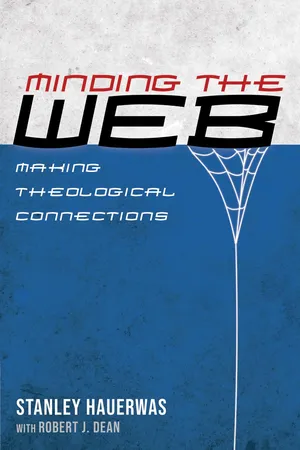
eBook - ePub
Minding the Web
Making Theological Connections
- 334 pages
- English
- ePUB (mobile friendly)
- Available on iOS & Android
eBook - ePub
About this book
For over forty years Stanley Hauerwas has been writing theology that matters. In this new collection of essays, lectures, and sermons, Hauerwas continues his life's work of exploring the theological web, discovering and recovering the connections necessary for the church to bear faithful witness to Christ in our complex and changing times. Hauerwas enters into conversation with a diverse array of interlocutors as he brings new insights to bear on matters theological, delves into university matters, demonstrates how lives matter, and continues in his passionate commitment to the matter of preaching. Essays by Robert Dean illumine the connections that have made Hauerwas's theological web-slinging so significant and demonstrate why Hauerwas's sermons have a crucial role to play in the recovery of a gospel-shaped homiletical imagination.
Information
Topic
Theology & ReligionSubtopic
Christian TheologyPart I
Matters Theological
1
Why Language Matters Theologically
On Reading and Writing
On Writing
“Call me Ismael.” Did Melville begin with that line or find it along the way as he wrote his great novel? I would like to think he found it along the way and that is one of the reasons it is so unforgettable. I would like to believe he found the sentence along the way because such sentences are so important that one suspects they could only be discovered with great difficulty. Sentences like “Call me Ismael” seem so organic, as if they just “happen”; but once they are found, they can never be replaced. Their very existence as a sentence creates a kind of necessity. Once a sentence like “Call me Ismael” exists, we know it cannot not exist.
A first sentence must be written to seduce the reader into reading the next sentence, and the next, and the next, until all the sentences have been read. That is true, for example, of the sentence I have just written. I wonder if the sentences with which I began meant whoever is now reading this could not resist reading this far? I should hope that to be the case, as I hope to seduce any reader of these sentences to read further.
Yet why am I writing about writing when I am trying to convince you to read? The reason that I can only write about reading by writing about writing is, as Verlyn Klinkenborg writes in his marvelous book Several Short Sentences about Writing, “You can only become a better writer by becoming a better reader.”65 It may even be true for some that you can only become a better reader by becoming a better writer.
That reading and writing are inseparable crafts is a widely shared presumption by writers and readers. Writers, however, are more likely than readers to argue that you only become a writer by reading what other writers have written. Some writers even report that they learned to write by copying sentence after sentence from another writer’s novel or essay. Some readers who have become writers even tell us that in the process of copying one sentence after another sentence before they knew it they had copied a whole novel.
Most readers of this essay, I suspect, are willing to grant that there is an important relation between reading and writing, but they might wonder why reading and writing matter theologically. I want to explore that question by attending to two writers, Rowan Williams and Craig Keen, who have written on the theological significance of writing, or, more accurately, on why language matters theologically. I will also take a side glance at Alasdair MacIntyre’s account of language, because MacIntyre develops an illuminating account of language by exploring how other species besides humans may develop innovative modes of communication. MacIntyre helps us see how at once we share many characteristics with other animals, while at the same time making clear the difference language makes. Williams and Keen, however, are crucial for the case I want to make because they are eloquent writers of theology who share in common a sense of how difficult it is to say what we mean. Crucial for both is Williams’s contention that “the labor involved in scrutinizing and using language about God with integrity is bound up with the scrutiny of language itself.”66
I focus on Williams and Keen because they write beautifully about the importance of writing beautifully about God. That is a great achievement because it is generally acknowledged that many theologians do not even write clearly, much less with beauty. The reasons theologians do not write well are no doubt complex, but at least one of the reasons is the relegation of theology to the university with the result that theologians now write mainly for other theologians. That theology has become primarily an academic specialty means theology—like many academic subjects—has confused incomprehensibility with profundity. Williams and Keen do not make that mistake.
It may be objected that Williams and Keen write primarily not about writing but about language. That is not surprising if you take notice of the fact that without language there would be no writing or reading. There is no correlate between those that write well and reflection on the nature of language itself, yet we should not be surprised that writers cannot resist trying to understand the words they use. Williams and Keen are theologians who not only develop accounts about the theological significance of language, they also write beautifully about why language is so important. I begin with Williams because his account of the incomplete character of language illumines Keen’s work.
Rowan Williams on Language
It is not surprising that Rowan Williams chose to concentrate on language in his Gifford Lectures delivered at the University of Edinburgh. It is not surprising because anyone who has followed Williams’s work over the years finds familiar themes in the published version of his lectures entitled, The Edge of Words: God and the Habits of Language. Deeply influenced by Wittgenstein, at the heart of Williams’s theological project has been what Charles Taylor has identified as the constitutive understanding of language. Taylor contrasts the constitutive view of language with what he calls the “enframing” account of communication. The enframing account of language assumes that life, behavior, purpose, and mental functioning can be described without reference to language.67 In contrast, for the constitutive view of language, a view Taylor attributes to Herder, there is no “outside” of language because any attempt to get at “reality” without language flounders on the reality that “reality” is linguistically constituted.68
The constitutive understanding of language, an understanding made possible only by having at our disposal linguistic resources, is the condition of the possibility of our being able to think at all. Yet because we are possessed by language, we are able to have ever changing emotions, goals, and relationships. Language, therefore, by its very nature cannot avoid, nor should language users try to escape, the necessity of new meanings being introduced into the world. Meaning is created because through language new properties—for example, new objects of admiration and/or indignation—are introduced into the world.69
I have begun with Taylor’s account of language as a way to introduce Williams’s very sophisticated account of what it means for us to be language-constituted beings. Though he does not use the term “constitutive,” Williams’s view of how we become language users is very similar to Taylor’s—thus Williams’s remark that “the fact of language is a good deal more puzzling than we usually recognize.”70 It is so, even though we normally think our language represents to us and makes present to us the patterns and rhythms of our world. Representation, however, is not a passive process.
Williams challenges the assumption that the primary task of language is to describe the world by distinguishing two ways of thinking about how we speak about our linguistic encounters with the world. Description is the name he gives to our presumption that the task of language is to produce a map that makes possible a structural parallel between what we say and what we perceive. Such a view of language, however, fails to account for what Williams calls the representational work of language that seeks “to embody, translate, make present or reform what is perceived.”71
Williams’s intent in The Edge of Words is to illumine the representational process, which he takes to be more significant than our mistaken presumption that description is more basic. The representational character of language presumes, as well as expresses, our ability to be an agent. To be sure, on Williams’s reading, we are complex agents, but nonetheless because of speech we are capable of acting in the world. We cannot, however, describe the world any way we want. “We cannot in human discourse simply say what we please.”72 Yet we cannot know the limits of what we can say in principle because we cannot know the full range of possible schemata.73
This means we cannot place a limit on conceptual possibilities. The diversity of representational possibilities points toward an understanding of our language as fundamentally unfinished. This unfinished character of language establishes us as speakers who must constantly seek to respond to changes in our place in the world. Metaphysically this means that claims to represent our environment presuppose, as Herbert McCabe suggested, that the universe not only looks like, but is a network of communication.74
We are at once determined and freed by our ability to speak. The freedom that characterizes language, a freedom that makes it possible to be truthful by what we say, comes through the struggle to say the right words in appropriate contexts. To test our language requires intelligent discernment because our language
creates a world, and so entails a constant losing and rediscovering of what is encountered. The connectedness of language to what is not language is a shifting pattern of correlation, not an index-like relation of cause and effect. We cannot easily imagine human speaking without the risk of metaphor, without the possibility of error and misprision, without the possibility of fiction, whether simple lying or cooperative fantasy. In other words, the human speaker takes the world as itself a ‘pro...
Table of contents
- Title Page
- Preface
- Introduction
- Part I: Matters Theological
- Part II: University Matters
- Part III: Lives Matter
- Part IV: The Matter of Preaching
- Epilogue: A Tale of Two StanleysStanleys, Or, Why We Need More Pointless Sermons from Hauerwas
Trusted by 375,005 students
Access to over 1.5 million titles for a fair monthly price.
Study more efficiently using our study tools.
Frequently asked questions
Yes, you can cancel anytime from the Subscription tab in your account settings on the Perlego website. Your subscription will stay active until the end of your current billing period. Learn how to cancel your subscription
No, books cannot be downloaded as external files, such as PDFs, for use outside of Perlego. However, you can download books within the Perlego app for offline reading on mobile or tablet. Learn how to download books offline
Perlego offers two plans: Essential and Complete
- Essential is ideal for learners and professionals who enjoy exploring a wide range of subjects. Access the Essential Library with 800,000+ trusted titles and best-sellers across business, personal growth, and the humanities. Includes unlimited reading time and Standard Read Aloud voice.
- Complete: Perfect for advanced learners and researchers needing full, unrestricted access. Unlock 1.5M+ books across hundreds of subjects, including academic and specialized titles. The Complete Plan also includes advanced features like Premium Read Aloud and Research Assistant.
We are an online textbook subscription service, where you can get access to an entire online library for less than the price of a single book per month. With over 1.5 million books across 990+ topics, we’ve got you covered! Learn about our mission
Look out for the read-aloud symbol on your next book to see if you can listen to it. The read-aloud tool reads text aloud for you, highlighting the text as it is being read. You can pause it, speed it up and slow it down. Learn more about Read Aloud
Yes! You can use the Perlego app on both iOS and Android devices to read anytime, anywhere — even offline. Perfect for commutes or when you’re on the go.
Please note we cannot support devices running on iOS 13 and Android 7 or earlier. Learn more about using the app
Please note we cannot support devices running on iOS 13 and Android 7 or earlier. Learn more about using the app
Yes, you can access Minding the Web by Stanley Hauerwas,Robert J. Dean, Robert J. Dean in PDF and/or ePUB format, as well as other popular books in Theology & Religion & Christian Theology. We have over 1.5 million books available in our catalogue for you to explore.