- 268 pages
- English
- ePUB (mobile friendly)
- Available on iOS & Android
eBook - ePub
About this book
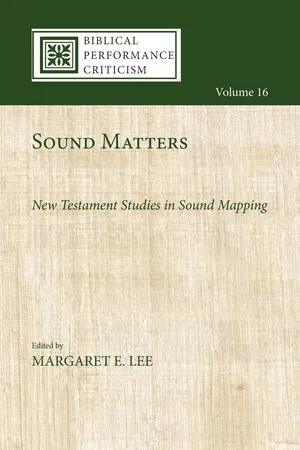
Sound matters. The New Testament's first audiences were listeners, not readers. They heard its compositions read aloud and understood their messages as linear streams of sound. To understand the New Testament's meaning in the way its earliest audiences did, we must hear its audible features and understand its words as spoken sounds. Sound Matters presents essays by ten scholars from five countries and three continents, who explore the New Testament through sound mapping, a technique invented by Margaret Lee and Bernard Scott for analyzing Greek texts as speech. Sound Matters demonstrates the value and uses of this technique as a prelude and aid to interpretation. The essays that make up this volume illustrate the wide range of interpretive possibilities that emerge when sound mapping restores the spoken sounds of the New Testament and revives its living voice.
Information
1
Sound Mapping Reassessed
Mapping sounds—the very concept seems strange and its usefulness elusive. Why plot sound on a map? The attempt to capture fleeting sound in a graphic image reflects the need to stabilize and then analyze ephemeral experience. Sound mapping commits to the proposition that sound matters. It places priority on the dynamics of listening and asks how these dynamics influence meaning. This essay traces the history of sound mapping, assesses recent studies that employ sound mapping, and suggests directions for the future.1
The Journey toward Listening
The idea of mapping a composition’s sounds began as Bernard Brandon Scott’s insight. Scott coined the term, “sound mapping” and was the first to perceive important possibilities for analyzing New Testament compositions as speech. Our collaboration began with a paper for the Matthew Seminar of the Society of Biblical Literature (SBL) in 1993 in which we conducted an experiment with sound mapping using the Sermon on the Mount as a test case.2 We chose this passage because it is memorable, framed as a speech, and contains significant material for detailed analysis. Our preliminary investigation convinced us that sound mapping could change how we understand the New Testament.
Encouraged by the initial reception of this experiment, I began to explore ancient discussions of literary composition in Greek to better appreciate their understanding of Greek literature as speech. My early investigations explored Greek grammar as a τέχνη or science of sound. My article, The Grammar of Sound, identified the colon and the period as basic sound units and suggested new interpretative horizons for mapping sounds in a Greek composition.3
I then undertook my doctoral dissertation project to develop a theoretics of sound, create a method and vocabulary for sound analysis, and test its power as an analytical tool. In that project I reexamined the Sermon on the Mount using the theoretics I had developed. I expanded, revised, and corrected our original sound map of Matt 5–7 and began to observe similarities between the Sermon’s auditory features and other sound signals in Matthew’s gospel.4 Armed with a more comprehensive foundation for sound analysis, Scott and I then resumed our collaboration in Sound Mapping the New Testament to present the process of sound mapping and analysis to a wider audience and apply it to a broader range of New Testament material.5
A Sound Approach
Sound mapping is an analytical technique with an empirical basis that draws from two tributaries of the same river: the characteristics of the Greek language and the precise configuration of sounds in a particular Greek composition. Put another way, a sound map plots distinctive features of both langue and parole. Aspects of the Greek language conducive to sound mapping include its flexible word order, rhyming inflections, and its aspectual system. Flexible word order creates a wide range of syntactic possibilities that allow an author to select where emphasis should fall and to specify precisely how syntactic elements are related. Rhyming inflections ensure that nominal elements can be perceived as clusters and not atomistically. The Greek aspectual system creates powerful verbal structures that open dimensions of meaning beyond a verb’s temporal implications.
Such linguistic features generate a vast expressive repertoire that extends beyond the semantic domain. Authors can imply subtleties of meaning using tone and timbre, melody and rhythm, speech and silence. Without even knowing what the words mean, we can feel the urgency of Mark’s gospel narrative with its repeated καί and its clipped cola. We sense the complexity of Paul’s ruminations through his nested, elliptical cola linked by undeclined particles and prepositions. The fourth gospel’s dramatic impact imposes imperatives on a listening audience through its distinctive exploitation of verbal aspect as an auditory cue, even before listeners come to terms with the meanings of its words. New Testament exegesis remains at best incomplete and at worst misguided when we neglect its soundscape.
A composition communicates its λόγος in the creative tension between its fixed, written form and its fluid, voiced quality. Like an opera’s libretto, a manuscript remains incomplete until animated by the human voice.6 Hellenistic Greek authors explicitly appreciate this range of expressive potential as they conceptualize literary compositions as woven fabric. They compare the written marks in a manuscript to the taut warp threads on a loom through which the varied and more colorful weft yarn that symbolizes the human voice is interlaced. In the Greek notion of literary composition as weaving or συμπλοκή, a composition consists of more than the manuscript that preserves it. Like empty warp threads hanging loose on a loom’s frame, a written composition lacks integrity until a human voice articulates its written marks. For these ancient audiences, a composition’s unity and meaning remained inaccessible until spoken; in fact, in the absence of speech, the composition did not actually exist.7 This ancient, governing image of composition as a woven fabric integrated by the human voice should guide our analytical approach to ...
Table of contents
- Title Page
- Acknowledgments
- Contributors
- Introduction
- Chapter 1: Sound Mapping Reassessed
- Chapter 2: New Adventures in Sound Mapping
- Chapter 3: Luke’s Strategy for Interpreting Parables
- Chapter 4: Caves, Cattle, and Koinonia
- Chapter 5: Investigations into the Sound’s Message of Philippians 1:27—2:18
- Chapter 6: Underexplored Benefits of Sound Mapping in New Testament Exegesis
- Chapter 7: Discourse Segmentation, Discourse Structure, and Sound Mapping
- Chapter 8: A Sound Map of Revelation 8:7–12 and the Implications for Ancient Hearers
- Chapter 9: Rhythm, Sound, and Persuasion
- Chapter 10: The New Testament Soundscape and the Puzzle of Mark 16:8
Trusted by 375,005 students
Access to over 1.5 million titles for a fair monthly price.
Study more efficiently using our study tools.
Frequently asked questions
Yes, you can cancel anytime from the Subscription tab in your account settings on the Perlego website. Your subscription will stay active until the end of your current billing period. Learn how to cancel your subscription
No, books cannot be downloaded as external files, such as PDFs, for use outside of Perlego. However, you can download books within the Perlego app for offline reading on mobile or tablet. Learn how to download books offline
Perlego offers two plans: Essential and Complete
- Essential is ideal for learners and professionals who enjoy exploring a wide range of subjects. Access the Essential Library with 800,000+ trusted titles and best-sellers across business, personal growth, and the humanities. Includes unlimited reading time and Standard Read Aloud voice.
- Complete: Perfect for advanced learners and researchers needing full, unrestricted access. Unlock 1.5M+ books across hundreds of subjects, including academic and specialized titles. The Complete Plan also includes advanced features like Premium Read Aloud and Research Assistant.
We are an online textbook subscription service, where you can get access to an entire online library for less than the price of a single book per month. With over 1.5 million books across 990+ topics, we’ve got you covered! Learn about our mission
Look out for the read-aloud symbol on your next book to see if you can listen to it. The read-aloud tool reads text aloud for you, highlighting the text as it is being read. You can pause it, speed it up and slow it down. Learn more about Read Aloud
Yes! You can use the Perlego app on both iOS and Android devices to read anytime, anywhere — even offline. Perfect for commutes or when you’re on the go.
Please note we cannot support devices running on iOS 13 and Android 7 or earlier. Learn more about using the app
Please note we cannot support devices running on iOS 13 and Android 7 or earlier. Learn more about using the app
Yes, you can access Sound Matters by Margaret E. Lee in PDF and/or ePUB format, as well as other popular books in Théologie et religion & Critique et interprétation bibliques. We have over 1.5 million books available in our catalogue for you to explore.