- 94 pages
- English
- ePUB (mobile friendly)
- Available on iOS & Android
eBook - ePub
About this book
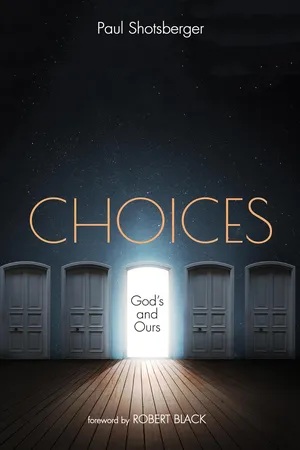
Choices: God's and Ours is a collection of stories and thoughts about how God's choices and our choices work together to advance His Kingdom. Written from the perspective of practical theology, the book is intended to help readers better understand the heart of God for us and the unlimited potential that exists when our moral will is aligned with His sovereign will.
Information
Topic
Theology & ReligionSubtopic
Christian TheologyChapter 1
The Choices God Makes
God’s natural laws that he has established, the physical laws that govern the universe, help us understand theologically how and when God intervenes in human affairs. I am a mathematician, so I will use probability as an example, but I promise not to test the reader’s patience with this analogy. I have no reason to doubt that the laws of probability were established at creation, much as gravity and other physical laws. God set this amazing system in place as background for our lives, parameters if you will for living on earth. Like it or not, these laws exist and cannot be broken by us. Further, these systems are connected to each other; results in one system are confirmed in another, such as the connection between mathematical laws and scientific laws. It’s all quite complex and beautiful and, above all for the mathematician, it produces results that do not contradict themselves.
Now, consider the question: if God put this complex and beautiful system in place to govern life on this earth, does it make sense that God would then oversee and in fact determine every roll of the dice, every card pulled from a deck, every twirl of some spinner? What’s the point? The system ensures predictable outcomes for large numbers of events. In other words, the system works. Why would God need to be in every event or experiment? He wouldn’t unless, of course, he had some specific reason for that intervention: unless for some reason he wanted to circumvent the laws he himself had established in order to serve some greater purpose.
The most direct example of this principle would be when lots were cast in the Old and New Testament. For instance, we are told in 1 Samuel 10 that Samuel the priest had already anointed Saul as the first king of Israel, but then in front of the entire nation he chose lots from all the tribes, and through this random-seeming selection process wound up identifying Saul from among all the people. The odds of this happening would have been astronomical but for God’s choice to intervene. We can also think about times when God countermanded the physical laws of the universe to accomplish his boulema. The two most obvious examples are when the Sun stood still in the sky for Joshua (Joshua 10) and when the shadow on the steps moved backward for Hezekiah (Isaiah 38). In these cases, there was an intervention into the system of the motion of the Earth around the Sun (and many other related laws) in order to create a specific sign for God’s people. Likewise, if we think of weather as a system that God established at creation, which has predictable outcomes over long periods of time, God chose to intervene during a storm on the Sea of Galilee as a sign for the disciples of Jesus (Mark 4:35–41).
Can God circumvent the laws he himself has established in order to accomplish his boulema? Yes, of course. Does he do it on a regular basis? It seems not. Are some events in God’s universe pre-determined? It seems so. We see this in Acts 4:27–28, where the believers pray, “Indeed Herod and Pontius Pilate met together with the Gentiles and people of Israel in this city to conspire against your holy servant Jesus, whom you anointed. They did what your power and will had decided beforehand should happen.” Well then, are all events pre-determined? We can answer that question with another question: Why would they be? Why would God establish these incredibly complex, powerful, and coherent systems if he only ever intended to determine the outcomes, event by event? It doesn’t really make much sense.
Now, here’s the theological application: Just as God has established physical laws for governing the universe, he has also established spiritual laws. Perhaps the most pervasive biblical law is the principle of sowing and reaping. God expects us to sow righteousness, and when we do, we reap spiritual blessing. When we do not, we suffer. This was the basis of God’s covenant with Israel. Biblically, it’s a very straight-forward principle with few exceptions. Yet, there are exceptions. There are those whose lives were anything but models of sowing in righteousness, and yet God’s blessing was upon them. How else can we explain the outcome of Jacob’s life? God simply chose, for his own reasons, to set aside the law of sowing and reaping and blessed Jacob and his family. God did this in order to establish the nation of Israel and eventually lead them into the Promised Land. In other words, God had a higher purpose than even the spiritual law he himself had established.
Speaking now of the historical events necessary for his mission to be accomplished, I believe God’s boulema applies at all times and in every case. In other words, the system works. There is no need to pre-determine each outcome, similar to the roll of the dice in probability. But I also believe that God does, from time to time, choose to intervene in the system, to change some particular outcome to achieve maximum glory for himself. It’s hard to read the Bible any other way. It seems, in fact, that God delights in doing this, in making the last first and the first last, because it directly points to him as the source of all blessing. I call these interventions God’s “deep selects.” In the military, there is a pecking order for promotion, an established order of rank and priority among officers. When a position of authority comes open, higher-ups go to the list, and it is immediately obvious who is next in line for the job. The system works and there are few exceptions. However, there are exceptions. In specific circumstances and for particular reasons, it is decided to pass over those at the top of the list for someone farther down. This happened at the beginning of World War II when Chester Nimitz was chosen to be Commander in Chief of the Pacific Fleet. He was not only a more junior officer, he was also a submariner—a highly unlikely choice.1 And yet, the decision was made, and the United States military effort in the Pacific profited as a result.
We see God involved in this “deep select” process at very strategic points in the biblical account, choosing Joseph over his brothers, David over his brothers, Gideon the nobody farmer from the nothing family, the teenager Mary from the tiny village of Nazareth, fishermen, a tax collector, and the Christian-hater Saul. Though some had questions for God about why they were chosen, we get the sense that their acceptance of God’s proposal was never in doubt. In other words, God had determined the outcome. Despite having a system in place for blessing individuals, God chose to lay aside the system in order to bless beyond the individual, to bless the nations.
Though we might be able to talk ourselves into accepting this aspect of God’s sovereignty, unfortunately, it only opens the door for more theological difficulties. The hard reality of the way in which God chooses to bless is that, as with games based on probability, if someone wins that invariably means someone else loses. Biblically, we might say that where there is choosing there is also losing. The choice of Jacob resulted in the loss of birthright and blessing on Esau’s part; the choice of Joseph resulted in his brothers bowing down to him in homage; the honoring of Job at the end of his story resulted in the humiliation of his friends. As difficult as the outcome was for those who lost in these situations, we are comforted by the fact that ultimately there was redemption available for the “losers.” In each of the above cases, God had made provision for those on the short end of the stick through the one who was blessed.
But this was not the case for all of those in the Bible who lost out on God’s blessing. For some, redemption never came. God hardened Pharaoh’s heart in order to bless the Israelites, and as far as we know, that condition did not change. Esther won the king’s favor and salvation for her people, but as a direct result, Haman swung on the gallows. Jesus called Judas Iscariot “ . . . the one doomed to destruction . . . ” (John 17:12), and Judas committed suicide having never rid himself of that label. These figures, Pharaoh, Haman, and Judas Iscariot, were pivotal in God’s plan of blessing for the nations. In each case, God intervened in the affairs of the human race to bring about a particular outcome that would glorify himself, which is completely within his purview as maker of the universe. And though we cheer for the winners (which includes us) in each of these situations, we are sobered by the tragedy that resulted for the losers. We hear echoes of this reality in God’s promise to the nation of Israel recorded in Isa 43:4: “Since you are precious and honored in my sight, and because I love you, I will give people in exchange for you, nations in exchange for your life.”
Why does God do this sort of thing? Why would he establish a perfectly good system and then simply set it aside? Further, when does he choose to do such a thing? Under what circumstances? The story of Jesus raising Lazarus from the dead in John 11 is instructive here. What more pervasive and enduring physical system can we imagine on this earth than the birth and death cycle? We are born, we live, we get sick, and we die. However, even though this was the reality for the vast majority of those whose stories are written about in the Bible, it was not true for everyone—time to time, the story would continue. This happened in both the Old Testament and New Testament. But among those stories, the account of Jesus’ resurrection of Lazarus stands out because of the deliberate choices Jesus, God himself, made.
The key decision made by Jesus was the one to stay on where he was for an additional two days after receiving the news that Lazarus was ill. Jesus’ choice resulted in two pivotal events: The death of Lazarus prior to Jesus’ arrival in Bethany, and Lazarus having been in the tomb four days before Jesus came on the scene. For Lazarus’s friends and family, it was game, set, and match. When Jesus finally arrived at their little town, both Martha and Mary expressed their understanding of God’s system by saying, “Lord, if you had been here, my brother would not have died” (vss 21, 32). This statement says, essentially, “I understand the system: people who are sick can get better, but not people who have died. You should have gotten here earlier.” However, Martha added a note of hope that Mary did not: “But I know that even now God will give you whatever you ask” (vs 22). In other words, God still makes his choices. A theological debate ensued between Jesus and Martha during which they discussed weighty topics like the resurrection of the dead and who Jesus really is. It seems clear from Martha’s answers to Jesus’ questions that her thoughts were on the hereafter, rather than the moment. This contrasts with Mary’s mindset, which was totally focused on the present.
When we ask why God chooses to intervene in his own system, we have to be mindful of this particular story from the Bible. God has his reasons, and God makes his choices, but those choices are made with us in mind. This is a remarkable but undeniable fact of Scripture. Somehow, God’s boulema is molded around our fragile existence. How else can we explain Jesus’ response to Mary? Whereas Martha made her statement to Jesus concerning her brother while standing at eye level in front of him, Mary makes the same statement from the dirt at Jesus’ feet. Jesus went to Bethany with the express purpose of raising Lazarus from the dead, primarily because it would bring maximum glory to his Father. When he arrived at that town, he was the only one who knew that in just a few minutes Lazarus would be alive once again. Yet, with Mary at his feet, he began to cry. The crowd around him said, “See how he loved him” (vs 36), and that was certainly true. But clearly, Jesus was not grieving.
I believe Jesus’ tears are unexplainable apart from the fact that Mary had found a way to touch his heart. She was someone who had spent time at Jesus’ feet while he was teaching, and she was affirmed by Jesus as having chosen the “better” way. She would be at his feet again when she anointed them with perfume prior to his death, a deeply significant act that Jesus said was his preparation for burial. We must always remember that God’s choices are not made in an eternal vacuum, devoid of any concern for his people. This is as true of the Old Testament as the New. How else can we understand the strange conversation between Abraham and God over the fate of the inhabitants of Sodom (Gen 18:16–33)? Or Moses pleading with God to spare the Israelites after the debacle of the golden calf, which resulted in the unimaginable: God altering a decision he had made (Exod 32:9–14). Or God’s accolades for Moses and Samuel in Jer 15:1, and Noah, Daniel and Job in Ezek 14:14—those who could touch his heart with their intercession. God’s pre-eminent concern is for his glory, but it seems in choosing that which will glorify him, he leaves the door of intercession ajar for those righteous ones who are also his glory.
This brings us to the ultimate choice: salvation. Is there a theological debate that has divided more Christians, churches and denominations throughout church history? Whose choice is it? Is it God’s or the individual’s? Of course, in one sense, it’s all God’s choice because he set up the system of salvation in the first place. If we apply the principles from the preceding discussion, we may conclude that God established a system that works wherein individuals, without the need for some kind of prior approval, are free to come to God through Christ Jesus and receive forgiveness for their sins and reconciliation with God. However, God reserves the right to intervene in this system, from time to time, to produce a salvation that goes far beyond the individual. If we give it a minute’s thought, all of us can come up with an example of a salvation story we are familiar with (perhaps even our own) that is so unlikely it defies human logic. The person was not “on the road to salvation.” In fact, it was quite the opposite—the person actually was an active condemner of God and of his followers. Yet, God in his mercy and for his glory “deep selected” that individual to be a part of his Kingdom.
Let’s consider a less controversial but equally mysterious choice, one we are called on to make every day as Christians: being led by the Spirit. In Romans 8, the Apostle Paul writes extensively on this subject, presenting us with a choice for living. We are either led by the Spirit, or we are led by our sinful nature, he says. It is our choice, but there are only two options, much as when Moses presented the Israelites with the choice of life or death, encouraging them to choose life. What exactly does Paul mean by being “led by the Spirit”? Interpretations abound, but here’s my best effort at a definition: We are led by the Spirit when we do the right thing for the right reason at the right time. It is not simply a matter of doing the right thing, or even doing the right thing for the right reason.
Many philosophers extol the virtues of acting morally, based on moral principles, but mo...
Table of contents
- Title Page
- Foreword
- Preface
- Introduction
- Chapter 1: The Choices God Makes
- Chapter 2: The Choice for Mission: The Life of Abraham
- Chapter 3: The Choice for Identity: The Life of Jacob
- Chapter 4: The Choice for Obedience: The Life of Joseph
- Chapter 5: The Choice for Righteousness: The Life of Job
- Chapter 6: The Choice for Worship: The Life of David
- Chapter 7: The Choice for Anointing: The Life of Elisha
- Chapter 8: The Choice for Suffering: The Life of Paul
- Chapter 9: The Choice for Redemption: The Advent of Jesus
- Conclusion
- Bibliography
Trusted by 375,005 students
Access to over 1.5 million titles for a fair monthly price.
Study more efficiently using our study tools.
Frequently asked questions
Yes, you can cancel anytime from the Subscription tab in your account settings on the Perlego website. Your subscription will stay active until the end of your current billing period. Learn how to cancel your subscription
No, books cannot be downloaded as external files, such as PDFs, for use outside of Perlego. However, you can download books within the Perlego app for offline reading on mobile or tablet. Learn how to download books offline
Perlego offers two plans: Essential and Complete
- Essential is ideal for learners and professionals who enjoy exploring a wide range of subjects. Access the Essential Library with 800,000+ trusted titles and best-sellers across business, personal growth, and the humanities. Includes unlimited reading time and Standard Read Aloud voice.
- Complete: Perfect for advanced learners and researchers needing full, unrestricted access. Unlock 1.5M+ books across hundreds of subjects, including academic and specialized titles. The Complete Plan also includes advanced features like Premium Read Aloud and Research Assistant.
We are an online textbook subscription service, where you can get access to an entire online library for less than the price of a single book per month. With over 1.5 million books across 990+ topics, we’ve got you covered! Learn about our mission
Look out for the read-aloud symbol on your next book to see if you can listen to it. The read-aloud tool reads text aloud for you, highlighting the text as it is being read. You can pause it, speed it up and slow it down. Learn more about Read Aloud
Yes! You can use the Perlego app on both iOS and Android devices to read anytime, anywhere — even offline. Perfect for commutes or when you’re on the go.
Please note we cannot support devices running on iOS 13 and Android 7 or earlier. Learn more about using the app
Please note we cannot support devices running on iOS 13 and Android 7 or earlier. Learn more about using the app
Yes, you can access Choices by Paul Shotsberger in PDF and/or ePUB format, as well as other popular books in Theology & Religion & Christian Theology. We have over 1.5 million books available in our catalogue for you to explore.