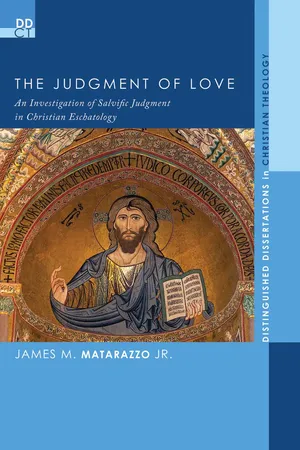
eBook - ePub
The Judgment of Love
An Investigation of Salvific Judgment in Christian Eschatology
- 330 pages
- English
- ePUB (mobile friendly)
- Available on iOS & Android
eBook - ePub
The Judgment of Love
An Investigation of Salvific Judgment in Christian Eschatology
About this book
This book seeks to explore the concept of divine judgment in Christian eschatology. It contends that this judgment is salvific rather than destructive. This notion can be described aphoristically as iudicandus est salvandus ("to be judged is to be saved"). The provocation to Christian eschatology is that human beings are not saved from judgment, but are saved within it. The exploration begins defining the context and moves into a review of the symbols and problems of judgment through a reappraisal of De novissimis ("concerning the last things"), the last section found in traditional works of Christian dogmatics. This is followed by a critical engagement with the soteriological optimism posited by four twentieth- and twenty-first century theologians: Sergei Bulgakov, Hans Urs von Balthasar, J. A. T. Robinson, and Marilyn McCord Adams. The event of the judgment is then defined as the event of absolute recognition: that it is within the eschatic recognition of God, the self, and the other that transformation and glorification of human persons occur in a way that avoids a dual outcome of salvation and damnation. The book concludes by proposing that we may approach divine judgment with faith, hope, and love--not only for ourselves, but for the human race as a whole.
Information
Topic
Theology & ReligionSubtopic
Christian Theologychapter 1
Introduction
The eschatological office is mostly closed these days.
—Ernst Troeltsch1
If Christianity be not altogether thoroughgoing eschatology, there remains in it no relationship whatsoever to Christ.
—Karl Barth2
In this book, I shall investigate the proposal that divine judgment is the judgment of love, that the judgment is salvific, and that the judgment is the event of absolute recognition of God, the self, and the other. Since this is an exploration of Christian eschatology (the study of the last things), it is first necessary briefly to discuss the theological tasks involved.
The quote above attributed to the German Protestant theologian Ernst Troeltsch (1865–1923) which was made before the onset of World War I shows how quickly the theological landscape can change, especially after two world wars destroyed the theological and social optimism of what was then deemed liberal Christian theology.3 It is not surprising that Karl Barth (1886–1968), also quoted above, reacted to the horrors of the Great War with the second edition of his commentary on the Epistle to the Romans (Die Römerbrief) in 1922. He re-wrote Die Römerbrief while he was a professor at the University of Göttingen. Barth was also the lead author of the Barmen Declaration (1934), which opposed National Socialism’s interference in the German Protestant churches through the Nazi-affiliated German Christian movement.4 The carnage of the twentieth century not only reopened the “eschatological office,” but it has stayed firmly open in the twenty-first century.
The word “eschatology,” the study of the eschata (ἔσχατα, “last things”), was coined from the Greek by German Protestant theologians during the period of Lutheran Orthodoxy in the seventeenth century. Markus Mühling argues that Philipp Heinrich Friedlieb (1603–63) was one of the first Protestant theologians to use the term.5 The earlier Latin term for the study of the last things is De novissimis (“concerning the last things”). These “last things” were enumerated as the quattuor novissima (“the four last things”): death, judgment, heaven, and hell.6 By the nineteenth century, the word eschatology had generally supplanted the Latin term.7
Before continuing, eschatology needs to be defined. For this, I turn to Mühling in his fivefold definition:
1. A description of the doctrine of all possible conceptions of the future and the afterlife;
2. The doctrine of the last things, the final events. These can be understood in either a temporal or an ontic sense;
3. The doctrine of that which is ultimate, the ultimate things. This may be understood in a temporal sense but is generally expressed in other categories such as the ontically transcendent meaning of an event, as in Tillich;
4. A historical term for the future-oriented or apocalyptic character of the teachings and life of Christ, whether this is understood in a historicizing way (Albert Schweitzer) or in a systematic and positive way; and
5. A description of the doctrine of the ultimate person, Jesus Christ.8
Using this definition, Christian eschatology is a vast subject. Other religions have their own respective eschatological doctrines, further broadening this discipline. Nonetheless, in this book, I am attempting to make a proposal that adds to the existing Christian eschatological corpus. Mühling considers Friedrich Daniel Ernst Schleiermacher (1768–1834) to be one of the most important of the first “modern” systematic theologians to engage in a critical exploration of the eschata in his summary of dogmatics Der christliche Glaube nach den Grundsätzen der evangelischen Kirche im Zusammenhange dargestellt (1830/1831). This work is usually referred to as Die Glaubenslehre (The Christian Faith).9 It is modern in the sense that it is post-Enlightenment. Schleiermacher did not feel bound to adhere to Reformation orthodoxy. Rather, he takes the creedal and confessional statements of the early church and the Reformation and reinterprets them, including the topic of eschatology.
Schleiermacher’s theology could be termed a “theology of experience.”10 In a limited sense, Schleiermacher echoes the Methodist Quadrilateral based on the works of John Wesley (1703–91): that Christian doctrine is to be formulated on the basis of Scripture, tradition, reason, and experience.11 However, while for Wesley Scripture is primary, for Schleiermacher the primary aspect for doctrinal definition is the experience of God-consciousness—all other sources (Scripture, tradition, reason) must be interpreted through the experience of the believer. This means that, since the future cannot be experienced now, Schleiermacher does not consider eschatology to be a study of the “last things.” He does, however, critique the novissima in a way that was unthinkable for the magisterial reformers.12 What should be noted is that Schleiermacher, as a post-Kantian theologian, does not really allow for eschatological speculation (as it is beyond human experience) as such, even though he does offer opinions about the possibility of post mortem redemption.
Mühling opines that Philip Melanchthon (1497–1560) essentially forbade speculation about the “last things” in the Augsburg Confession (Confessio Augustana, 1530) by its curt treatment of the topic and condemnation of radical reformers that proposed eschatological innovations:
It is also taught among us that our Lord Jesus Christ will return on the last day for judgment and will raise up all the dead, to give eternal life and everlasting life to believers and the elect but to condemn ungodly [humans] and the devil to hell and eternal punishment. Rejected, therefore, are the Anabaptists who teach that the devil and condemned [humans] will not suffer eternal pain and torment.13
Interestingly, Melanchthon not only asserts salvific dualism, but also condemns universal salvation and an early (and violent) ant...
Table of contents
- Title Page
- Foreword
- Preface
- Acknowledgements
- Abbreviations
- Chapter 1: Introduction
- Chapter 2: The Symbols and Problems of Judgment
- Chapter 3: The Larger Hope: Divine Judgment in Optimistic Soteriology
- Chapter 4: The Purpose of Divine Judgment
- Chapter 5: Towards a Christian Eschatology of Absolute Recognition
- Chapter 6: Conclusion
- Bibliography
Trusted by 375,005 students
Access to over 1.5 million titles for a fair monthly price.
Study more efficiently using our study tools.
Frequently asked questions
Yes, you can cancel anytime from the Subscription tab in your account settings on the Perlego website. Your subscription will stay active until the end of your current billing period. Learn how to cancel your subscription
No, books cannot be downloaded as external files, such as PDFs, for use outside of Perlego. However, you can download books within the Perlego app for offline reading on mobile or tablet. Learn how to download books offline
Perlego offers two plans: Essential and Complete
- Essential is ideal for learners and professionals who enjoy exploring a wide range of subjects. Access the Essential Library with 800,000+ trusted titles and best-sellers across business, personal growth, and the humanities. Includes unlimited reading time and Standard Read Aloud voice.
- Complete: Perfect for advanced learners and researchers needing full, unrestricted access. Unlock 1.5M+ books across hundreds of subjects, including academic and specialized titles. The Complete Plan also includes advanced features like Premium Read Aloud and Research Assistant.
We are an online textbook subscription service, where you can get access to an entire online library for less than the price of a single book per month. With over 1.5 million books across 990+ topics, we’ve got you covered! Learn about our mission
Look out for the read-aloud symbol on your next book to see if you can listen to it. The read-aloud tool reads text aloud for you, highlighting the text as it is being read. You can pause it, speed it up and slow it down. Learn more about Read Aloud
Yes! You can use the Perlego app on both iOS and Android devices to read anytime, anywhere — even offline. Perfect for commutes or when you’re on the go.
Please note we cannot support devices running on iOS 13 and Android 7 or earlier. Learn more about using the app
Please note we cannot support devices running on iOS 13 and Android 7 or earlier. Learn more about using the app
Yes, you can access The Judgment of Love by James M. Matarazzo Jr in PDF and/or ePUB format, as well as other popular books in Theology & Religion & Christian Theology. We have over 1.5 million books available in our catalogue for you to explore.