eBook - ePub
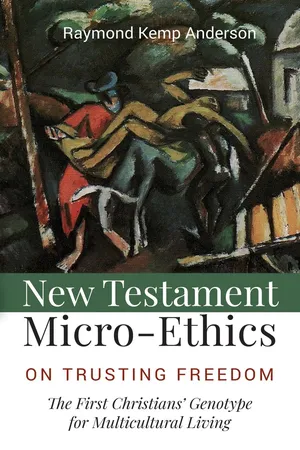
New Testament Micro-Ethics
On Trusting Freedom: The First Christians’ Genotype for Multicultural Living
- 118 pages
- English
- ePUB (mobile friendly)
- Available on iOS & Android
eBook - ePub
New Testament Micro-Ethics
On Trusting Freedom: The First Christians’ Genotype for Multicultural Living
About this book
Anderson shows how Early Christians' faith took root in a multicultural world just as diverse and conflicted as our own. Their basic attitude turns out to have been one of astounding freedom--not a cultus of rules, but a matter of whole-hearted response; for they lived in conversation with the One whose love for all his wayward creatures is utterly tenacious.
We find ourselves continually surprised by an insistent grace that treasures all persons equally while exposing and deposing our evil. Such faith still evokes basic confidence; and we find ourselves, ever again moved by gratitude and trusting each others' Christ-emboldened freedom.
If we are embraced by grace, our becoming "great again" can only mean unlimited concern for all and free-flowing interactive service. The playful work ethic that ensues holds promise for our politically splintered post-industrial age. The New Testament's seed-like ethical genotype still unfolds into a secure, all-embracing, and mutually supportive "sabbatic" life stance. What could be more relevant for our future in conflicted times?
Information
Topic
Theology & ReligionSubtopic
Biblical StudiesTable of contents
- Title Page
- Foreword by Raymond Carr
- Preface
- Introduction: The Minimal Ethic of the First Christians’ Gospel
- Chapter 1: Jesus’ Minimal Ethical Teaching
- Chapter 2: Why a Mustard-Seed Ethic
- Chapter 3: Paul’s Cross-Cultural Paraenesis
- Chapter 4: Our Life in Grace Spans Time and Space
- Chapter 5: Paul Urges: Think on These Things
- Chapter 6: In Christ, Be Yourselves
- Chapter 7: Ethics Stripped Down for the World
- Abstract
- Bibliography
Trusted by 375,005 students
Access to over 1.5 million titles for a fair monthly price.
Study more efficiently using our study tools.
Frequently asked questions
Yes, you can cancel anytime from the Subscription tab in your account settings on the Perlego website. Your subscription will stay active until the end of your current billing period. Learn how to cancel your subscription
No, books cannot be downloaded as external files, such as PDFs, for use outside of Perlego. However, you can download books within the Perlego app for offline reading on mobile or tablet. Learn how to download books offline
Perlego offers two plans: Essential and Complete
- Essential is ideal for learners and professionals who enjoy exploring a wide range of subjects. Access the Essential Library with 800,000+ trusted titles and best-sellers across business, personal growth, and the humanities. Includes unlimited reading time and Standard Read Aloud voice.
- Complete: Perfect for advanced learners and researchers needing full, unrestricted access. Unlock 1.5M+ books across hundreds of subjects, including academic and specialized titles. The Complete Plan also includes advanced features like Premium Read Aloud and Research Assistant.
We are an online textbook subscription service, where you can get access to an entire online library for less than the price of a single book per month. With over 1.5 million books across 990+ topics, we’ve got you covered! Learn about our mission
Look out for the read-aloud symbol on your next book to see if you can listen to it. The read-aloud tool reads text aloud for you, highlighting the text as it is being read. You can pause it, speed it up and slow it down. Learn more about Read Aloud
Yes! You can use the Perlego app on both iOS and Android devices to read anytime, anywhere — even offline. Perfect for commutes or when you’re on the go.
Please note we cannot support devices running on iOS 13 and Android 7 or earlier. Learn more about using the app
Please note we cannot support devices running on iOS 13 and Android 7 or earlier. Learn more about using the app
Yes, you can access New Testament Micro-Ethics by Raymond Kemp Anderson in PDF and/or ePUB format, as well as other popular books in Theology & Religion & Biblical Studies. We have over 1.5 million books available in our catalogue for you to explore.