- 192 pages
- English
- ePUB (mobile friendly)
- Available on iOS & Android
eBook - ePub
About this book
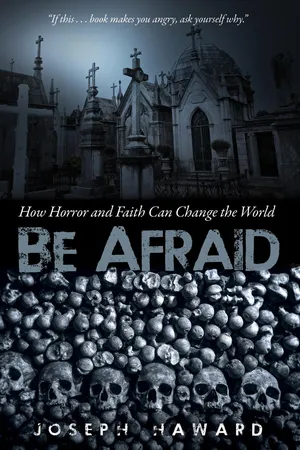
You would usually imagine blood-sucking vampires and crucifix-holding priests in a fight to the death, but professional "holy man" Reverend Joe Haward believes horror can show us how to truly live. Could it be that horror, combined with faith, has the power to transform the world for the better? In this controversial book you are invited to discover how flesh-eating zombies, ghosts, and Jesus have the potential to turn the world upside down and create beautiful communities of peace. From Hannibal Lecter showing us the power of forgiveness, to Stephen King's IT revealing why authentic speech might change your life forever, this book will take you into the heart of terror, and lead you into a brave new world. Be afraid, because you might never be the same again.
Information
1
Monsters
The Horror of Compassion
MacReady: Somebody in this camp ain’t what he appears to be. Right now that may be one or two of us. By spring, it could be all of us.
Childs: So, how do we know who’s human? If I was an imitation, a perfect imitation, how would you know if it was really me?
—The Thing1
Jaws remains a film of enduring significance. While the scenes with the shark may appear at times clunky and unrealistic, the power of the film lies in its ability to keep the shark monster off the screen while the threat of the monster remains very real. Whenever someone is even near water, we feel a sense of dread, an uncertainty and fear that we cannot shake off. We know that the best outcome for everyone is to simply stay out of the water! And yet the draw of the water, the skepticism that a killer shark actually exists, is too powerful to stop people from diving into the crystal waves. The constant sense of apprehension that you feel as a viewer while people are in the water is a credit to the genius of Steven Spielberg.
Jaws is a film for our time, for it speaks into a Western culture whose narrative is one of fear of what lurks beyond us. It is a monster that we glimpse that needs to be destroyed, that we know is not everywhere, that is very specifically in one place, albeit a vast and expansive space, and yet at the same time the media and government make us feel like the threat lies potentially everywhere. Since 9/11, the American and UK governments have committed themselves to the “war on terror.” We have spent billions on war, sending troops on the ground, dropping bombs from the air, and increasing our ability for monitoring and surveillance of our own citizens—all to combat and defeat the threat of “terror.” We have been fed a narrative through the media and government that there is a specific threat that needs to be dealt with, and our energy and money needs to be given to the eradication of this threat, a threat that we should be afraid of. In one scene in Jaws the beach is packed full of people, all sunbathing and playing on the sand, but no one has gone into the sea. A boy has already died earlier in the film, eaten by the underwater monster that results in a massive search for the killer shark, with seemingly the whole town out in their boats looking for the shark to kill it. One boat finds and kills a massive tiger shark, and the whole town celebrates, yet, paradoxically, uncertainty remains. The visiting shark expert, Matt Hooper, tells Chief Brody that the shark that has been caught is not the shark they are looking for, that it’s too small, but the mayor will have none of it, fearing any talk of a killer shark still on the loose will damage the town’s summer economy. The townspeople and summer visitors seem to have an enduring sense of fear, unsure whether it is actually safe to go back in the water, so that on the Fourth of July weekend everyone is on the beach but not in the sea. The mayor throughout the film is deeply concerned by lost profits and revenue. A beach where no one is swimming is not good advertising. He walks up and down the beach ordering the locals to get in the water, which they eventually do. Once one person starts swimming many others join them, and fears of a killer shark soon disappear. But of course the threat remains, and another shark attack leads Chief Brody, Hooper, the marine specialist, and Quint, the hardened, skilled, and battle-worn fisherman, to go in search of the underwater monster. At the climax of the film Quint has been killed by the shark, the war veteran devoured by the relentless, sleepless killing machine. The hero, it turns out, is Brody, the middle-class, hard-working, white, all-American, saving the all-American town, preserving its middle-class beauty. Brody, having jammed a pressurized scuba tank in the shark’s mouth, climbs the mast of the sinking boat, and starts shooting at the tank. He then utters the immortal line, “Smile, you son of a bitch,”2 and shoots the tank and destroys the shark. What then, you might ask, has this to do with “the war on terror”?
Fear is a great motivator, and fear of the unknown, the unusual, or “other” can result in our desire for security and protection, whatever the cost. The “war on terror” has cost a lot: money and lives. What we seek is a resolution, for the unseen enemy to be destroyed. We want our way of life to be preserved, indeed, to remember how things used to be and reclaim our country, in order to have a better life that has been eroded and disturbed by forces out of our control. The narrative from both media and successive governments is that there is a terrorist threat that needs destroying, so we send our “all-American heroes” or “British heroes”; these regular, hardworking people, we send them out to hunt and destroy the terrorists who are killing us and terrorizing our way of life. The only way to defeat the enemy is though violence, through bullets ripping through the enemy’s territory, much like Brody’s bullets tearing through the water. The scuba tank in the shark’s mouth is perhaps a modern-day symbolism of our own weapons in the hands of terrorists, sold to Saudi Arabia, resold to terrorist groups. Jaws, then, is that classic monster tale—a story of fear, of peace disrupted, a monster out to destroy our way of life—and the only way to overcome it is through our violence, a violence that will preserve our way of life. But not all monster stories follow this pattern; The Babadook is a different monster story altogether that offers us another way to handle the fear that the unseen terror evokes within us.
Babadookian Fear
The Babadook tells the story of Amelia, a depressed and troubled widow, who is struggling to raise her six-year-old son, Sam. Amelia’s husband, Oskar, was killed in a car accident while Amelia was in labor with Sam. Throughout the film we discover the strain this has caused on Amelia’s ability to bond with Sam, a simmering and sometimes overt resentment to her son. One night, Amelia reads to Sam a pop-up storybook called Mister Babadook, a mysterious man/monster with a top hat and pointed fingers, dressed in black with a pale face, who torments his victims once they become aware of his existence. She doesn’t finish the story, but the first few pages are enough to terrorize Sam.
The poem of Mister Babadook goes like this,
If it’s in a word
or in a look,
you can’t get rid of the Babadook.
If you’re really a clever one
and you know what it is to see,
then you can make friends with a special one,
a friend of you and me.
A rumbling sound
then three sharp knocks,
“A Baba-dook-dook-dook”
Let me in.
This is what he wears on top,
He’s funny don’t you think?
That’s when you know he’s around
you’ll see him if you look.
See him in your room at night
and you won’t sleep a wink.
I’ll soon take off my funny disguise.
Take heed of what you read.
Once you see what’s underneath,
You’re going to wish you were dead.
I’ll wager with you
I’ll make you a bet,
The more you deny the stronger I get.
You start to change when I get in,
the Babadook growing right under your skin.3
The book, understandably, gives Sam nightmares, and so he climbs into his mum’s bed. Once Sam is asleep, Amelia moves across the bed as far from her son as possible, a look of revulsion written over her face.
As the film progresses the unseen presence of the Babadook grows, as does Amelia’s paranoia and fear that something is lurking in the shadows, hunting her and her son. Eventually Amelia is literally possessed by the Babadook, but Sam manages to tie her up in the basement. He pleads with his mum to admit to herself that the Babadook is inside of her otherwise she can never get rid of him. Sam goes to her and strokes her face, at which she manages to get her hands free and begin to strangle h...
Table of contents
- Title Page
- Foreword
- Preface
- Abbreviation
- Introduction
- Chapter 1: Monsters
- Chapter 2: Vampires
- Chapter 3: Cannibalism
- Chapter 4: Apocalypse
- Chapter 5: It
- Chapter 6: Demons
- Chapter 7: Aliens
- Chapter 8: Ghosts
- Chapter 9: Frankenstein
- Chapter 10: Zombies
- Conclusion: The Power of Peace
- Bibliography
Trusted by 375,005 students
Access to over 1.5 million titles for a fair monthly price.
Study more efficiently using our study tools.
Frequently asked questions
Yes, you can cancel anytime from the Subscription tab in your account settings on the Perlego website. Your subscription will stay active until the end of your current billing period. Learn how to cancel your subscription
No, books cannot be downloaded as external files, such as PDFs, for use outside of Perlego. However, you can download books within the Perlego app for offline reading on mobile or tablet. Learn how to download books offline
Perlego offers two plans: Essential and Complete
- Essential is ideal for learners and professionals who enjoy exploring a wide range of subjects. Access the Essential Library with 800,000+ trusted titles and best-sellers across business, personal growth, and the humanities. Includes unlimited reading time and Standard Read Aloud voice.
- Complete: Perfect for advanced learners and researchers needing full, unrestricted access. Unlock 1.5M+ books across hundreds of subjects, including academic and specialized titles. The Complete Plan also includes advanced features like Premium Read Aloud and Research Assistant.
We are an online textbook subscription service, where you can get access to an entire online library for less than the price of a single book per month. With over 1.5 million books across 990+ topics, we’ve got you covered! Learn about our mission
Look out for the read-aloud symbol on your next book to see if you can listen to it. The read-aloud tool reads text aloud for you, highlighting the text as it is being read. You can pause it, speed it up and slow it down. Learn more about Read Aloud
Yes! You can use the Perlego app on both iOS and Android devices to read anytime, anywhere — even offline. Perfect for commutes or when you’re on the go.
Please note we cannot support devices running on iOS 13 and Android 7 or earlier. Learn more about using the app
Please note we cannot support devices running on iOS 13 and Android 7 or earlier. Learn more about using the app
Yes, you can access Be Afraid by Joseph Haward in PDF and/or ePUB format, as well as other popular books in Social Sciences & Religion. We have over 1.5 million books available in our catalogue for you to explore.