- 146 pages
- English
- ePUB (mobile friendly)
- Available on iOS & Android
eBook - ePub
About this book
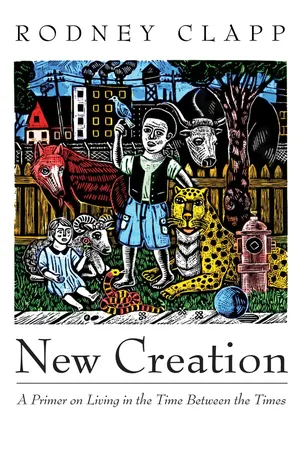
New Creation introduces readers to the thrilling, biblically-based vision of a whole world created by and to be redeemed by God. Written at an eminently accessible level, it shows how endings (or eschatologies) animate our lives. It rehearses the biblical story from an eschatological angle, emphasizing that Christian eschatology entails a politics. It then delves into how eschatology affects the priesthood of all believers, peace-making, prayer, and creation (including the rocks and trees, dogs and bees, and maybe even sex). With a light hand, it provides biblical cultural background where needed. Throughout, it connects theological groundings to present-day life, Christian discipleship, and contemporary issues. Here is a view of eschatology that bypasses escapist Rapture theology and puts forward a robust, exciting life now and in the age to come, very different from New Yorker cartoons featuring the afterlife as a bland, boring affair of strumming harps on clouds.
Information
Topic
Theology & ReligionSubtopic
Christian TheologyChapter 1
The Story
Imagine you discover a discarded suitcase in your backyard. In the suitcase nestle sixty-six boxes, of various shapes and sizes. To make sense of the boxes, you must open them and examine their contents. But they are locked. Further unpacking the suitcase, you discover a key that will unlock the boxes.
The Bible, I want to suggest, is like this suitcase. Actually a library, the Bible is comprised of sixty-six books, written over a period of 1,500 years. The books represent a dazzling variety of genres: history, legend, love songs (The Song of Solomon), song and prayer books (the Psalms), wisdom literature (Proverbs, Ecclesiastes), prophecy, letters of exhortation, and outright end-of-the-world tracts (Daniel, Revelation). As anyone who has read (or tried to read) it from cover to cover can attest, the Bible is often confusing and difficult. Indeed, it resembles a vast and challenging nonfiction novel. To read it and make sense of it as a whole, we need a key.
That key is eschatology. What binds the Bible together, from beginning to conclusion, is the hope of an ending. In this chapter, then, I will review the biblical story with the eschatological key ready to hand. I will not, of course, offer an exhaustive review or reading—that would require several books. Instead, to depart from the key metaphor, I will range across the sacred library using an eschatological lens, looking at how the sense of an ending pervades and unifies the parts into a whole, into a single all-encompassing story. This story includes the purpose and God-intended ends not just of individuals, but of history and the entire cosmos. So the content itself excites and stimulates. Even more exciting is to know that we are invited to be inducted into this story, to become not merely readers of it but vital characters within it.
Creation
“In the beginning . . . God created the heavens and the earth . . .” (Genesis 1:1). The Bible’s first sentence is comprehensive. God creates all that is; the heavens and the earth comprehend the universe. The creation story proceeds in a series of permissives and commendations: “Let there be . . .” and “God saw that it was good . . .” First, “Let there be light,” and “God saw that the light was good.” Then, let there be a sky. Next, earth and the seas. “And God saw that it was good.” Then, vegetation: “plants yielding seed, and trees of every kind bearing fruit with seeds in it.” Again, “God saw that it was good.” Next, the sun and the moon and the stars. “And God saw that it was good.” Then, “swarms of living creatures” in the water, and in the sky “every winged bird of every kind.” Again, “God saw that it was good.” Next, God made the wild animals of the earth of every kind, and the domesticated animals (“cattle”) of every kind. “And God saw that it was good.” Finally, God created humankind in his image, “in the image of God he created them, male and female he created them.” God surveys his completed creation, teeming with life of all sorts. “God saw everything he had made, and indeed, it was very good” (Genesis 1:4–31).
To appreciate the gentleness and evocativeness of the Genesis creation story, we can contrast it with the Babylonian epic of creation, contemporary to it. In the Babylonian epic of creation, the story centers on the ocean goddess Tiamat and the young warrior god Marduk. This creation begins with violent rebellion. Tiamat is an older goddess, and Marduk is the younger god appointed to overthrow her. In a gory frenzy, Marduk shoots her full of arrows, flays her, and stabs her heart. He tramples her corpse, crushes her skull, and scatters her blood in the wind—all to the cheers of the other younger gods. Finally Marduk splits Tiamat in two. From one half of her he makes the rain-bearing heavens. From the other half he makes the earth with its land, as well as springs, rivers, and oceans. Humanity is created as slaves of the gods, digging canals, cultivating crops, harvesting and preparing food for the gods, and, not entirely coincidentally, for the kings and priests who represent the gods. Slaughter and enslavement lie at the heart of this creation myth.
If the Babylonian epic presents the gods creating like bloodthirsty warriors, the Genesis story presents God creating like a loving artist, enthralled by his creation. God simply and gently speaks creation into being. We could say he delights it into being. In its repetition, rhythmic quality, and sense of celebration, Genesis 1 resembles nothing so much as a children’s play chant or song. God gives creation a life of its own, permitting it to come alongside him and join him in the joyous chorus of life. So the “greater and lesser lights,” the sun and the moon, are charged to govern or rule day and night (Genesis 1:16, 18). “The earth brought forth vegetation,” cooperating with God in creation (Genesis 1:12). And the living creatures, including humankind, are called to “be fruitful and multiply,” to fill and complete the creation of the waters and the land (Genesis 1:11–12, 20, 24). Generosity and freedom are at the heart of this creation story.
Note, now, the role of humanity in creation. Humanity is made in the image of God. This means humanity, at the crown of creation, is to “have dominion over the fish of the sea, and over all the cattle, and over all the wild animals of the earth, and over every creeping thing that creeps upon the earth” (Genesis 1:26). Humanity is made God’s vice-regents or stewards on the earth. In God’s image and after the way of God’s artistry, humanity’s “dominion” is not to be rapacious and exploitative. Instead, its stewardship is an exercise of generous and noncoercive power. Like God’s power, this stewardly power invites, evokes, and permits. It is more power with and power for than power over the rest of creation. It is not reflected in strip-mining, for example, which gouges off mountaintops, regarding trees and rocks only as much “overburden.” Nor is this stewardly power reflected when industries heedlessly dump pollution into rivers or belch it into the skies. This power is better reflected in the woodworker who brings out wood’s natural strength and beauty. It is reflected in the cook’s seasoning and careful preparation that releases the glories of apples or green beans. It is reflected in the vintner who patiently plants, prunes, cultivates, and waters to evoke the grape’s striking piquancy.
Such was the beauty and arrangement of creation. Set on this trajectory, its end would have been progressive development beside and under humanity’s benevolent stewardship. But then, as we are all too aware, something went horribly awry.
Fall
Another, complementary account of the creation also gives us the story of what is classically called the fall. God situates nascent humanity, Adam and Eve, in the Garden of Eden. They are at peace with all the animals, whom Adam knows so well that he can name them according to their essences. They have abundant fruit and vegetation from which to eat, without toil. But they are commanded never to eat from the Tree of the Knowledge of Good and Evil.
They cannot bear this temptation and, seduced by the smooth-talking serpent, they eat from the forbidden Tree. This act results in a series of breaks or separations. First, humanity is separated from God. Ashamed in their sin, they hide from God and attempt to avoid his presence (Genesis 3:8). Second, they are separated from one another. Confronted by God about the consumption of the forbidden fruit, Adam blames Eve, alienating the two of them from one another (Genesis 3:12). Third, they are separated from their fellow creation. Eve blames an animal, the serpent, for her sin. And Adam is told that as a result of his sin the food of soil and vegetation will no longer be easily available but, with him alienated from it, will only produce fruit burdensomely, with sweat and toil (Genesis 3:18–19). These three breaks provide a deft working definition of sin. Sin is alienation from God, from others, and from creation.
These alienations go to the core of humanity. From them arises the first murder, Cain’s killing of his brother Abel (Genesis 4:1–16). Murder is the worst of humanity’s separation from God, from one another, and from the rest of creation. Within generations it becomes prevalent and because “the earth is filled with violence,” God almost totally despairs of his creation (Genesis 6:13). Thus the end, the eschatology, of all creation almost comes to a premature conclusion. But from a worldwide flood sent to wipe the slate of creation clean, God rescues one righteous man, Noah, and his family (as well as an ark full of animals).
And after the flood God seems chastened. He establishes a covenant with Noah that he will never again destroy the earth by a flood and makes the rainbow the sign of this covenant. “When the bow is in the clouds, I will see it and remember my everlasting covenant between God and every living creature of all flesh that is on the earth” (Genesis 9:16).
That God will never totally despair of his creation and destroy it is good news. But still, sin remains, w...
Table of contents
- Title Page
- Introduction
- Chapter 1: The Story
- Chapter 2: Heaven
- Chapter 3: Priesthood
- Chapter 4: Peace
- Chapter 5: Prayer
- Chapter 6: Creation
- Chapter 7: Sex
- Chapter 8: Judgment
- Chapter 9: The Eschatological Attitude
- Appendix 1: Reading the Bible for the First Time
- Appendix 2: Reading Karl Barth for the First Time
- References and Further Reading
- Acknowledgments
Trusted by 375,005 students
Access to over 1.5 million titles for a fair monthly price.
Study more efficiently using our study tools.
Frequently asked questions
Yes, you can cancel anytime from the Subscription tab in your account settings on the Perlego website. Your subscription will stay active until the end of your current billing period. Learn how to cancel your subscription
No, books cannot be downloaded as external files, such as PDFs, for use outside of Perlego. However, you can download books within the Perlego app for offline reading on mobile or tablet. Learn how to download books offline
Perlego offers two plans: Essential and Complete
- Essential is ideal for learners and professionals who enjoy exploring a wide range of subjects. Access the Essential Library with 800,000+ trusted titles and best-sellers across business, personal growth, and the humanities. Includes unlimited reading time and Standard Read Aloud voice.
- Complete: Perfect for advanced learners and researchers needing full, unrestricted access. Unlock 1.5M+ books across hundreds of subjects, including academic and specialized titles. The Complete Plan also includes advanced features like Premium Read Aloud and Research Assistant.
We are an online textbook subscription service, where you can get access to an entire online library for less than the price of a single book per month. With over 1.5 million books across 990+ topics, we’ve got you covered! Learn about our mission
Look out for the read-aloud symbol on your next book to see if you can listen to it. The read-aloud tool reads text aloud for you, highlighting the text as it is being read. You can pause it, speed it up and slow it down. Learn more about Read Aloud
Yes! You can use the Perlego app on both iOS and Android devices to read anytime, anywhere — even offline. Perfect for commutes or when you’re on the go.
Please note we cannot support devices running on iOS 13 and Android 7 or earlier. Learn more about using the app
Please note we cannot support devices running on iOS 13 and Android 7 or earlier. Learn more about using the app
Yes, you can access New Creation by Rodney Clapp in PDF and/or ePUB format, as well as other popular books in Theology & Religion & Christian Theology. We have over 1.5 million books available in our catalogue for you to explore.