eBook - ePub
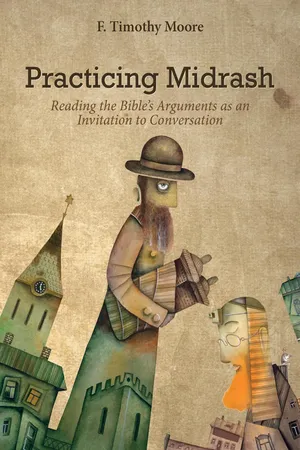
Practicing Midrash
Reading the Bible’s Arguments as an Invitation to Conversation
- 238 pages
- English
- ePUB (mobile friendly)
- Available on iOS & Android
eBook - ePub
About this book
Have you ever been puzzled by contradictions in the Bible? Or wondered why there are four Gospels, three sets of Ten Commandments, or two creation stories at the beginning of Genesis?
Beginning with the first pages of Genesis, the Bible tells most of its stories through multiple versions, which contain both similarities and disagreements. The inherent arguments in Scripture did not seem to bother the Jewish faith. A practice called midrash developed in Judaism sometime before the days of Jesus. Rabbis and scholars sparred over opposing passages, developed theological arguments, and filled gaps in biblical stories with their own understandings.
This book will use the threefold prayer of St. John of the Cross to allow the divergent voices in Scripture to speak and practice midrash with each other, enabling the reader to join the conversation. The contradictions and arguments have a divine purpose. Not only did they prompt the Bible's evolution over hundreds of years, but have enabled it to remain a living word for thousands of years. This pluralism in the Bible is good news for the faithful living in a multi-cultural, pluralistic age.
Information
chapter 1
Which God Created the World?
The test of a first-rate intelligence is the ability to hold two opposed ideas in mind at the same time, and still retain the ability to function.13
—F. Scott Fitzgerald
The Bible begins with an argument, a disagreement between friends, who agree to disagree. You do not have to be a biblical scholar to see this. All you have to do is pretend you have never read the beginning of the Bible, remove any preconceived notions about the first two stories and read them plainly as would a child.
A plain reading of the stories reveals a break at Genesis 2:4. The creation process starts over again. It is apparent that there are two stories, and that they have few things in common. In the first story God creates the world in six days, seven, if you include the Sabbath rest. In the second story, God pulls an all-nighter and finishes the work in a single day. In the first story God ends by creating human beings. In the second story God begins with a human being. In the first story God creates with methodical precision. In the second God creates by trial and error. The two stories read as polar opposites.
This is a curious beginning to the Bible, which should lead one to wonder. Why does the Bible begin with two contrasting creation stories? This question is worth pondering throughout this chapter, indeed, throughout this whole book. The first two pages of the Bible are the first impressions of God’s written word. If you believe that God is the inspiration of the Scriptures, then what purpose would God have in beginning the Bible with contradictory tales? If this were an anomaly, it would be easy to toss it aside as an inconsequential mystery. Rather than being an exception, what happens on the first two pages of the Bible continues throughout, where dueling stories give conflicting accounts of Abraham’s blessing, the Ten Commandments, King David’s life and Jesus’ ministry.
Given the regularity with which Bible stories are told through multiple versions, it is rather surprising that the church has not taught the faithful how to read comparative stories in order to form their faith. The task of this book will be to highlight the differences in contrasting stories of the Bible and to encourage readers to work out their own faithful understanding of dueling texts. We will begin with the beginning.
EXCURSUS 1.1
Two Creation Stories
The first two chapters of the Bible tell competing stories on the creation of the world. The first story was part of the Priestly writings in Genesis. The second story was written by the Yahwist, a storyteller of a number of tales in Genesis, Exodus and possibly elsewhere. This examination of the two creation stories will assume an editor put these two contrasting stories together sometime after the Babylonian exile—sixth to fifth century BC.
There is nothing in either story that suggests one was dependent on the other. It is possible neither author knew of the other’s work. An editor brought them together to be read side-by-side. He did not mind the disagreement, since he could have easily changed the first words of the second story to remove some of the contradictions. Rather than keep, “In the day that the Lord God made the earth and the heavens,” he could have written, “In the day that the Lord God made human beings,” then removed vv. 5–6, and it would have been less obvious that these were originally two different stories.
The Torah (the first five books of the Bible) is a collection of numerous stories that were passed down and compiled by the Priests of the Second Temple period (sixth to fifth century BC).14 The Priests (P) wrote major portions of the Torah in addition to gathering other texts. Their tradition claimed a heritage to the Zadokite priests of Solomon’s temple.
Another author, whom scholars have called the Yahwist for the past one hundred fifty years because he always referred to God as Yahweh, compiled a collection of stories about Israel’s early history and prehistory. A generation ago scholars typically dated the Yahwist as early as the tenth century BC, possibly writing as a scribe for King Solomon.15 Yahwist theory has been substantially questioned in more recent scholarship; some reasoning that there never was a Yahwist. John Van Seters thinks a Yahwist did write an Israelite history. However, he shows that it was dependent on Deuteronomy and was an exilic text (sixth century BC).16 If Van Seters is correct, then the Yahwist’s stories of God’s steadfast love would have been a challenge to Deuteronomy’s emphasis on God’s justice and offered Jewish exiles a different understanding of their loss. In this book the Yahwist will be regularly identified as the Storyteller.
This examination of the two creation stories will be read from the perspective that an editor put these opposing tales together—one by the Priests of Judah and the other by a Storyteller—sometime after the Babylonian exile.
In the Beginning or In the Day
The creation stories on the first pages of the Bible begin with similar first sentences. “In the beginning when God created the heavens and the earth” is how the first story begins. “In the day that the Lord God made the earth and the heavens” is almost an echo of the first. There is one main difference between the initial sentences. They use different names for God. This is the case throughout both stories. In the first creation story the name for God is Elohim, which was a common name for God in the ancient world and used by Israelites and other peoples.17 The second creation story calls God by the specific name Yahweh, which is translated Lord in the Bible using all uppercase letters to signify that this is a translation of the divine name. Throughout the second creation story the divine references are always Lord God (Yahweh Elohim), a practice that is dropped by the Storyteller in the fourth chapter of Genesis where the name Yahweh stands alone.18 The two names for God used in these creation stories suggest that there are two different authors with two different theologies about God operating in these stories. They are both speaking of the God of Israel. In using different names for God they offer a clue that invites us to explore the ways in which they uniquely experienced God.
With the first words in Genesis 1:1 God created order out of chaos: “The earth was a formless void and darkness covered the face of the deep. . . . Then God said, ‘Let there be light’; and there was light.” This God creates by a methodical, detached manner, bringing ever-increasing levels of order into being. As the light so created by God’s word drives out the darkness, so the order of God’s creation drives out the chaos of pre-creation. In successive order God creates light, sky, dry land, vegetation, sun, moon, stars, the animal kingdom, and finally, human beings. God creates by words. God speaks a thing and it comes into being. At the end of each day God looks upon what has been created and saw that it was good. Before moving onto the next step, God evaluated what had been created and declared divine satisfaction.
You may find it help...
Table of contents
- Title Page
- Preface
- Acknowledgments
- Abbreviations
- Introduction
- Chapter 1: Which God Created the World?
- Chapter 2: How Deep and Wide Is the Love of God?
- Chapter 3: Do You Want the Whole Truth?
- Chapter 4: Dueling Prophets
- Chapter 5: Which People Are Our People?
- Chapter 6: Countertestimonies
- Chapter 7: Following Jesus
- Chapter 8: Who Is My Neighbor?
- Chapter 9: Saints and Sinners
- Chapter 10: Who Should Be Leaders in the Church?
- Conclusion: Wrestling with the Bible
- Bibliography
Trusted by 375,005 students
Access to over 1.5 million titles for a fair monthly price.
Study more efficiently using our study tools.
Frequently asked questions
Yes, you can cancel anytime from the Subscription tab in your account settings on the Perlego website. Your subscription will stay active until the end of your current billing period. Learn how to cancel your subscription
No, books cannot be downloaded as external files, such as PDFs, for use outside of Perlego. However, you can download books within the Perlego app for offline reading on mobile or tablet. Learn how to download books offline
Perlego offers two plans: Essential and Complete
- Essential is ideal for learners and professionals who enjoy exploring a wide range of subjects. Access the Essential Library with 800,000+ trusted titles and best-sellers across business, personal growth, and the humanities. Includes unlimited reading time and Standard Read Aloud voice.
- Complete: Perfect for advanced learners and researchers needing full, unrestricted access. Unlock 1.5M+ books across hundreds of subjects, including academic and specialized titles. The Complete Plan also includes advanced features like Premium Read Aloud and Research Assistant.
We are an online textbook subscription service, where you can get access to an entire online library for less than the price of a single book per month. With over 1.5 million books across 990+ topics, we’ve got you covered! Learn about our mission
Look out for the read-aloud symbol on your next book to see if you can listen to it. The read-aloud tool reads text aloud for you, highlighting the text as it is being read. You can pause it, speed it up and slow it down. Learn more about Read Aloud
Yes! You can use the Perlego app on both iOS and Android devices to read anytime, anywhere — even offline. Perfect for commutes or when you’re on the go.
Please note we cannot support devices running on iOS 13 and Android 7 or earlier. Learn more about using the app
Please note we cannot support devices running on iOS 13 and Android 7 or earlier. Learn more about using the app
Yes, you can access Practicing Midrash by F. Timothy Moore in PDF and/or ePUB format, as well as other popular books in Theology & Religion & Biblical Criticism & Interpretation. We have over 1.5 million books available in our catalogue for you to explore.