- 356 pages
- English
- ePUB (mobile friendly)
- Available on iOS & Android
eBook - ePub
About this book
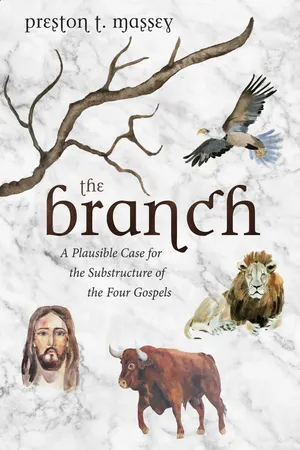
The thesis of the book may be stated simply: it is an argument based upon the four prophetic texts of Jer 23:5; Zech 3:8; 6:12; and Isa 4:2 as a foundational pattern for the four Gospels. These four prophetic texts, it will be argued, mention a King Branch, a Servant Branch, a Man/Priest Branch, and a Lord God Branch. This study seeks to show how Matthew presents Jesus as the King Branch, Mark as the Servant Branch, Luke as the Priest/Man Branch, and John as the Lord God Branch. Consideration will also be given to explore the ramification of the four living Beings as described in Rev 4:6-7. Given the sum total of this sequence of literary facts, the conclusion of this book will raise a number of possible implications. One of these implications will offer the conclusion that the four evangelists could not have written their four Gospels solely on their own human unaided efforts.
Information
1
A Plausible Case for Divine Revelation
Among academics, the concept of divine revelation has fallen upon hard times. The past century was not kind to this viewpoint as an ever escalating number of scholars concluded that supernatural inspiration was indefensible. As a consequence, this increasingly larger coterie of academics has turned to issues of historicity, literary relationships both inside and outside the sacred text(s), and social backgrounds.1 Paul Tillich may serve as an entry point for the prevailing pessimism: “The idea of revelation is a creation of Hellenistic philosophy.”2 H. Richard Niebuhr, a Yale professor of theology and a representative voice from the 1940’s intellectual climate, weighed in from the American side with an even more dismal appraisal. After dubbing belief in revelation as “fanciful,” Niebuhr expanded his criticism into the following judgment: “It seems to be a part of the general flight of a troubled generation to fairy-tales and historical romances.”3 Two representative quotations from the 1960s underscore a similar point. F. Gerald Downing claimed, “The word ‘revelation’ is a source of great confusion. A theology based on it is inadequate for the exposition of the traditional faith of Christians.”4 In a similar vein, Emil Bruner referred to revelation as a “scandal” to the modern mind.5 Moving into more recent times, J. J. M. Roberts pronounced a funeral oration over the subject of revelation suggesting not just a decline but a “demise” in biblical theology.6 As if rendering a coroner’s verdict, his judgment placed the subject of revelation in the coffin of academic dead bones. More recently, William J. Abraham writes: “If truth be told, the contemporary academy does not find the appeal to divine revelation at all attractive. Outside theology, and often within theology itself, the appeal to revelation is simply not permissible.”7 Most recently, Bart D. Ehrman has registered his own personal disillusionment with inspiration by advocating that Scripture is simply and purely a “very human book.”8 Whether labeled as confusing, outdated, offensive, impossible, or impermissible, the concept of revelation is no longer considered relevant in theological discourse.9 Thus, judging from the above selected examples, the academic study of Scripture for the past seventy-five years has been marinating in a sauce of humanistic ingredients. Although precise data may not be possible to determine,10 there are exceptions to this consensus at the academic level.11
Probing into the Present State of Affairs: Dogmas and Dogmatics
For the benefit of some readers, it may be worthwhile to inquire into this state of affairs. Why has contemporary theology abandoned the discussion of divine inspiration? In short, the answer is that the claims of Scripture are no longer viewed as authoritative and, as a result, they cannot be used as decisive evidence in the forum of international scholarship. This objection may be summed up accordingly: the idea that Scripture makes a valid claim on its own behalf for its unique divine origin is no longer tenable; Scripture as a self-authenticating text is thus dismissed. Or, to state this otherwise: just because Scripture says something does not automatically make it true.12 Furthermore, the self-witness of Scripture does not exempt such auto-proclamations from being studied critically as any other book. It is difficult, therefore, in today’s academic climate to argue that Scripture is divinely inspired—regardless of the Bible’s own particular claims.13 This means that no given biblical text can be accepted at face value; all must be interpreted in light of various scholarly disciplines. In fact, some would even argue that unless Scripture is corroborated elsewhere outside the sacred text, it is probably not true.14
In scholarly literature the theological concept of dogmatics is often introduced and set at odds with history.15 While “dogmatics” can be a sobriquet for a branch or discipline of study,16 it can also convey a sense of naïveté. In this sense, a dogma may represent something personally and subjectively believed in contrast to something objective or reasonable. Furthermore, dogmatic labels often end up being used like stickers to attach to a gullible person. For example, in the Hellenistic Greek tradition Polybius coined the term λαοδογματικός to describe “people’s opinions” or “popular notions.”17 The geographer Strabo made use of similar language to describe similar postures.18 The idea that inheres within the word is that of a simpleton who clings to strong opinions supported by little or no evidence. There is yet another use, not often mentioned in biblical studies, but apparent. A dogmatic attitude can describe a stubborn and unbudging position.19 Quite often, though, scholars using the term “dogma” may consciously present themselves as objectively innocent and bipartisanly neutral, when, in fact, such neutrality is impossible. Dogmatic agendas exist on both sides of the aisle. As Eric Lane Titus once said, “It has always been one of the pitfalls of historico-critical research that there are hidden dogmatic interests.”20
From my own viewpoint, I consider the notion that Mary remained a virgin for all of her life an idea (or “dogma”) that is foreign to the biblical text and, therefore, an unreasonable claim. Yet, I consider the idea that Jesus was not born of a virgin also an unreasonable dogma, since that, too, is foreign to the biblical text. A case in point is Amand Puig i Tàrrech’s treatment of Mary in his recent Jesus: A Biography.21 While discussing the reference to the brothers and sisters of Jesus as recorded in Mark 6:3, Tàrrech finds it difficult to believe that Mary had biological sons and daughters after the birth of Jesus. In other words, he believes that Mary remained a virgin for all of her married life. I would add only that a dogma such as the perpetual virginity of Mary is foreign to the biblical text while her virginity is not an alien and extraneous element. Admittedly, then, this delineation serves to highlight that the word “dogma” can be a handy tag to describe others. As already stated, a dogma can be used to describe an unreasonable or stubborn attitude that resists fresh information.22 Moreover, the pejorative use of the word usually results in the words “dogma” or “dogmatic” being employed to describe the unacceptable premise that reason must give way to the authority of Scripture.23 As the skeptical argument goes, the theological cost of believing in divine revelation is purchased at the high price of forfeiting one’s personal autonomy.24
The Influence of the Enlightenment
The erosion of confidence can be attributed to further antecedent causes. The impetus for this clashing view is generally traced back to the intellectual goal of the Enlightenment in which the scholar’s conscience is liberated and protected against the constraints of extraneous religious authority. Although his life has been variously assessed, the usual scapegoat for the avant-garde view of throwing off biblical authority a...
Table of contents
- Title Page
- Acknowledgments
- Abbreviations
- Introduction
- Chapter 1: A Plausible Case for Divine Revelation
- Chapter 2: Disagreement in the Greco-Roman Literary Tradition and the Implications for Gospel Research118
- Chapter 3: Minor Matters: Redaction, Allusions, Grids, and Silence
- Chapter 4: The Gospel of Matthew: The King Branch
- Chapter 5: The Genealogy of Jesus in Matthew
- Chapter 6: The Gospel of Mark: The Servant Branch
- Chapter 7: The Absence of a Genealogy in Mark
- Chapter 8: The Gospel of Luke: The Man/Priest Branch
- Chapter 9: The Genealogy of Jesus in the Gospel of Luke
- Chapter 10: The Gospel of John: The LORD God Branch
- Chapter 11: Rev 4:6–7 and the Four Living Beings around the Throne
- Chapter 12: Conclusion
- Bibliography
Trusted by 375,005 students
Access to over 1.5 million titles for a fair monthly price.
Study more efficiently using our study tools.
Frequently asked questions
Yes, you can cancel anytime from the Subscription tab in your account settings on the Perlego website. Your subscription will stay active until the end of your current billing period. Learn how to cancel your subscription
No, books cannot be downloaded as external files, such as PDFs, for use outside of Perlego. However, you can download books within the Perlego app for offline reading on mobile or tablet. Learn how to download books offline
Perlego offers two plans: Essential and Complete
- Essential is ideal for learners and professionals who enjoy exploring a wide range of subjects. Access the Essential Library with 800,000+ trusted titles and best-sellers across business, personal growth, and the humanities. Includes unlimited reading time and Standard Read Aloud voice.
- Complete: Perfect for advanced learners and researchers needing full, unrestricted access. Unlock 1.5M+ books across hundreds of subjects, including academic and specialized titles. The Complete Plan also includes advanced features like Premium Read Aloud and Research Assistant.
We are an online textbook subscription service, where you can get access to an entire online library for less than the price of a single book per month. With over 1.5 million books across 990+ topics, we’ve got you covered! Learn about our mission
Look out for the read-aloud symbol on your next book to see if you can listen to it. The read-aloud tool reads text aloud for you, highlighting the text as it is being read. You can pause it, speed it up and slow it down. Learn more about Read Aloud
Yes! You can use the Perlego app on both iOS and Android devices to read anytime, anywhere — even offline. Perfect for commutes or when you’re on the go.
Please note we cannot support devices running on iOS 13 and Android 7 or earlier. Learn more about using the app
Please note we cannot support devices running on iOS 13 and Android 7 or earlier. Learn more about using the app
Yes, you can access The Branch by Preston T. Massey in PDF and/or ePUB format, as well as other popular books in Theology & Religion & Biblical Criticism & Interpretation. We have over 1.5 million books available in our catalogue for you to explore.