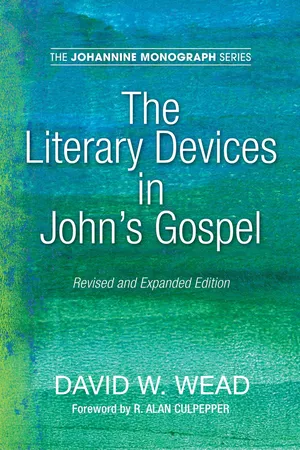
eBook - ePub
The Literary Devices in John's Gospel
Revised and Expanded Edition
- 172 pages
- English
- ePUB (mobile friendly)
- Available on iOS & Android
eBook - ePub
The Literary Devices in John's Gospel
Revised and Expanded Edition
About this book
As an interdisciplinary forerunner of the new literary approaches to gospel narratives over the last four decades in New Testament scholarship, the revised and expanded monograph by David Wead makes a timely contribution to the advancement of those studies. Rooted in comparative analyses of contemporary Hellenistic and Jewish literary techniques, and drawing from the best of Continental scholarship, Wead not only points Johannine scholars to relevant ancient resources, but his analyses prepare the way for fresh interpretations of John's story of Jesus today. Published originally in Switzerland, this book was overlooked by many scholars, to the detriment of their work. However, in addressing such themes as John's post-resurrection point of view, the Johannine sign, the Johannine double meaning, irony in the Fourth Gospel, and metaphor in the Fourth Gospel, Wead's work is now available to new generations of scholars, who will find his work both instructive and provocative.
This newly revised and expanded edition, edited by Paul Anderson and Alan Culpepper, not only includes a new epilogue by David Wead, featuring new reflections and insights, but it also includes an expansive overview of the literature--before and after Wead's work--including a helpful assessment of Wead's monograph in service to ongoing Johannine scholarship. No serious study of Gospel literary features, devices, and strategies can afford to overlook this important book!
Information
Chapter 1
The Post-Resurrection Point of View
Often a movie or a novel will begin with an event and then move back into the past to show earlier events that preceded the opening event. This movement is necessary because the relationship between the event and its past is such that the one affects the other’s meaning. The present event cannot be properly understood without knowledge of what was past, and past events are not complete without knowledge of the effects that they caused.
Such a process, involving reflection upon events of the past and their meaning, is what has produced the Gospel of John. John assumes a literary point of view in his Gospel, which allows readers to consider the life of Jesus from a point in time following the resurrection. With their knowledge of the life of Jesus and its effects, later readers are allowed to see the significance of that life in a complete perspective. This perspective governs much of John’s thought and his mode of expression, allowing the narrator to choose different material, place common material in an entirely different light, and give readers valuable insights into the life of Jesus.
Analysis of the Literary Point of View
Since Henry James laid the foundations for twentieth-century literary criticism, the point of view, or Erzählungssituation, has become one of the most discussed areas of literary analysis. Percy Lubbock, among others of James’ disciples, did important work to bring this literary device to its place of prominence.1 Point of view shows the position where the author stands in relation to the events he is relating to his readers. It does not deal with the subject of who is talking, in spite of the fact that the author may use either the first or third person when relating what went on. Rather, it deals with the higher question of who is telling the story.
When we come to explore the question of point of view, there are three main questions Connolly poses in A Rhetoric Case Book that may be asked of every narration to determine the point of view.2 Who is telling the story? From what physical point of view or angle of narration is he telling the story? From what mode, or mental point of view, is he telling the story?
Of these three, the first is the least important. However, the second and third must be properly understood if we are to gain the necessary access into the story and the meaning the author desired. The author may choose to tell the story through the eyes of a character in the event, or tell the story himself.
The physical point of view is usually limited to two authorial choices. One may either be an observer in the event (the first-person point of view), or one may present the account of a person separated from the event (the third-person point of view).3 The first gives a feeling of immediacy; the reader is made to participate in the event. But the first-person vantage point also greatly limits the range with which the author can deal with the event. One is thereby limited to the expressions of the sensations, feelings, and thoughts of the observers.
The third-person point of view may thus lose its feeling of closeness with the reader. Immediacy is sacrificed to gain greater range of perspective, from which the author can relate the narration. The author may add later insights and meaning his characters have received through the perspective of time. He can interrupt the narrative to give pertinent details that no firsthand observer would be able to grasp.
Are we placed before a particular scene, an occasion, at a selected hour in the lives of these people whose fortunes are to be followed? Or, are we surveying their lives from a height, participating in the privilege of the novelist—sweeping their history with a wide range of vision and absorbing a general effect? Here at once is a necessary alternative.4
When the author uses this latter point of view, he or she must also face another decision: determining how to include information that the firsthand observer will not know. The author may choose either to limit the narrator’s knowledge, or one may insert into the narration important facts and information, which the readers need in order to understand the sequence of events properly, or the significance of particular events.5 This “omniscient-author convention” may create an intimacy between the author and the reader as they communicate, enabling the reader’s identification with the author.6
The mental point of view of the author is equally as important as the physical point of view. If there is to be any coherence in the story, the mental point of view must be consistent with the physical point of view. The author must make his or her mental analysis of the situation agree with the point of view expressed physically, as authorial sense-perceptions and thoughts affect the course and progress of the story. They determine the predominant tone and attitude of the narration. According to Connolly, a man must speak through his own mind with his own purpose and understanding as it affects the story.7
In terms of John’s narrative, this means that our author cannot reveal a post-resurrection physical point of view and yet maintain a naïveté to the theological meaning of the theological events he relates. As he explicates his mental point of view as a theologian, he must deal with the events theologically and from the significance of the physical point of view.
The Author’s Storyteller: The Beloved Disciple
When we turn to the first of these three questions that Connolly suggests, we find that the text itself answers the question of who is telling the story. But this comes only at the very end of the work in John 21:24: “This is the disciple who testifies to these things and who wrote them down, and we know his testimony is true.”8 By associating himself with this disciple, the author has very carefully given himself access to the events of the life of Christ. He is an eyewitness or had acquaintance with an eyewitness of all that has happened. Beginning with 1:35–42, the author includes, in addition to Andrew, the witness of an unnamed disciple of John the Baptist. Through the account of the disciple known to the high priest (18:15–16) and the disciple whom Jesus loved (13:24, 19:26, 20:2, 21:20), the narrator has been very careful to have a witness available. The exceptions—such as the trial before Pilate, where it is unlikely that a witness was present—are rare. We cannot with assurance unite these figures to form one personality, but we can see in all these figures the presence of a witness to the events, who relates them to us as readers. Thus, the author includes witnesses to events in the narrative, implying firsthand acquaintance with them.
The Physical Point of View
This rightly brings us to Connolly’s second question: from what physical point of view or angle of narration is the author telling the story? This question as it relates to the Gospel of John provides a basic difference between John and the Synoptics. John uses the third-person point of view in contrast to the writers of the Synoptics, who use the first person. While the Johannin...
Table of contents
- Title Page
- Abbreviations
- David W. Wead’s Contribution to Johannine Scholarship
- Introduction
- Chapter 1: The Post-Resurrection Point of View
- Chapter 2: The Johannine Sign
- Chapter 3: Double Meaning in the Fourth Gospel
- Chapter 4: Irony in the Fourth Gospel
- Chapter 5: The Johannine Metaphors
- Epilogue
- Bibliography
Trusted by 375,005 students
Access to over 1.5 million titles for a fair monthly price.
Study more efficiently using our study tools.
Frequently asked questions
Yes, you can cancel anytime from the Subscription tab in your account settings on the Perlego website. Your subscription will stay active until the end of your current billing period. Learn how to cancel your subscription
No, books cannot be downloaded as external files, such as PDFs, for use outside of Perlego. However, you can download books within the Perlego app for offline reading on mobile or tablet. Learn how to download books offline
Perlego offers two plans: Essential and Complete
- Essential is ideal for learners and professionals who enjoy exploring a wide range of subjects. Access the Essential Library with 800,000+ trusted titles and best-sellers across business, personal growth, and the humanities. Includes unlimited reading time and Standard Read Aloud voice.
- Complete: Perfect for advanced learners and researchers needing full, unrestricted access. Unlock 1.5M+ books across hundreds of subjects, including academic and specialized titles. The Complete Plan also includes advanced features like Premium Read Aloud and Research Assistant.
We are an online textbook subscription service, where you can get access to an entire online library for less than the price of a single book per month. With over 1.5 million books across 990+ topics, we’ve got you covered! Learn about our mission
Look out for the read-aloud symbol on your next book to see if you can listen to it. The read-aloud tool reads text aloud for you, highlighting the text as it is being read. You can pause it, speed it up and slow it down. Learn more about Read Aloud
Yes! You can use the Perlego app on both iOS and Android devices to read anytime, anywhere — even offline. Perfect for commutes or when you’re on the go.
Please note we cannot support devices running on iOS 13 and Android 7 or earlier. Learn more about using the app
Please note we cannot support devices running on iOS 13 and Android 7 or earlier. Learn more about using the app
Yes, you can access The Literary Devices in John's Gospel by David W. Wead, Paul N. Anderson,R. Alan Culpepper, Paul N. Anderson in PDF and/or ePUB format, as well as other popular books in Theology & Religion & Biblical Criticism & Interpretation. We have over 1.5 million books available in our catalogue for you to explore.