Portraying themselves as challenging blind religious dogma with evidence-led skepticism, the neo-atheist movement claims that the New Testament contains unreliable tales about a mythical figure who, far from being the resurrected Lord of life, may not even have lived. This comprehensive critique documents the falsehood of these neo-atheist claims, correcting their historical and philosophical mistakes to show how we can get at the truth about the historical Jesus.
eBook - ePub
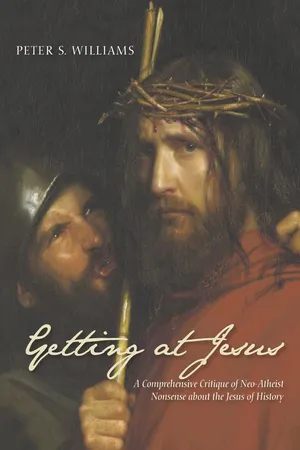
Getting at Jesus
A Comprehensive Critique of Neo-Atheist Nonsense about the Jesus of History
- 454 pages
- English
- ePUB (mobile friendly)
- Available on iOS & Android
eBook - ePub
Getting at Jesus
A Comprehensive Critique of Neo-Atheist Nonsense about the Jesus of History
About this book
Information
Topic
Theology & ReligionSubtopic
Christian Theologychapter 1
Getting at Jesus
“Anyone should be able to see . . . whether a historical claim has merit or is pure fantasy driven by an ideological or theoretical desire for a certain set of answers to be right.”
—Bart Ehrman1
Victor J. Stenger (1935–2014) rose to public prominence as a member of the “New Atheism.” In an interview published in 2014, Stenger (who was Adjunct Professor of Philosophy at the University of Colorado and Professor Emeritus of Physics and Astronomy at the University of Hawaii) summarized his critique of Christianity in the following terms:
Physical and historical evidence might have been found for the miraculous events and the important narratives of the scriptures. For example, Roman records might have been found for an earthquake in Judea at the time of a certain crucifixion ordered by Pontius Pilate . . . In fact, there isn’t a shred of independent evidence that Jesus Christ is a historical figure.2
There’s so much wrong here that one hardly knows where to begin. Pointing out that objecting to believing anything in the absence of “independent evidence”3 is to undermine any and all academic pursuits would be a good start. If “independent evidence” were essential for rational belief, it would never be rational to believe anything, because one’s “independent evidence” would itself always stand in need of “independent evidence,” and so on. Such a demand creates an insatiable, infinite regress.
Alternatively, we could question Stenger’s assertion that “there isn’t a shred of independent evidence that Jesus Christ is a historical figure,”4 but we’ll return to this subject in Chapter Two.
In the meantime, let’s begin by focusing on a point of agreement. For although Stenger’s critique is deeply flawed, it isn’t entirely wrong-headed. Stenger clearly understands the historical nature of the Christian revelation claim.
The collection of first-century literature we call the “New Testament” (NT) contains a good deal of purported historical reportage: “since I myself have carefully investigated everything from the beginning,” writes one of the authors, “I too decided to write an orderly account . . .” (Luke 1:3). The NT even contains some purported eyewitness testimony: “That . . . which we have heard, which we have seen with our eyes, which we have looked at and our hands have touched—this we proclaim” (1 John 1:1–2).
On the one hand: “You simply do not find this kind of empirical, verificationist language in the Bhagavad-Gita, the Granth, the Tripitaka, or the Qur’an.”5 On the other hand: “The writers of the New Testament were obsessed with this kind of language . . .”6 As the neo-atheist author and neuroscientist Sam Harris recognizes: “One can speak about Buddhism shorn of its miracles . . . The same cannot be said of Christianity . . .”7
By making an evidence-based critique of Christianity, Stenger recognizes that there is an ineluctably historical dimension to the NT. As theoretical physicist turned theologian Sir John Polkinghorne comments:
Christianity is a historically orientated religion. Its foundational stories . . . are not simply symbolic tales given us to stir our imaginations, but are . . . mediated through particular persons and events. Therefore there is an evidential aspect to what we are told in the Bible.8
Likewise, noted lawyer and Lutheran theologian Professor John Warwick Montgomery observes:
Christianity . . . declares that the truth of its absolute claims rests squarely on certain historical facts open to ordinary investigation. These facts relate essentially to the man Jesus, his presentation of himself as God in human flesh, and his resurrection from the dead as proof of His deity.9
The evidential aspect of Christianity’s historically-oriented foundational stories includes the miraculous claims listed by Montgomery, which are narrated by various NT documents as taking place within history rather than once upon a time in a mythical never-never land. As atheist John Gray writes: “If Jesus was not crucified and did not return from the dead the Christian religion is seriously compromised . . . Christianity is liable to falsification by historical fact.”10
Of course, the fact that a claim is historically testable in principle doesn’t guarantee it is historically testable in practice. The passage of time means that the contemporary reader of one of the first-century biographies of Jesus, later gathered into the NT and which we call “gospels” (from the Old English word gōdspel meaning “good news”), was obviously better able to check certain truth-claims made therein than is the modern-day reader. We in the fleeting p...
Table of contents
- Title Page
- Preface
- Chapter 1: Getting at Jesus
- Chapter 2: Getting at the Historical Jesus
- Chapter 3: Getting at the Gospels
- Chapter 4: Getting at Evidence for the Resurrection
- Chapter 5: Getting at the Best Explanation
- Conclusion
- Selected Resources
- References
Trusted by 375,005 students
Access to over 1.5 million titles for a fair monthly price.
Study more efficiently using our study tools.
Frequently asked questions
Yes, you can cancel anytime from the Subscription tab in your account settings on the Perlego website. Your subscription will stay active until the end of your current billing period. Learn how to cancel your subscription
No, books cannot be downloaded as external files, such as PDFs, for use outside of Perlego. However, you can download books within the Perlego app for offline reading on mobile or tablet. Learn how to download books offline
Perlego offers two plans: Essential and Complete
- Essential is ideal for learners and professionals who enjoy exploring a wide range of subjects. Access the Essential Library with 800,000+ trusted titles and best-sellers across business, personal growth, and the humanities. Includes unlimited reading time and Standard Read Aloud voice.
- Complete: Perfect for advanced learners and researchers needing full, unrestricted access. Unlock 1.5M+ books across hundreds of subjects, including academic and specialized titles. The Complete Plan also includes advanced features like Premium Read Aloud and Research Assistant.
We are an online textbook subscription service, where you can get access to an entire online library for less than the price of a single book per month. With over 1.5 million books across 990+ topics, we’ve got you covered! Learn about our mission
Look out for the read-aloud symbol on your next book to see if you can listen to it. The read-aloud tool reads text aloud for you, highlighting the text as it is being read. You can pause it, speed it up and slow it down. Learn more about Read Aloud
Yes! You can use the Perlego app on both iOS and Android devices to read anytime, anywhere — even offline. Perfect for commutes or when you’re on the go.
Please note we cannot support devices running on iOS 13 and Android 7 or earlier. Learn more about using the app
Please note we cannot support devices running on iOS 13 and Android 7 or earlier. Learn more about using the app
Yes, you can access Getting at Jesus by Peter S. Williams in PDF and/or ePUB format, as well as other popular books in Theology & Religion & Christian Theology. We have over 1.5 million books available in our catalogue for you to explore.