- 250 pages
- English
- ePUB (mobile friendly)
- Available on iOS & Android
eBook - ePub
About this book
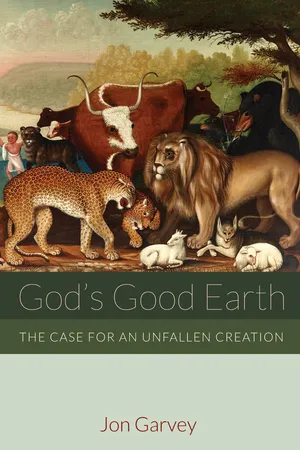
God's world was created "very good," Genesis chapter 1 tells us, and in this book Jon Garvey rediscovers the truth, known to the Church for its first 1,500 years but largely forgotten now, that the fall of mankind did not lessen that goodness. The natural creation does not require any apologies or excuses, but rather celebration and praise. The author's re-examination of the scriptural evidence, the writings of two millennia of Christian theologians, and the physical evidence of the world itself lead to the conclusion that we, both as Christians and as modern Westerners, have badly misunderstood our world.
Restoring a truer vision of the goodness of the present creation can transform our own lives, sharpen the ministry of the church to the world of both people and nature, and give us a better understanding of what God always intended to bring about through Christ in the age to come.
Information
Topic
Theology & ReligionSubtopic
Christian TheologySection 1—The Bible
Chapter 1—God’s Relationship to Creation
O let the Earth bless the Lord : yea, let it praise him, and magnify him for ever.
O ye Mountains and Hills, bless ye the Lord : praise him, and magnify him for ever.
O all ye Green Things upon the Earth, bless ye the Lord : praise him, and magnify him for ever.
O ye Wells, bless ye the Lord : praise him, and magnify him for ever.
O ye Seas and Floods, bless ye the Lord : praise him, and magnify him for ever.
O ye Whales, and all that move in the Waters, bless ye the Lord : praise him, and magnify him for ever.
O all ye Fowls of the Air, bless ye the Lord : praise him, and magnify him for ever.
O all ye Beasts and Cattle, bless ye the Lord : praise him, and magnify him for ever.
—Prayer of Azariah1
Yahweh as Creation’s Governor
A number of biblical passages are habitually cited to support the doctrine of a fallen creation, of which the most important are in the first three chapters of Genesis. However, before I deal with those in detail, it will be instructive to look at what the Bible says about God’s relationship with the natural creation in our world as it is—the world after the fall of humankind. I will deal with the usual key passages in the next chapter.
I propose to bypass, for the most part, God’s relationship to human agency, although it is important in its own right, in order to concentrate on the nonhuman creation, which is the matter in question. In Scripture, God’s sovereignty over nature is not sharply distinguished from his sovereignty over human affairs, but the aim of this study is to point out that what happened to humankind in the garden did not spread to the rest of the world, the “irrational creatures.”
Another reason for steering clear of the interface between sovereignty and sinful human will is that, particularly amongst theistic evolutionists, there is a chronic confusion between “free will” and various concepts of “autonomy” applied improperly to inanimate nature, a confusion that I do not propose to perpetuate here.2 For both of these reasons I will concentrate on the creation apart from humanity.
As is generally the case, the Old Testament is the best source from which to establish the basic foundations of biblical religion, on which the gospel is built. And a good place to start this study, for our purposes, is the list of blessings and curses associated with the Mosaic covenant.
It is now pretty well accepted in Old Testament scholarship that the Jewish “law” or torah, the first five books of our Bible (the Pentateuch), has a close affinity with ancient near eastern treaty documents, and particularly with those of the Hittites in the second millennium BCE.3 The pattern of Israel’s covenant with Yahweh follows that of the treaties that powerful kings would make with their vassals.
The book of Deuteronomy, which consists largely of Moses’s discourse to Israel as they prepare to cross the Jordan, follows the pattern of such a treaty in its entirety. The pattern in the rest of the Pentateuch is broken up with law codes, narrative, and so on, but one can still discern part of the pattern of such a covenant document in the account of Moses on Mount Sinai in Exodus, and in Leviticus. The covenant is also restated in the book of Joshua.
Old Testament and ancient near east scholar John H. Walton gives the basic elements of an ancient near east treaty as follows:
Introduction of the speaker
Historical prologue
Stipulations
Divine witnesses
Curses and blessings4
In the Exodus account of the making of the covenant, the first heading (introduction of the speaker) is limited to 20:2.
“I am the Lord your God, who brought you out of Egypt, out of the land of slavery.”
The historical prologue occurs in 19:3–6, in which God describes how he has brought Israel to himself, out of Egypt, and offers them the covenant—that they will be his treasured possession if they are faithful to him.
The stipulations are primarily the Ten Commandments of 20:3–17. A typical ANE treaty would, at this point, have items such as the paying of tribute, providing military support, and showing general faithfulness to the king making the treaty. The Ten Commandments, however, being part of a treaty with God as King rather than with an earthly ruler, instead embody faithfulness to Yahweh in the “first table,” and faithfulness to brother-Israelites in the “second table.”
Their role as covenant stipulations explains their global scope and ethical basis. They are not “laws” as such, for they would be practically unenforceable. Instead they stipulate what kind of people the Israelites are to be, if they are to stay faithful to the gracious covenant God has made with them, having rescued them from Pharaoh’s power. And, like the treaties made elsewhere in the ANE, Israel’s copy is kept for reference in the temple of their god—in this case, of course, the two tables of stone kept in the ark of the covenant in the tabernacle.5
Coming to the matter in hand, the Ten Commandments are backed up by a series of blessings and curses, just as were ANE treaty stipulations. Walton says that even in these political treaties, it was the gods who were the agents who would bless compliance or, more often, punish violation.6 The biblical blessing...
Table of contents
- Title Page
- Acknowledgements
- Introduction
- Section 1—The Bible
- Section 2—The Theologians
- Section 3—The Science
- Section 4—The Application
- Chapter 13—What Difference Does It Make, Anyway?
- Conclusion
- Appendix: Prometheus Abridged
- Bibliography
Trusted by 375,005 students
Access to over 1.5 million titles for a fair monthly price.
Study more efficiently using our study tools.
Frequently asked questions
Yes, you can cancel anytime from the Subscription tab in your account settings on the Perlego website. Your subscription will stay active until the end of your current billing period. Learn how to cancel your subscription
No, books cannot be downloaded as external files, such as PDFs, for use outside of Perlego. However, you can download books within the Perlego app for offline reading on mobile or tablet. Learn how to download books offline
Perlego offers two plans: Essential and Complete
- Essential is ideal for learners and professionals who enjoy exploring a wide range of subjects. Access the Essential Library with 800,000+ trusted titles and best-sellers across business, personal growth, and the humanities. Includes unlimited reading time and Standard Read Aloud voice.
- Complete: Perfect for advanced learners and researchers needing full, unrestricted access. Unlock 1.5M+ books across hundreds of subjects, including academic and specialized titles. The Complete Plan also includes advanced features like Premium Read Aloud and Research Assistant.
We are an online textbook subscription service, where you can get access to an entire online library for less than the price of a single book per month. With over 1.5 million books across 990+ topics, we’ve got you covered! Learn about our mission
Look out for the read-aloud symbol on your next book to see if you can listen to it. The read-aloud tool reads text aloud for you, highlighting the text as it is being read. You can pause it, speed it up and slow it down. Learn more about Read Aloud
Yes! You can use the Perlego app on both iOS and Android devices to read anytime, anywhere — even offline. Perfect for commutes or when you’re on the go.
Please note we cannot support devices running on iOS 13 and Android 7 or earlier. Learn more about using the app
Please note we cannot support devices running on iOS 13 and Android 7 or earlier. Learn more about using the app
Yes, you can access God’s Good Earth by Jon Garvey in PDF and/or ePUB format, as well as other popular books in Theology & Religion & Christian Theology. We have over 1.5 million books available in our catalogue for you to explore.