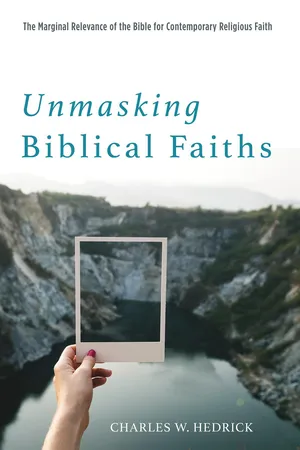
eBook - ePub
Unmasking Biblical Faiths
The Marginal Relevance of the Bible for Contemporary Religious Faith
- 376 pages
- English
- ePUB (mobile friendly)
- Available on iOS & Android
eBook - ePub
Unmasking Biblical Faiths
The Marginal Relevance of the Bible for Contemporary Religious Faith
About this book
Unmasking Biblical Faiths aims to address many of the challenges to traditional Christian faith in the modern world. Since the eighteenth-century Age of Enlightenment, human reason, formerly tethered by the constraints of organized religion, has been set free to explore the universe relatively unchallenged. The influence of the Bible, on the other hand, weakened due to the successes of modern historical criticism, is found to be inadequate for the task of enabling the faith "once for all delivered to the saints" (Jude 3), in that it cannot adequately respond to the many questions about religious faith that human reasoning raises for modern human beings. In a series of short but tightly reasoned essays, Charles Hedrick explores the confrontation between traditional Christian faith and aggressive human reason, a conflict that is facilitated by Western secular education.
Information
1
The Nature of the Universe
§1 The Biblical View of the Universe
The ancient Israelites had no single word for material space, such as “world” or “cosmos.” The aspects of material space occupied by human beings were known simply as heaven and earth (Gen 1:1); heaven, earth, and sea (Exod 20:11); heaven, earth, and water under the earth (Exod 20:4); heaven, earth, sea, and the deep (Ps 135:6). The earth was like a saucer surrounded by water and resting upon water (Gen 1:1, 6–8) or foundational pillars (Prov 8:27–29). In short, there was a bit of firmament (the vault or arch of the sky) sheltering a flat earth from a surrounding watery chaos.
The material space of the world was created by God, who regarded it as “very good” (Gen 1:31). The biblical story about this space is marred by disobedience. Adam, the first man, created by God, breaks the creator’s one rule (Gen 2:17), and as a result he and Eve, the first divinely created woman, are banished from the good life in the garden of Eden. Life outside the garden is difficult, threatening, and ends in death (Gen 3:16–19).
The apostle Paul used the banishment of Adam and Eve from the garden to explain why Adam and his descendants die. They die because of Adam’s disobedience (Rom 5:12–14, 17). Perhaps even the physical creation was also affected by Adam’s act, for Paul describes the creation as being in bondage to decay waiting for redemption (Rom 8:18–21). Today even the most ardent Bible believer should recognize that this primitive description of the universe is mythical because photographs have been taken from the moon of earth, a more-or-less spherical, planet surrounded by limitless space in a universe of billions of galaxies and planetary systems with not a drop of water around it.
The world into which Adam and Eve, the progenitors of humanity, were forced has a bizarre landscape. Things are not what they seem on the surface. Horrid demons lurk about (satyrs, Lev 17:7; the night demon Lilith, Isa 34:14; the noonday devil, Ps 91:6). For those sharing the biblical view of the world, a plethora of demonic entities and evil forces must be negotiated. For example, the Prince of the Power of the Air (Eph 2:2; John 14:30, 16:11) leads a consortium of demons and evil spirits that threaten harm to human beings.
We denizens of the earth “are not contending against flesh and blood, but against the principalities, against the powers, against the world rulers of this present darkness, against the spiritual hosts of wickedness in the heavenly places (Eph 6:12 RSV).
Evil and unclean spirits fall upon humans unawares, possess them, and cause them to behave insanely (Mark 5:1–10); they infect them with deafness, muteness (Mark 9:25), infirmity (Luke 13:11), and epilepsy (Matt 17:15–18); they empower in them the black art of divination (Acts 16:16) and the performance of signs of coming evil days (Rev 16:13–14). They even cause prophets to lie (1 Kgs 22:21–23). Satan, the archenemy of God, can even transform himself into an angel of light (2 Cor 11:14), so that a person never knows if s/he deals with a good or evil force. There is also a cadre of good spirits and angels at work in the world; For example, a Great Spirit assigns angels to watch over “little ones” (Matt18:10).
Fortunately certain human beings, empowered by benevolent spirits can combat the evil forces. For example, Jesus gave his disciples authority to cast out unclean spirits (Matt 10:1) and in addition commissioned them “to heal the sick, raise the dead, cleanse lepers, cast out demons” (Matt 10:8). In other words the world is a place of constant struggle between the spiritual forces of good and evil, and the contested territory is precisely the mind, health, and behavior of human beings; at least that is what the Biblical writers seemed to believe.
Strange things happen in the biblical world: ax-heads float (2 Kgs 6:4–7), donkeys talk (Num 22:21–30), the dead won’t stay dead (Matt 27:51–54), people defy gravity and walk on water (Mark 6:45–52), on command the earth stops rotating (Josh 10:12–14), snakes carry on conversations with people (Gen 3:1–5). There are magic cloths that heal diseases and drive out evil spirits (Acts 19:12; Mark 5:24–30).
I don’t find the world I live in to be like it is described in the Bible. I have never personally encountered spirit forces. True, the world I live in is dangerous, but pretty bland when compared to the world seen through the eyes of the biblical writers. My life and welfare are always at risk from natural forces and even nature itself, but I have never been threatened with harm by evil spirits or demons. I have never met an angel. In the world, as I experience it, people who die stay dead, and day passes into night with amazing regularity.
Did a world such as it is described in the Bible ever actually exist? Or did it exist only in the imaginations of the ancient writers, and in the minds of those who choose to believe those ancient writers? My money is on the latter alternative. (2–21–16)
§2 Is the Universe Just?
I define just as acting or being in conformity with what is morally upright or good. This definition includes the idea of justice, which is an impartial administration of rewards and punishments; that is to say, if the universe is just, what you receive in common space and time should be balanced. By universe I mean the whole body of things and phenomena; the totality of material entities, conceived as an orderly and harmonious system.
How we humans have conceived the universe has changed through time. In antiquity it was a primitive three-tiered construct: earth in the center, the primordial waters beneath the earth, and the fixed luminaries in a domed structure that protected the earth from the waters above.50 In biblical faith God is believed to have used weather, the elements, and historical events to reward and punish, although not always in a just way (for example, consider his treatment of the Amalekites, 1 Sam 15).
Until the twentieth century our view of the universe was limited. In the second century CE Ptolemy proposed a geocentric system for the movements of the heavenly bodies in what we now know as our solar system: the sun, moon, and five planets circulated around the earth below the (so-called) fixed stars, which were so distant they appeared never to move.51 Dante Alighieri (1300s) draws on the theological system of the Middle Ages in order to reflect the view of the universe at that time. With the earth at its center, the universe included both the various levels of hell as well as dwelling places for saints, angels, and the deity.52
In the 1600s, Copernicus proposed a heliocentric system: the sun was the center of our solar system. The earth rotated on its axis and circulated along with the planets around the sun. This explanation was resisted by the church until the nineteenth century, because an earth-centered universe was best harmonized with the Bible and Christian doctrine.53
Today we live on an insignificant planet on the outskirts of a galaxy of perhaps a hundred billion planetary systems in a universe of perhaps one hundred billion galaxies.54 Our universe has no edge but is unbounded and expanding outwards toward some unknown destination.
The question with which I began (is the universe just?) assumes too much. Since the universe is not sentient, it could not be “just.” The universe does not think or see, so there is no way that it could perceive an imbalance in justice—much less consider correcting it. The aggregate of existing stuff and entities that fill the void of space act more or less in accord with what physicists and astronomers (i.e., scientists: people who study the universe) call the laws of physics.
In short, the universe is inflexible. It blindly follows its own rules, some of which we know; most of which we do not. Do not expect the universe to balance out your allotment of good and bad in life. We only have to recall a few of our recent tragic encounters with the physical world on this blue and white planet to know that there is not an ounce of compassion in the universe over the loss of human life, unjustified suffering, and property damage caused by the physical elements such as the San Francisco earthquake (1989), the Indonesian tsunami (2004), Hurricane Katrina in New Orleans (2005), the Joplin tornado (2011), and Hurricane Sandy (2012).
What happens in the natural world is not the result of evil. Rattlesnakes and disease, for example, are not caused by the devil or by God. Rattlesnakes are true to their nature; disease is a natural phenomenon that human beings can cure, and control once the causations have been discovered. Chickenpox, diphtheria, and polio, for example, have been either cured or managed.
For these reasons I cannot seriously entertain the idea that “God” is a universal Spirit pervading all things in the universe with divine presence—a leaf, the sunrise, a drop of water, a gurgling brook, and so forth.55 The universe is simply too hostile toward human beings to think it reflects the character of benevolent Spirit. Nor can I seriously consider that God actively runs the universe in a benevolent hands-on way (Col 1:16–17), correcting, like Don Quixote, its excesses and imbalances.
We seem instinctively to know that the universe is not just, and recognize that a benevolent Deity is not controlling the universe in our interest. That is why a common feature of religion in general is to hope, believe, or expect that Deity will balance the books on our life in this world in the afterlife, if such there be. That is, that God will compensate us for any imbalance of good and bad we experienced in life. (3–19–15)
§3 Where Does Evil Come From?56
Every discussion of evil should begin with a definition of evil. What I mean by evil is an unethical, deliberately malicious, act that results in harm to human beings. By this definition, not everything harmful that happens to humans is evil. For example, an accident involving harm to another party is not an evil act, although it may maim someone or even result in someone’s death. What is lacking in the accident is deliberate malicious intent, and the one causing the accident may be as grieved as the friends and family of the injured party.
Within this definition, nature...
Table of contents
- Title Page
- Preface
- Abbreviations
- Introduction
- Chapter 1: The Nature of the Universe
- Chapter 2: Reason and Faith
- Chapter 3: On Being Human in the Contemporary World
- Chapter 4: The Bible
- Chapter 5: The Nature of God
- Chapter 6: Jesus of Nazareth
- Chapter 7: Traditional Christian Beliefs
- Chapter 8: On Being Christian in the Contemporary World
- Postscript
- Bibliography
Trusted by 375,005 students
Access to over 1.5 million titles for a fair monthly price.
Study more efficiently using our study tools.
Frequently asked questions
Yes, you can cancel anytime from the Subscription tab in your account settings on the Perlego website. Your subscription will stay active until the end of your current billing period. Learn how to cancel your subscription
No, books cannot be downloaded as external files, such as PDFs, for use outside of Perlego. However, you can download books within the Perlego app for offline reading on mobile or tablet. Learn how to download books offline
Perlego offers two plans: Essential and Complete
- Essential is ideal for learners and professionals who enjoy exploring a wide range of subjects. Access the Essential Library with 800,000+ trusted titles and best-sellers across business, personal growth, and the humanities. Includes unlimited reading time and Standard Read Aloud voice.
- Complete: Perfect for advanced learners and researchers needing full, unrestricted access. Unlock 1.5M+ books across hundreds of subjects, including academic and specialized titles. The Complete Plan also includes advanced features like Premium Read Aloud and Research Assistant.
We are an online textbook subscription service, where you can get access to an entire online library for less than the price of a single book per month. With over 1.5 million books across 990+ topics, we’ve got you covered! Learn about our mission
Look out for the read-aloud symbol on your next book to see if you can listen to it. The read-aloud tool reads text aloud for you, highlighting the text as it is being read. You can pause it, speed it up and slow it down. Learn more about Read Aloud
Yes! You can use the Perlego app on both iOS and Android devices to read anytime, anywhere — even offline. Perfect for commutes or when you’re on the go.
Please note we cannot support devices running on iOS 13 and Android 7 or earlier. Learn more about using the app
Please note we cannot support devices running on iOS 13 and Android 7 or earlier. Learn more about using the app
Yes, you can access Unmasking Biblical Faiths by Charles W. Hedrick in PDF and/or ePUB format, as well as other popular books in Theology & Religion & Biblical Criticism & Interpretation. We have over 1.5 million books available in our catalogue for you to explore.