- 124 pages
- English
- ePUB (mobile friendly)
- Available on iOS & Android
eBook - ePub
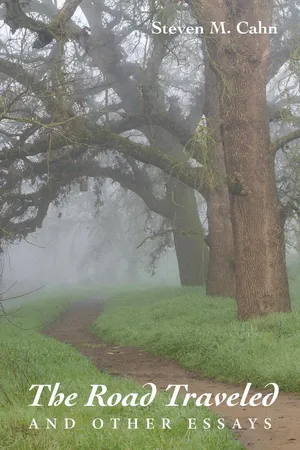
The Road Traveled and Other Essays
About this book
The Road Traveled and Other Essays presents the recent work of philosopher and educator Steven M. Cahn. This book offers his latest reflections on the nature of well-being, the rationality of religious belief, and the aims of higher education. Also included are a selection of his challenging philosophical puzzles. The work concludes with a detailed account of his career as a faculty member, foundation executive, and university administrator.
Information
Topic
PhilosophySubtopic
Philosophy of ReligionPart I
Well-Being
1
Living Well
In Ronald Dworkin’s posthumously published Religion Without God, he argues that an atheist can be religious. While this claim would come as no surprise to adherents of Jainism, Theravada Buddhism, or Mimamsa Hinduism, Dworkin has in mind not these Asian religious traditions but a viewpoint common to many Western thinkers denying theism yet recognizing “nature’s intrinsic beauty” and the “inescapable responsibility” of each person to “live well.”1 Dworkin considers such an outlook religious.
Leaving aside his curious line of thought that finds support for religious belief in such disparate phenomena as the Grand Canyon, the prowling of jaguars, and the discovery by physicists of the Higgs boson, let us concentrate instead on his view that we should all seek to live well so as to achieve “successful” lives and avoid “wasted” ones.2
Does one model fit all? On this important point Dworkin wavers. He maintains that “there is, independently and objectively, a right way to live.” Yet he also recognizes “the responsibility of each person to decide for himself ethical questions about which kinds of lives are appropriate and which would be degrading for him.”3
What sort of life did Dworkin find degrading? We are not told but suspect that for such a successful academic, a degrading life might have been one without intellectual striving, just as a famed athlete might find to be degrading a life as a couch potato.
But what sorts of lives are worthy? To help answer the question, consider the following two fictional, though realistic, cases.
I. Pat received a bachelor’s degree from a prestigious college, earned a PhD in philosophy from a leading university, was awarded an academic position at a first-rate school, and eventually earned tenure there. Pat is the author of numerous books, articles, and reviews, is widely regarded as a leading scholar and teacher, and is admired by colleagues and students for fairness and helpfulness. Pat is happily married, has two children, enjoys playing bridge and the cello, and vacations each summer in a modest house on Cape Cod. Physically and mentally healthy, Pat is in good spirits, looking forward to years of continued happiness.
II. Lee did not attend college. After graduation from high school, Lee moved to a beach community in California and is devoted to sunbathing, swimming, and surfing. Lee has never married but has experienced numerous romances. Having inherited wealth from deceased parents, Lee has no financial needs but, while donating generously to worthy causes, spends money freely on magnificent homes, luxury cars, the latest in electronic equipment, designer clothes, meals in fine restaurants, golfing holidays, and trips to far-flung locations. Lee has many friends and is admired for honesty and kindness. Physically and mentally healthy, Lee is in good spirits, looking forward to years of continued happiness.
Both Pat and Lee live in ways that appear to suit them. Both enjoy prosperity, treat others with respect, engage in activities they find fulfilling, and report they are happy. So are both living well? Are both pursuing equally successful lives? Is either life being wasted?
Dworkin offers little guidance to help answer these questions. He urges that we “make our lives into works of art,”4 but works of art typically contain complexities and conflicts not found in the lives of Pat or Lee. The story of each might be told in the form of a play or novel, but neither individual appears to have the makings of a Medea, Hamlet, or Raskolnikov.
Dworkin remarks that “Someone creates a work of art from his life if he lives and loves well in family or community with no fame or artistic achievement at all.”5 Here Dworkin, having urged us to live well by making our lives into works of art, unhelpfully explains that works of art are those made by living well. This circular explanation sheds no light on how to live well, so Dworkin’s appeal to works of art does not help us choose between the lives of Pat and Lee.
Many other philosophers, however, have provided reasons for believing that Pat’s life is superior to Lee’s. They rate the pursuit of philosophical inquiry, playing the cello, or raising a family more highly than surfing, having a series of romances, or living in a luxurious home.
Yet not all philosophers agree with this assessment. Two who do not are Richard Taylor and Harry Frankfurt, each of whom would maintain that Pat and Lee are living equally well.
Consider first Taylor’s approach. He discusses the case of Sisyphus, who, according to Greek myth, was condemned for his misdeeds to the eternal task of rolling a huge stone to the top of a hill, only each time to have it roll down to the bottom again. Is the activity of Sisyphus meaningless? Taylor concludes that the answer depends on whether Sisyphus has a desire to roll stones up hills. Most of us don’t, but if Sisyphus does, then he has found “mission and meaning.”6 So, according to Taylor, living well is living in accord with your desires. If your activities match your wishes, then your life is successful. Whether the activity is teaching philosophy, driving luxury cars, or rolling stones up hills makes no difference.
Frankfurt reaches a similar conclusion. He maintains that we infuse our lives with meaning by loving certain intrinsic ends and caring about the means to achieve them. Need they be of a particular sort? Not according to Frankfurt. As he writes, “Devoting oneself to what one loves suffices to make one’s life meaningful, regardless of the inherent or objective character of the objects that are loved.”7 Therefore while Pat loves discussing philosophy, playing bridge, and spending time with family, Lee loves surfing, golfing, and engaging in romantic adventures. Thus, according to Frankfurt, both possess the essentials of a meaningful life.
As we noted, however, most philosophers reject this view of what makes a life significant.8 Susan Wolf, for instance, argues that if your life is to have meaning, you need to be engaged with projects of worth, i.e., those with objective value.9 What are these? Unfortunately, Wolf offers no theory of objective value to guide us, but she does provide examples of activities that are worthwhile and others that are not. For example, she maintains that caring for an ailing friend gives life meaning but providing financial support for a sick stranger doe...
Table of contents
- Title Page
- Preface
- Part I: Well-Being
- Part II: Religious Belief
- Part III: Academic Life
- Part IV: Doctoral Education
- Part V: Puzzles
- Part VI: Reminiscences
- Bibliography
- About the Author
Trusted by 375,005 students
Access to over 1.5 million titles for a fair monthly price.
Study more efficiently using our study tools.
Frequently asked questions
Yes, you can cancel anytime from the Subscription tab in your account settings on the Perlego website. Your subscription will stay active until the end of your current billing period. Learn how to cancel your subscription
No, books cannot be downloaded as external files, such as PDFs, for use outside of Perlego. However, you can download books within the Perlego app for offline reading on mobile or tablet. Learn how to download books offline
Perlego offers two plans: Essential and Complete
- Essential is ideal for learners and professionals who enjoy exploring a wide range of subjects. Access the Essential Library with 800,000+ trusted titles and best-sellers across business, personal growth, and the humanities. Includes unlimited reading time and Standard Read Aloud voice.
- Complete: Perfect for advanced learners and researchers needing full, unrestricted access. Unlock 1.5M+ books across hundreds of subjects, including academic and specialized titles. The Complete Plan also includes advanced features like Premium Read Aloud and Research Assistant.
We are an online textbook subscription service, where you can get access to an entire online library for less than the price of a single book per month. With over 1.5 million books across 990+ topics, we’ve got you covered! Learn about our mission
Look out for the read-aloud symbol on your next book to see if you can listen to it. The read-aloud tool reads text aloud for you, highlighting the text as it is being read. You can pause it, speed it up and slow it down. Learn more about Read Aloud
Yes! You can use the Perlego app on both iOS and Android devices to read anytime, anywhere — even offline. Perfect for commutes or when you’re on the go.
Please note we cannot support devices running on iOS 13 and Android 7 or earlier. Learn more about using the app
Please note we cannot support devices running on iOS 13 and Android 7 or earlier. Learn more about using the app
Yes, you can access The Road Traveled and Other Essays by Steven M. Cahn in PDF and/or ePUB format, as well as other popular books in Philosophy & Philosophy of Religion. We have over 1.5 million books available in our catalogue for you to explore.