eBook - ePub
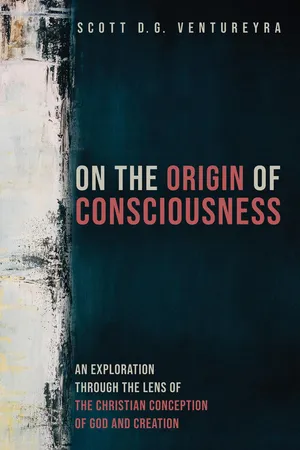
On the Origin of Consciousness
An Exploration through the Lens of the Christian Conception of God and Creation
- 342 pages
- English
- ePUB (mobile friendly)
- Available on iOS & Android
eBook - ePub
On the Origin of Consciousness
An Exploration through the Lens of the Christian Conception of God and Creation
About this book
Have you ever thought about how self-consciousness (self-awareness) originated in the universe?
Understanding consciousness is one of the toughest "nuts to crack." In recent years, scientists and philosophers have attempted to provide an answer to this mystery. The reason for this is simply because it cannot be confined to solely a materialistic interpretation of the world. Some scientific materialists have suggested that consciousness is merely an illusion in order to insulate their worldviews. Yet, consciousness is the most fundamental thing we know, even more so than the external world since we require it to perceive or think about anything. Without it, reasoning would be impossible.
Dr. Scott Ventureyra, in this ground-breaking book, explores the idea of the Christian God and Creation in order to tackle this most difficult question. He demonstrates that theology has something significant to offer in reflection of how consciousness originated in the universe. He also makes a modest claim that the Christian conception of God and Creation provide a plausible account for the origin of self-consciousness. He integrates philosophy, theology, and science in an innovative way to embark on this exploration.
Information
Topic
Theology & ReligionSubtopic
Christian TheologyChapter 1
Robert John Russell’s “Creative Mutual Interaction”
This chapter will explain who Robert John Russell is, his CMI program, and the reasons that have led me to apply the CMI method to the origin of consciousness. It also provides some relevant appraisals and criticisms of the CMI.
1.1 Robert John Russell
It would be worthwhile to provide some background information on Robert John Russell since I will be utilizing his general framework regarding the interaction between science and theology. A word on Russell’s education is relevant since it has played a significant role in the development of his CMI.
Robert Russell earned an undergraduate degree in physics from Stanford, and an MS and PhD in physics from University of California.113 He also received a minor in religion while completing his undergraduate degree in physics. Moreover, he has completed a M.Div. and an MA in theology from the Pacific School of Religion.114 This extensive academic training has given him an excellent background to assess the importance and significance of the disciplines of science and theology. His background in physics has given him an in-depth understanding of modern physics, evidenced by his writings, as well as hands-on experience in the applications of physics. This is something that a theologian would lack unless he had done a great amount of research and reading on his own, as is the case with thinkers like Wolfhart Pannenberg and William Lane Craig. Russell’s training in the natural sciences provides him with invaluable insights that can be relevant to both the fields of science and theology. Although Russell does not possess a doctorate in theology, he has demonstrated his competence in the fields of theology, and science and theology, as attested by his long publication list.115 As a result of his unique academic training, Russell is well equipped to tackle the issue of theology’s contribution to the natural sciences.
1.2 The Center for Theology & the Natural Sciences
Russell is the founder and director of the CTNS at the Graduate Theological Union, Berkeley, California. This center has been fruitful for the disciplines of science and theology. It has helped Russell to develop much of his thinking and to write extensively in the field of science and theology. The CTNS has cultivated an environment whereby both scientists and theologians are able to critically question one another while pursuing a fruitful dialogue. The CTNS has made a major contribution to the dialogue. What was unthinkable thirty years ago seems to be possible now, namely lively exchanges between theologians and scientists that permit a greater understanding of each field and their interaction with one another.
1.3 An Insight Revealed by Steve Fuller’s Thought Coupled with Nagel’s Vision
In reading works in the science and theology/religion field, I began to think about some of the issues that were not directly addressed in what I had read. Years ago, I happened to be listening to a debate between Steve Fuller and Jack Cohen, a reproductive biologist at the University of Warwick. Upon listening to this debate, a key insight emerged that was necessary and significant for this entire research endeavor. It not only influenced my master’s research but also inspired subsequent thought. This insight, coupled with Nagel’s critique of reductive materialism’s ability to explain consciousness, has inspired this work. The main insight, revealed through Fuller’s thought, was the notion that theology can contribute something fruitful to the natural sciences.116
Moving forward, in light of recent thought, such as Nagel’s criticism of reductive materialistic explanations and its trivialization of the dilemma at hand concerning the origin of consciousness, I pose the following questions: Is there a fruitful opportunity for theology to speak to the sciences? Can theology offer potential research programs? If a full blown naturalistic explanation does not seem plausible or forthcoming, can theology offer a fertile ground for scientific research for those willing to approach the issues with a new set of questions and outlook(s)? This is precisely the direction which brings more substance to my original question regarding theology’s fruitfulness to the natural sciences.
1.4 Warrant for Using Russell’s Creative Mutual Interaction (CMI)
Taking into consideration the various attempts highlighted in the above-mentioned typologies, regarding the science-theology interaction and their acknowledged complexities, the aim of this book is to explore one approach: one developed by physicist and theologian Robert John Russell. Because of its own methodological developments and its strategy of developing some precise guidelines for the interaction, Russell’s work deserves, in my judgment, particular attention. In this work, I will explore the contribution that theology makes to the scientific understanding of the origins and emergence of consciousness. Although I will briefly explore how the sciences influence theology, that will not be the focus of this work. Nonetheless, I will provide a brief outline of such a component of the science-theology interaction (as will be discussed by the eight pathways [five from science to theology and three from theology to science]). I wish to develop my warrant for selecting Russell’s approach for this book by prefacing it with a brief comment.
It is worth pointing out that an initial interest in Russell’s work resulted in a master’s thesis which documented his methodology as applied to the concepts of eschatology, resurrection, and cosmology.117 Since my master’s thesis, I have gained many other insights as I sifted through much of the literature in science and theology, the natural sciences, the neurosciences, philosophy of mind, and philosophy of religion. This will be illustrated by the arguments about the fruitfulness of theology’s contribution to the origin of consciousness.
I would like to briefly outline some of the various merits of Russell’s methodological approach to science and theology, as illustrated by his notion of CMI and his willingness to confront some of the toughest questions in the field of science and theology. A look at what some of his colleagues have observed will also be of interest.118
Several years ago, Russell applied his CMI methodology to the theological thought of the eminent theologian, Wolfhart Pannenberg (1928–2014). Russell utilized some of Pannenberg’s insights, in interaction with both philosophy and modern physics. One of these valuable theological insights is revealed by Pannenberg in the following quote:
Is there conceivable any positive relation between the concept of eternity and the spatio-temporal structure of the physical universe? . . . This is one of the most arduous but also one of the most important questions in the dialogue between theology and the natural science . . . Without an answer to the question regarding time and eternity, the relationship of God to this world remains inconceivable.119
In this work titled Time in Eternity: Pannenberg, Physics and Eschatology in Creative Mutual Interaction, Russell explores concepts of time, eternity, physics, and eschatology, as well as their mutual interactions.120 Many of the refinements in Russell’s thought exemplified throughout this work will be examined throughout this book.
According to Ted Peters, Russell’s CMI is his most important contribution to the field. In support of this, Ted Peters states that:
[I]t seems to me, the single most valuable contribution of Robert John Russell to the blossoming field of Science & Religion is his conceptual contribution. Taking advantage of his training in both physics and theology, Russell has brought to the dialogue some of the most insightful and revolutionary proposals for breakthrough into a new domain of shared understanding. Beyond warfare, beyond two languages, beyond dialogue, be...
Table of contents
- Title Page
- Acknowledgements
- Abbreviations
- Introduction
- Chapter 1: Robert John Russell’s “Creative Mutual Interaction”
- Chapter 2: The Role of Philosophy in the Science-Theology Interaction
- Chapter 3: Creation & Evolution
- Chapter 4: A Test Case: Teilhard’s “Scientific Theology”
- Chapter 5: Arguments from Natural Theology & Philosophical Theology
- Chapter 6: Arguments from Systematic Theology
- Chapter 7: The Application of Russell’s CMI to the Christian Conception of God and Creation in Understanding the Origin of Consciousness
- Chapter 8: Different Christian Understandings of Consciousness
- Conclusion
- Appendix 1: Diagram of The Method of Creative Mutual Interaction (CMI)
- Appendix 2: The Trinitarian Mode of Creation represented by a schematic diagram of a general communication system
- Bibliography
Trusted by 375,005 students
Access to over 1.5 million titles for a fair monthly price.
Study more efficiently using our study tools.
Frequently asked questions
Yes, you can cancel anytime from the Subscription tab in your account settings on the Perlego website. Your subscription will stay active until the end of your current billing period. Learn how to cancel your subscription
No, books cannot be downloaded as external files, such as PDFs, for use outside of Perlego. However, you can download books within the Perlego app for offline reading on mobile or tablet. Learn how to download books offline
Perlego offers two plans: Essential and Complete
- Essential is ideal for learners and professionals who enjoy exploring a wide range of subjects. Access the Essential Library with 800,000+ trusted titles and best-sellers across business, personal growth, and the humanities. Includes unlimited reading time and Standard Read Aloud voice.
- Complete: Perfect for advanced learners and researchers needing full, unrestricted access. Unlock 1.5M+ books across hundreds of subjects, including academic and specialized titles. The Complete Plan also includes advanced features like Premium Read Aloud and Research Assistant.
We are an online textbook subscription service, where you can get access to an entire online library for less than the price of a single book per month. With over 1.5 million books across 990+ topics, we’ve got you covered! Learn about our mission
Look out for the read-aloud symbol on your next book to see if you can listen to it. The read-aloud tool reads text aloud for you, highlighting the text as it is being read. You can pause it, speed it up and slow it down. Learn more about Read Aloud
Yes! You can use the Perlego app on both iOS and Android devices to read anytime, anywhere — even offline. Perfect for commutes or when you’re on the go.
Please note we cannot support devices running on iOS 13 and Android 7 or earlier. Learn more about using the app
Please note we cannot support devices running on iOS 13 and Android 7 or earlier. Learn more about using the app
Yes, you can access On the Origin of Consciousness by Scott D. G. Ventureyra in PDF and/or ePUB format, as well as other popular books in Theology & Religion & Christian Theology. We have over 1.5 million books available in our catalogue for you to explore.